

A $12,000 commission check feels like the whole reward for three months of showings, negotiations, and paperwork. Real estate agent tax deductions decide how much of it you keep.
Nobody withheld taxes from that check, so the tax is yours to calculate. The expenses that can reduce it, meanwhile, are scattered throughout the year: gas receipts, MLS invoices, and even a closing gift you paid for in cash.
Below is the full list of what you can claim, the line each one belongs on, and the conditions that catch agents out. There are two worked scenarios at the end that show how the numbers land.
The 14 Deductions at a Glance
Here’s a summary on the tax deductions for real estate agents for a quick skim:
1. Licensing and Registration Fees
A license is what makes you legal to list a property, hold an open house, and collect a commission, and the state charges you to keep it. Renewals, your city or county business license, and the regulatory fees stapled to them are all costs of staying in business.
They can be deducted on Schedule C under Taxes and licenses, the line for professional licenses and regulatory fees.
The pre-licensing course and exam are not covered because Treasury regulations treat education that meets the minimum requirements of a trade you are not yet in as permanently personal. The fee itself may be a start-up cost if you paid it before your first client.
2. Home Office
Plenty of agents run the business side of the job from home. You pull comps at the kitchen table, write offers there, and chase lender paperwork from the same chair.
If a dedicated space is set aside for that work and nothing else in your home, it can come off your taxes. The area has to pass an exclusive use test, meaning nothing personal happens in it, and a regular use test, meaning the business use is ongoing.
It then needs to qualify as your principal place of business, a place where clients regularly meet with you and their use of your home is substantial and integral to your work, or a separate structure, such as a converted garage. To qualify as your principal place of business, you need to do your administrative and management work there and have no other fixed location where you perform substantial administrative work.
That second condition trips agents up, though only a brokerage desk where you do substantial admin work counts as another fixed location.
The simplified method is $5 per square foot up to 300 square feet, which caps the deduction at $1,500 and drops onto Schedule C. The document Form 8829 uses your real housing costs instead. Either way the deduction stops at your gross income from the home's business use, and only Form 8829 carries an unused amount forward.
3. Office Space Rental
Some agents skip the home office and rent a space instead, or pay the brokerage for a desk and a phone line. Whatever you pay for room to work in is deductible.
It goes on Schedule C under rent or lease of other business property, along with any franchise fee. Having that space usually blocks the home office deduction rather than doubling it, because if the outside office is where your admin happens, your home stops being your principal place of business.
4. Insurance Premiums
Errors and omissions coverage exists because one bad disclosure can end your real estate career. General liability exists because strangers walk through houses with you. Most agents also insure the equipment they work from.
All three go on the Schedule C line captioned Insurance, other than health. Life and personal disability premiums do not qualify, and car insurance belongs on the car and truck line only under the actual expense method, because the per-mile rate already covers it.
Your own health premiums are not a Schedule C expense either, though an employee's are. Yours is an adjustment to income on Schedule 1, which means you get it without itemizing.
You lose it for any month you were eligible for an employer-subsidized plan, including your spouse's. It also cannot exceed your earned income from the business after half your self-employment tax and any retirement contributions come off.
5. State and Local Business Taxes and Licenses
States, counties, and cities all handle property transactions differently, and running a business in one of them costs you more than the license fee.
Business property tax, annual licenses, regulatory fees, and your employer share of payroll taxes are deductible on Schedule C. Your home's property tax and all of your state income tax are not, because those belong to the SALT deduction if you itemize.
6. Vehicle and Mileage
You drive to a listed home, then to an inspection, then across town to sit in a client's living room. By December, that is thousands of driving miles you paid for yourself through deductions.
The trip from home to the brokerage you report to is considered commuting, and that one does not count as a deduction.
If you have a regular work location away from home, though, trips to a temporary one like a showing count at any distance, and a home office that is your principal place of business makes every work trip out of it counts as a deduction.
2026 has two rates, and you split your miles by the date you drove them. Business miles from January 1 through June 30 are worth 72.5 cents each, and from July 1 through December 31 they are worth 76 cents. A log carrying only a yearly total gets half of it wrong.
The alternative is the actual expense method, where you claim car repairs as a tax deduction alongside gas, insurance, lease payments, and depreciation.
If you choose the per-mile rate in the first year the car is available for business use, you can switch to straight-line depreciation later. But if you start with actual expenses, you’re generally locked into that method for the life of the car. For a leased car, whichever method you choose binds you for the entire lease, including renewals.
Business parking, tolls, the business share of your car loan interest, and personal property tax on the car survive under either method. The monthly space at your own office does not, because that is commuting.
7. Marketing and Advertising
A listing costs money before it makes any. You pay a photographer, sometimes a drone operator, the sign company, and the printer for the postcards that go out to the neighborhood.
The boosted post and the paid slot on a portal are the same kind of spending, and all of it goes on Schedule C under Advertising. Treasury regulations put advertising and other selling expenses squarely in the deductible column.
Hosting and ad spend for your website are current expenses, but whether websites, domain names, or other digital assets come off this year or over several years depends on what you bought and what it cost.
8. Trade Conventions and Events
You go to the state association conference, rent a booth at the expo, and fly to the regional summit. If the event benefits your business and its program relates to your work, the cost of being there is deductible.
That covers registration, booth rental, signage, giveaways, and the travel to get there. A convention outside the North American area needs the meeting to be directly related to your business and as reasonable to hold there as within the area, and that area already includes Canada, Mexico, Puerto Rico, and much of the Caribbean.
9. Legal, Professional, and Accounting Services
At some point a deal goes sideways and you need a lawyer. Or the books outgrow a spreadsheet, and you hire a bookkeeper. Paying professionals to keep the business running is deductible.
Attorney, accountant, and bookkeeper fees that are ordinary, necessary, and directly related to the business go on Schedule C, including tax advice about the business. The portion of a tax prep bill covering your personal return does not, so ask for a split invoice, and fees to acquire a specific property get added to that property's cost.
10. Coaching and Education Costs
This market moves fast enough that standing still can cost you listings. The continuing education your state requires is deductible, as are the coach you hired to improve your conversion rate and the course you took on the CRM everyone just switched to.
It matters whether the education maintains or improves the skills you use in your current work without qualifying you for a different profession. Education required by law to maintain your current status can also qualify.
But courses that merely meet the minimum requirements of your trade, or that prepare you for a new one, do not, which is why a pre-licensing course doesn’t make the cut.
11. Listing Services and Brokerage Dues
You cannot work without the MLS, and this costs a lot for your operation. The same goes for the lockbox, board membership, your brokerage’s desk fee, and the CRM you moved your entire database into.
All of it is an ordinary cost of the work and deductible on Schedule C, while paid placement or premium agent status on a portal like Zillow belongs on the advertising line. The share your association spends on lobbying is not deductible, but only to the extent it reports that share to you, and if no percentage arrives, you deduct in full.
12. Travel Expenses and Meals
Mileage covers the driving only. Travel covers the flight to meet a relocating buyer, the hotel two states over, and the dinner where you talked through an offer.
Your work has to keep you away from the general area of your tax home substantially longer than an ordinary workday and leave you needing sleep or rest, which the IRS says napping in your car does not satisfy. Your "tax home" is your regular place of business, which is not always where you live.
On a domestic trip that is primarily business, your flights and the lodging and meals for the business days come off, and a couple of vacation days at the end do not cost you the airfare. Reverse it and the airfare goes with it, because on a primarily personal trip, only what you spent on business at the destination survives.
Outside the country, the airfare itself may have to be split between business and personal days.
Meals are 50 percent deductible if they are not lavish and you or an employee is there, and the 2026 change that ended most employer-provided meal deductions does not touch client meals.
13. Gifts for Clients
The closing gift is part of the job: a bottle of wine, a cutting board with the address burned into it, a card to the restaurant down the street. It builds the referral pipeline, and it is deductible.
You get $25 per person per year, and that figure has never been indexed for inflation, so the $200 bottle still gets you $25. If you are wondering whether gift cards are tax-deductible for a business, they land in the same place.
Engraving, packing, and shipping do not count against the cap if they add no substantial value. Items costing $4 or less are exempt when your name is permanently imprinted, and they are part of a batch you hand out widely.
14. Property Staging Costs
An empty house shows badly, so you rent a sofa, a rug, some art, and a bowl of fake fruit for six weeks. If you’re the one paying that bill rather than the seller, it’s a marketing cost like any other.
Taxes Real Estate Agents Usually Pay
Rented staging pieces go on the rent line for other business property, while furniture you buy and reuse across listings is property you depreciate. There is no IRS guidance or court decision that addresses staging specifically, so the deduction rests on the general business-expense rule. Keep the invoice, the listing address, and the dates to support it.
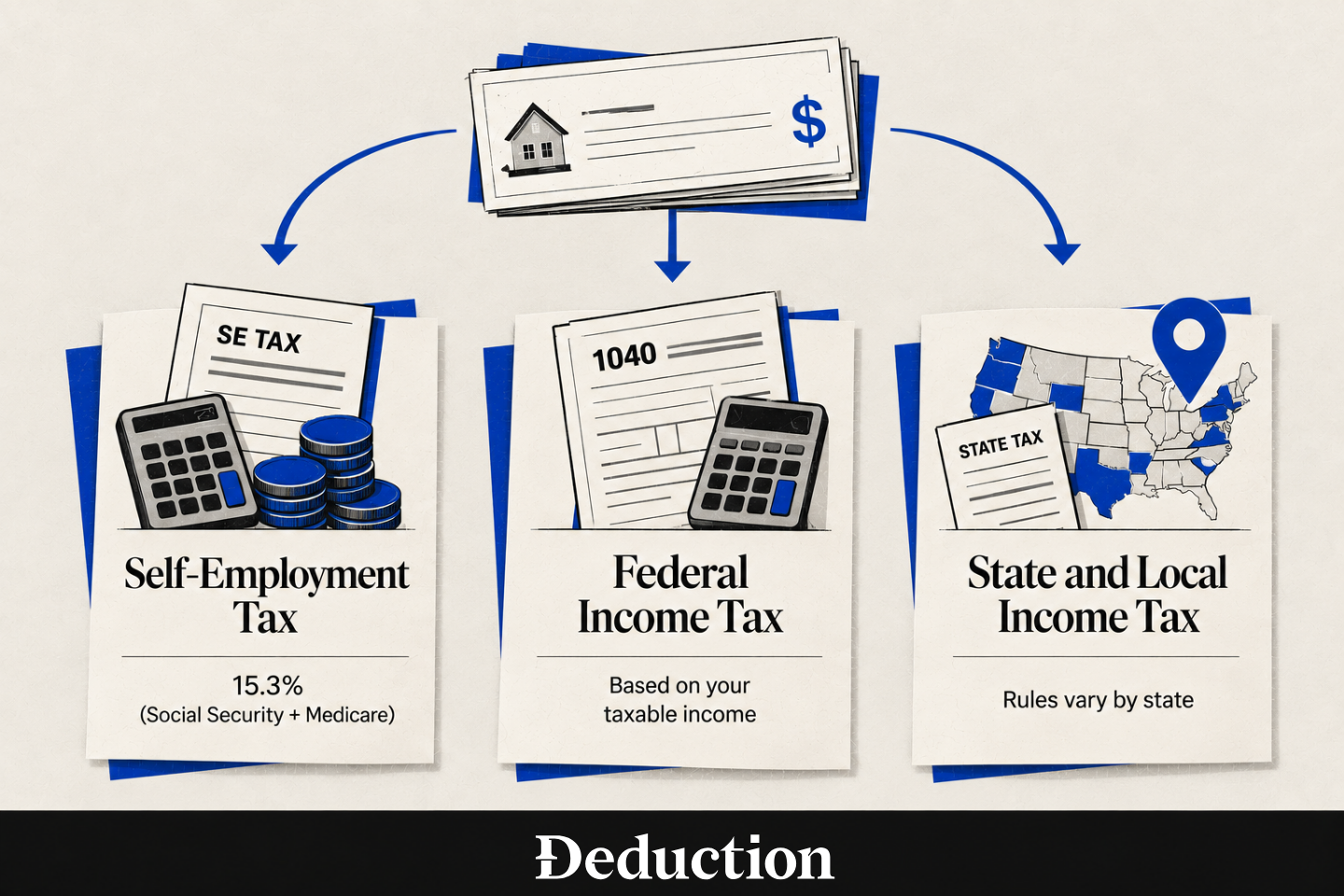
Three separate taxes come out of your commission income, and only one of them is the income tax most people picture.
- Self-employment tax: A licensed real estate agent is a statutory nonemployee when pay tracks sales rather than hours and a written contract says you are not an employee. Nothing is withheld, so the full 15.3 percent is yours to pay.
That 15.3% has two parts: 12.4% for Social Security, which applies to the first $184,500 of your 2026 earnings, and 2.9% for Medicare, which has no income cap. The tax is calculated on 92.35% of your net profit, and you can deduct half of what you pay on Schedule 1.
- Federal income tax: This runs on your taxable income, not your gross commission, so every deduction above lowers it. The 2026 standard deduction is $16,100 filing single and $32,200 filing jointly.
The QBI deduction can take up to another 20 percent off. It runs on your profit after the deductions for half your self-employment tax, your health premiums, and your retirement contributions, and it is capped at 20 percent of taxable income minus net capital gain.
- State and local income tax: Rules differ by state, and a few states do not tax income at all. If you work across state lines, the state where you performed the work generally taxes that income. That matters if you list in one state and live in another.
How to Prepare Real Estate Agent Tax Deductions
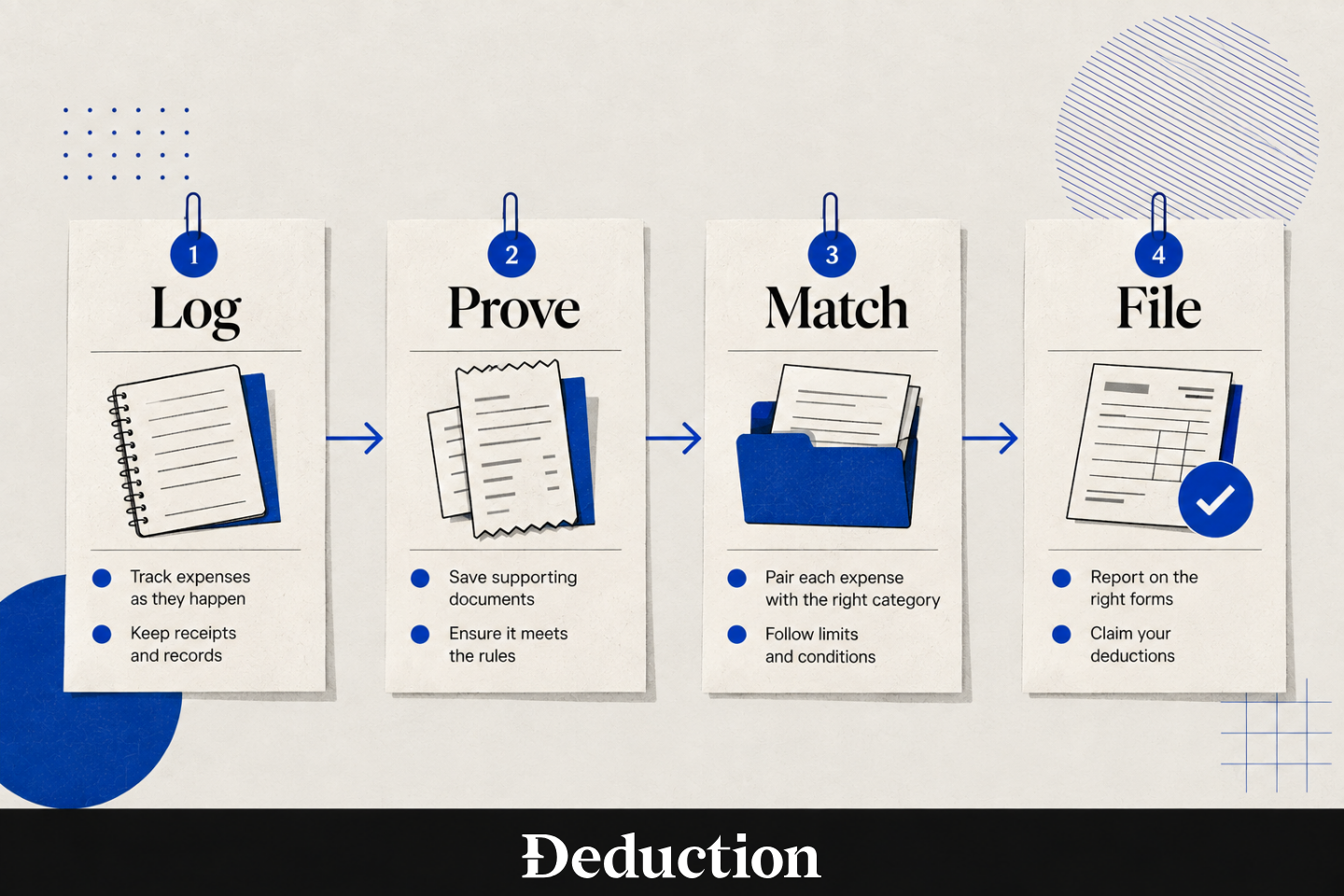
The deductions above are only worth what you can prove. Here is the order to work in:
- Log every business activity as it happens: Miles with the date and the client, meals with who was there and what you discussed, gifts with the recipient's name. Rebuilding this in April is where most deductions get lost.
- Keep the primary paper trail: Receipts, invoices, closing statements, bank and card records. This is the evidence that the money left your account.
- Keep the secondary support too: Calendar entries, the texts and emails that set up the meeting, listing photos, event badges. Primary records prove you paid; secondary records prove it was business.
- Match your year against a checklist: Work down a list built for your situation rather than a generic one you found on the internet. This article covers what is specific to agents, and the wider set of tax deductions for 1099 filers catches the generalized ones.
- Put each deduction on the right line: Schedule C for business expenses, Schedule SE for self-employment tax, Schedule 1 for health insurance and half your SE tax, and Form 8829 if you use the regular home office method.
- Pay quarterly, then file: 2026 estimated payments are due April 15, June 15, September 15, and January 15, 2027, and paying at least the safe harbor amount is what keeps a penalty off your return.
- Get help where the judgment calls are not obvious: An AI deduction finder can pull the deductions out of the documents you already have, and a CPA review catches the ones that turn on your specific facts. Overclaiming costs more than underclaiming.
Tips on Making Tax Prep for Real Estate Agents Smoother
None of the following changes what you can deduct. It changes how much of it you can still prove in April.
- Set money aside on every commission check: A commission is not income you have kept. Moving a quarter to a third of it into a separate account the day it lands is the simplest guard against a spring shortfall.
- Stay current with your brokerage: Desk fees, franchise fees, and split adjustments that go unpaid or unreconciled turn into a payable right when you are trying to close out the year.
- Record sales and expenses as they happen: Fifteen minutes a week beats a January reconstruction, and it is the only way a mileage log stays accurate enough to survive a question.
- Judge an S corporation election on its own math: No IRS rule names an income level at which you should elect. What matters is whether the self-employment tax you would save beats the payroll and compliance cost, and whether you can defend a reasonable salary. The tax deductions for S corp owners shift as well.
- Stop treating the commission as yours: Price your time and your business decisions against what is left after tax, not against the gross.
- Use software that tracks deductions during the year: Tools that categorize as you go turn tax prep into a review instead of an excavation.
Scenarios of Paying Taxes as a Real Estate Agent
Both agents below are hypothetical, and all figures here are estimates for illustration.
Maya, single, sole proprietor in Oregon. She brings in $200,000 in commissions, roughly $50,000 a quarter. She has no office, no staff, and a wide rural territory she covers by car.
Mileage makes up nearly half of her total deductions because driving is a major part of her work. Altogether, her deductions equal about one-sixth of her commissions, roughly what you would expect for a solo agent with no office and no employees.
That leaves her with $167,900 in profit. She owes about $23,700 in self-employment tax, while the qualified business income deduction reduces her taxable income by another $27,988. Her total federal tax bill comes to about $43,200, or roughly $10,800 per quarter.
The mid-year rate change handed her $350 of extra deduction on identical driving, worth about $110 in tax. So keep your mileage log current, because covering a wide territory is where the real money on this list sits.
David, married filing jointly, is based in New York. He brings in $850,000 in commissions, rents an office, and has one assistant on payroll. He flew to California to meet one client and to Florida to meet another.
That is close to a quarter of his commissions and six times Maya's total in dollars. He deducts more of everything because he runs a real office with a real employee, and his two biggest lines, payroll and marketing, do not exist on her list at all.
His profit is $647,200. Social Security tax stops at the $184,500 ceiling, so his self-employment tax is about $40,200 rather than a flat 15.3 percent, plus $3,100 of Additional Medicare Tax. His total federal bill is near $177,700.
The deduction that took nearly $28,000 off Maya’s taxable income works differently for him. Once his taxable income exceeds $553,500, the deduction is limited by the W-2 wages his business pays and the qualified property it owns. In his case, only the wages count.
Half of his assistant's $65,000 salary gives him a $32,500 deduction. With nobody on payroll, the cap would be zero, and he would fall back on the $400 minimum the law guarantees, so that one hire is worth $32,100 of deduction by itself.
Real estate brokerage is not an SSTB for Form 8995, so his profession is not what limits him. Payroll is. Same profession as Maya, same deduction list, and what decides the biggest number on the page is whether anyone is on the payroll.

Let Deduction Handle Your Taxes While You Hustle
You can have every receipt scanned, every mile logged, and clean totals by category, and still not know whether the desk at your brokerage disqualifies your home office, or whether the broker course you took this spring counts as a new trade.
Those are the calls that decide whether a deduction holds up, and they turn on your specific facts rather than anything you can look up. Deduction exists for that gap. We respect the hustle, and we would rather you keep the commission you earned than lose a chunk of it because nobody told you what you qualified for.
- Upload your documents: Commission statements, 1099s, receipts, mileage records, brokerage invoices. Whatever you have.
- The AI finds your deductions and credits: It reads what you sent, matches it against the rules for your situation, and surfaces what you qualify for.
- A real CPA reviews it and files: A licensed CPA checks the judgment calls before anything goes to the IRS.
That combination, a tax deduction finder with a real CPA behind it, is what matters when the answer depends on your facts rather than a lookup table.
Frequently Asked Questions About Real Estate Agent Tax Deductions
What Expenses Can You Write Off as a Real Estate Agent?
Anything ordinary and necessary to your business: mileage, a qualifying home office, office rent, errors and omissions and liability insurance, license renewals, MLS and board dues, marketing, client gifts up to $25, coaching, conventions, overnight travel, half of business meals, staging you paid for, and legal and accounting fees.
What Is the Most Overlooked Tax Break?
The half of your self-employment tax that is deductible against income tax. It sits on Schedule 1 and is easy to skip. Close behind is the self-employed health insurance deduction, which comes off without itemizing but disappears for any month you could have joined a subsidized plan through your own or a spouse's employer.
Can You Write Off Realtor Fees on Taxes?
As an agent, yes. MLS fees, board and association dues, brokerage desk fees and license renewals are deductible business expenses, minus the lobbying share of association dues. If you mean the commission a home seller pays, that is not deductible, but it does reduce the taxable gain on the sale.
What Is the 20% Agent Tax Break for Realtors?
It is the Section 199A qualified business income deduction, worth up to 20 percent of your net business profit. Below the 2026 taxable income threshold of $201,750 single or $403,500 joint it is straightforward. Above it, a cap based on your business's W-2 wages and property phases in, applying in full above $276,750 or $553,500.
Can I Write Off Clothes as a Realtor?
Almost never. Work clothes are deductible only if your work requires them and they are not suitable for everyday wear. A suit, a blazer or a branded polo all fail the second test, because you could wear any of them anywhere. Dry cleaning for those clothes fails for the same reason.
Can a Real Estate Agent Write Off a Car Purchase?
Partly. With business use above 50 percent you can use Section 179 and bonus depreciation, but a passenger car placed in service in 2026 caps first-year depreciation at $20,300 with bonus and $12,300 without. Only the business-use share counts, and claiming depreciation locks you out of the per-mile rate.
What Are the Best Tax Write-Offs for Real Estate Agents?
By dollars, mileage usually wins, followed by a home office that qualifies, office rent and marketing. The qualified business income deduction often beats all of them and costs nothing to claim. Small ones like the $25 gift cap take more effort than they return.
This article is general information, not tax advice. Rules change, and how they apply depends on your specific situation, so check with a CPA before claiming anything here on a return.