

You pay your premium every month, watch it climb every year, and at some point ask the obvious question: is car insurance tax-deductible? It’s a fair thing to wonder about a bill you can’t legally avoid.
Most answers online say yes and leave it there. They skip the one condition that decides it, and that condition rules out most drivers.
Here’s the complete version. Car insurance is tax-deductible only when you drive the car for business, and even then only if you claim your car costs the right way. This guide covers who qualifies, how much you can claim, and how to file it.
Key Takeaways
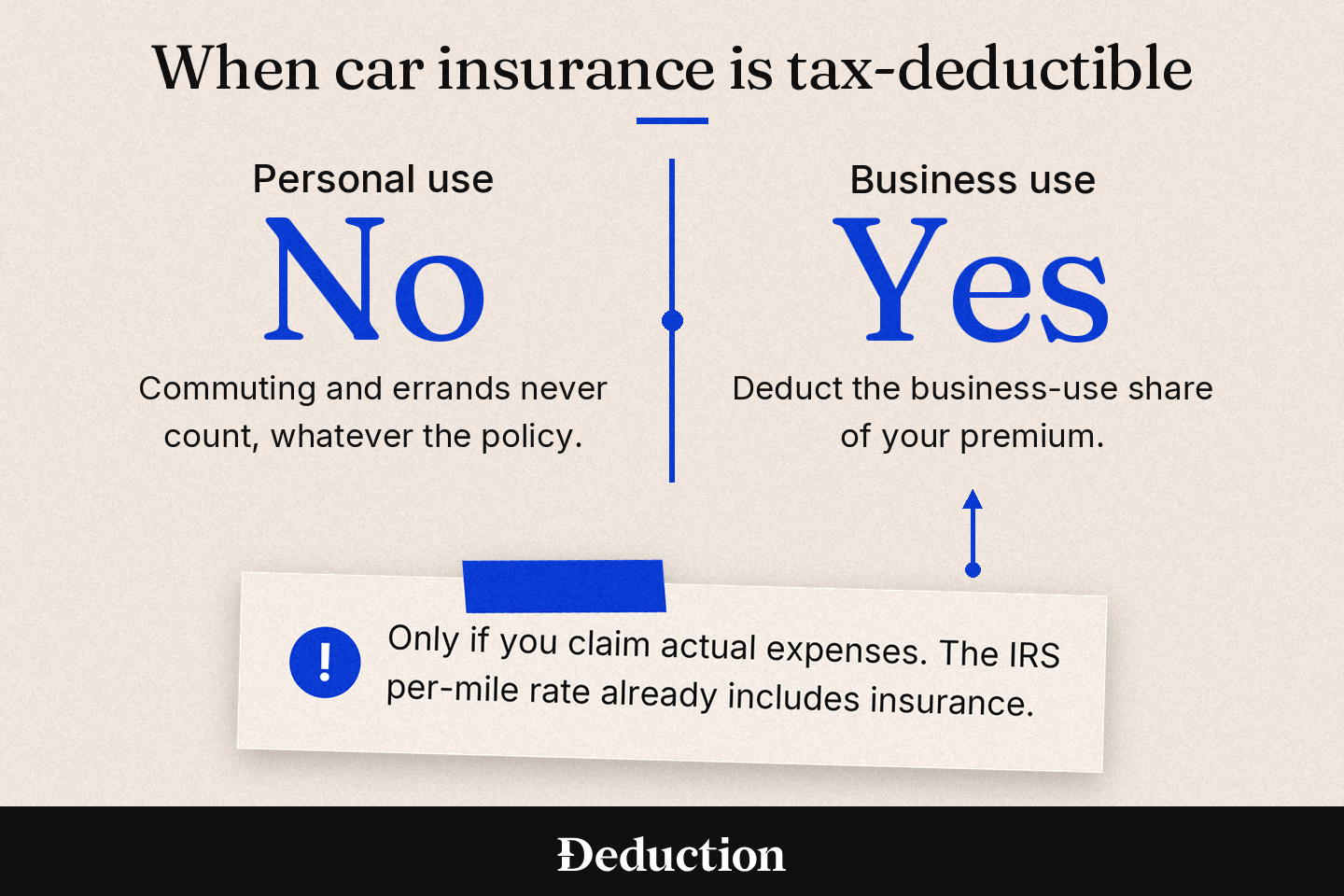
- Personal car insurance isn’t deductible. Commuting and errands don’t create a write-off, and no version of the rules changes that.
- Business use is what creates the deduction, not the type of policy you bought.
- You can only deduct insurance if you claim your real costs. The per-mile shortcut already has it built in.
- Most employees lost this deduction for good. A few select groups can still claim work expenses, and even they face extra limits.
- A separate new break lets you deduct up to $10,000 of car loan interest, but only on a new US-assembled vehicle you drive personally; it shrinks at higher incomes, and it never covers premiums.
Types of Car Insurance
Before the rules, one misunderstanding worth clearing up: the kind of policy you carry doesn’t decide whether you can deduct it. A bare-minimum liability policy and a fully loaded comprehensive policy get treated the same. Here are the coverages you’re likely paying for:
- Liability coverage: This pays for injuries and property damage you cause to someone else, and nearly every state requires it. You may see it called third-party coverage.
- Collision coverage: This pays to repair or replace your own vehicle after a crash, regardless of who was at fault.
- Comprehensive coverage: This covers damage that doesn’t come from a collision, including fire, theft, hail, flooding, and hitting an animal. A narrower "fire and theft" policy is a limited version of the same idea.
- Personal injury protection and medical payments: These cover medical bills for you and your passengers after an accident, and a handful of states require PIP.
- Uninsured and underinsured motorist coverage: This covers you when the driver who hit you has no insurance, or not enough of it to cover the damage.
- Commercial auto and specialty policies: These cover vehicles used in a trade or business. Classic car policies, rideshare endorsements, and trucking policies sit in this group.
IRS Criteria on Deductible Car Insurance
The IRS doesn’t have a rule about car insurance specifically. It has a rule about car expenses, and insurance is one line inside it.
Business-Related Car Usage
If you’re self-employed and you use a car for work, the business share of your car insurance is deductible as an ordinary business expense. That covers contractors, rideshare and delivery drivers, real estate agents, mobile pet groomers, owner-operator truckers, and anyone else whose vehicle is part of how they earn money.
One note for truckers: a tractor-trailer isn’t a car, van, pickup, or panel truck, so the choice described below never applies to it. You deduct the business share of the insurance as an ordinary business expense.
There’s a catch that trips up almost everyone. The IRS gives you two ways to claim car costs, and insurance only counts in one of them.
The actual expense method lets you deduct the business share of gas, oil, repairs, tires, insurance, registration fees, and depreciation or lease payments. The standard mileage rate lets you deduct a flat per-mile amount instead. Watch the date on 2026, because the rate moved partway through the year: it is 72.5 cents for business miles driven before July 1 and 76 cents from July 1 onward.
That rate already has insurance built into it, so if you take the per-mile deduction, you can’t write off your premium on top.
One more limit applies no matter which method you pick. Driving from your home to your regular place of work is commuting, and commuting is never deductible, even for the self-employed.
There are three exceptions worth knowing.
If you have a home office that qualifies, meaning you use it regularly and only for work, and it’s your main place of business, you aren’t commuting at all, so your drives from home to other work locations in that same business count.
You can also deduct the trip from home to a temporary job site outside the metro area where you live and normally work, and the trip from home to a temporary job site in the same business when you already have a regular workplace somewhere else.
Personal Car Usage
If your car is for personal use, your insurance isn’t deductible. There’s no threshold to clear and nowhere to put it.
A few select groups of employees can still deduct unreimbursed work expenses, and even then only for the business portion. The first four below file Form 2106, while eligible educators claim theirs on Schedule 1 or Schedule A instead:
- Armed forces reservists: Members of a reserve component can deduct travel for duties performed more than 100 miles from home, but their car expenses are capped at the standard mileage rate. Because that rate already includes insurance, a reservist never gets a separate premium deduction.
- Qualified performing artists: Performers who meet strict income and multiple-employer tests can deduct work-related car expenses.
- Fee-basis state or local government officials: Officials paid in whole or part on a fee basis rather than a salary still qualify.
- Employees with impairment-related work expenses: Workers with a physical or mental disability can deduct the expenses that let them do their job, though this one lands on Schedule A, so it only helps if you itemize.
- Eligible educators: K-12 teachers and other eligible educators have long been able to deduct certain unreimbursed work expenses as an adjustment to income, up to the educator expense limit. What is new is that for 2026 they may alternatively claim them as an itemized deduction.
Everyone outside those groups is out.
The 2017 tax law eliminated the deduction for unreimbursed employee expenses, and the One Big Beautiful Bill made that permanent rather than letting it expire.
What If You Use the Same Car for Personal and Business Use?
Then you deduct part of it, based on how much of your driving is for business. That fraction is your business-use percentage, and it’s counted in miles, not hours.
Say you drove 12,000 miles last year and 4,500 of them were business trips. Your business-use percentage is 37.5%. If your annual premium was $1,800, the deductible portion is $675. The same percentage applies to your gas, repairs, and registration. All figures here are estimates for illustration.
This only works if you can show your work. Keep a mileage log with the date, the destination, the business purpose, and the miles for each trip, plus your odometer reading at the start and end of the year. An app that logs trips automatically is fine.
A figure you reconstruct months later usually won’t hold up, because the law doesn’t let you deduct car expenses on estimates or your own claims, so the record has to be made at or near the time you drive.
Your business-use percentage does more than size your insurance deduction. It also decides whether you can use Section 179 or bonus depreciation on the vehicle itself, since those require business use of more than 50%.
How to Write Off Your Car Insurance
Once you know you qualify, the steps are simple. Work through them in order, because step three locks in everything after it:
- Gather your records for the year. You need premium statements, fuel and repair receipts, registration paperwork, lease or loan documents, and a mileage log showing total miles and business miles.
- Calculate your business-use percentage. Divide business miles by total miles driven for the year. Keep the number you land on, because it applies to every vehicle expense you claim.
- Choose your method, and know what you’re choosing. Standard mileage is simpler and includes insurance in the rate. Actual expenses are more work and are the only route to a separate insurance deduction. If you own the car and want the option to switch later, you have to use standard mileage in the first year it’s in service. If you lease, whichever method you pick applies for the entire lease. The standard rate is off the table entirely if you run five or more cars, vans, pickups, or panel trucks at the same time, or if you have already claimed Section 179, bonus depreciation, or MACRS depreciation on that vehicle.
- Total your actual expenses and apply the percentage. Add insurance, gas, oil, repairs, tires, and registration fees, then multiply by your business-use percentage.
- Report it on the right form. Sole proprietors put car and truck expenses on Schedule C, line 9, not on line 15, which is for other business insurance. Farmers use Schedule F. The four employee categories use Form 2106. Add Form 4562 if you’re claiming depreciation or Section 179.
- Keep the documentation. Hold on to your log and receipts for at least three years after filing, which is the general window for the IRS to question a return.
If tracking all of this by hand sounds like a lot of work for a few hundred dollars, that’s a fair reaction. An AI tax deduction finder can pull the figures off your statements, run the split for you, and compare both methods, which is usually the difference between claiming this correctly and skipping it.
Do I Need to Itemize My Car-Related Tax Deductions?
Probably not, and the word "itemize" is doing two different jobs here. Let’s break it down.
Itemizing in the normal sense means listing deductions on Schedule A instead of taking the standard deduction, which for 2026 is $16,100 for single filers, $32,200 for married couples filing jointly, and $24,150 for heads of household.
Business car expenses have nothing to do with that choice. They go on Schedule C and reduce your business profit before your standard deduction is ever applied, so you get them either way.
Special-case employees work differently. Reservists, qualified performing artists, and fee-basis officials take their deduction as an adjustment to income, so they don’t need to itemize either. Impairment-related work expenses go on Schedule A.
The real either-or is the one from step three: standard mileage versus actual expenses. You pick one per vehicle per year, and only actual expenses let you deduct insurance separately.
Neither method wins automatically. A rough guide is that high-mileage driving in a cheap, reliable car favors the standard rate, while a car that’s expensive to insure, expensive to repair, or driven fewer miles often favors actual expenses.
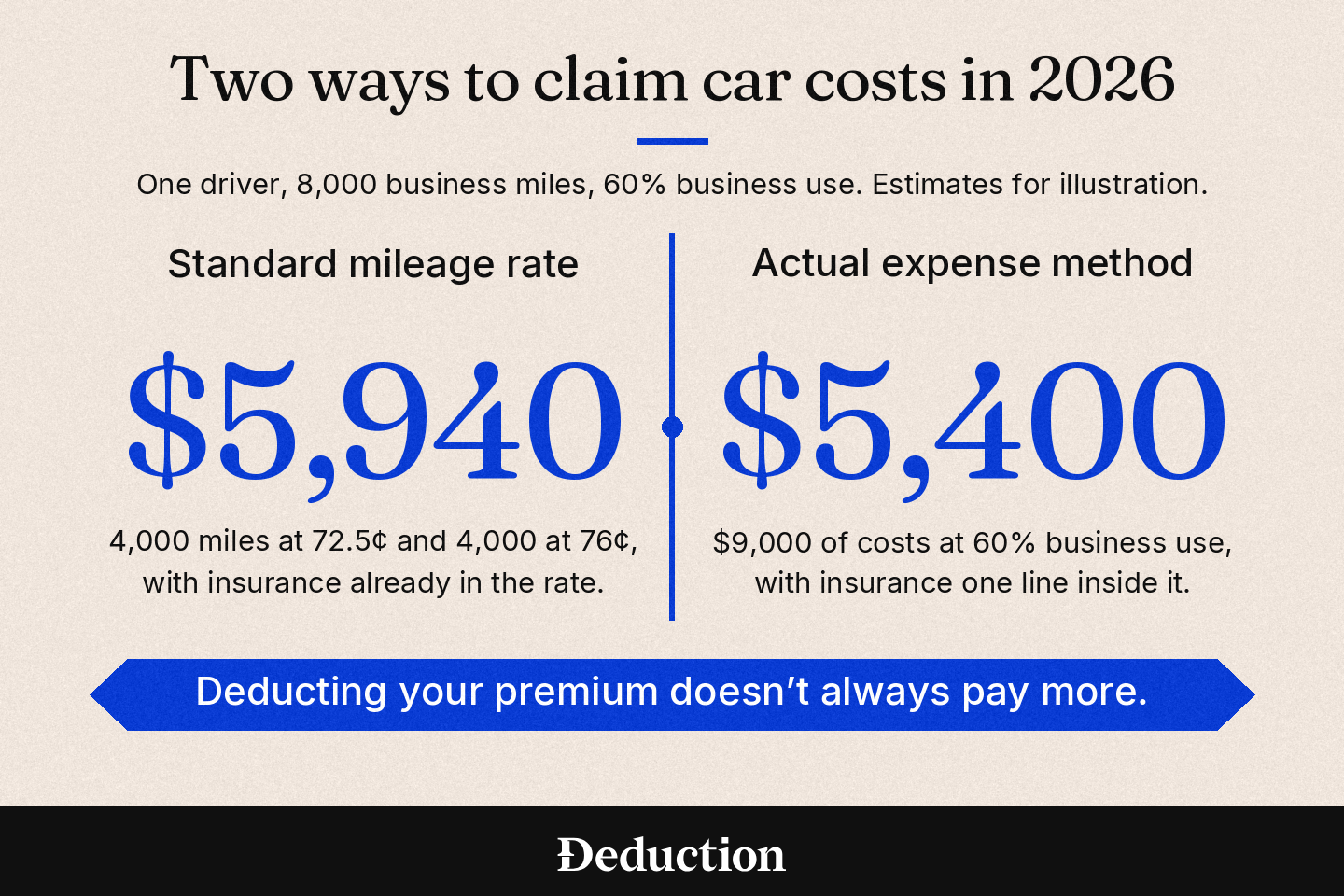
Here’s what that comparison looks like in practice. Assume you drove 13,333 miles, 8,000 of them for business, which is 60% business use. All figures are estimates for illustration.
Under the standard mileage rate, your miles straddle the July 1 change. Say 4,000 came before it at 72.5 cents, which is $2,900, and 4,000 came after at 76 cents, which is $3,040. That’s $5,940 for the year.
Under actual expenses, suppose your year ran $2,400 in gas, $1,900 in insurance, $1,100 in repairs and tires, $200 in registration, and $3,400 in depreciation, for $9,000 total. Multiply by 60%, and you get $5,400.
The per-mile method wins by $540 here, and the $1,900 premium never shows up on the return.
That’s the part people miss. Your car insurance can be deductible in principle and still be worth nothing to you, because the other method paid more.
Other Car-Related Deductions You Can Claim
Insurance is only one of several vehicle costs you can write off. If you’re already claiming your real costs, these are the others worth tracking alongside it:
- Fuel and oil: Gas and oil are deductible at your business-use percentage under the actual expense method. They’re already covered by the standard mileage rate, so you can’t add them on top of it.
- Vehicle repairs and maintenance: Tires, oil changes, brake jobs, and body work all count. A repair your insurer paid for isn’t deductible, because the cost wasn’t yours.
- Mileage: If you take the standard rate rather than actual costs, the per-mile rate is itself the deduction. Business parking and tolls are deductible on top of either method, though parking at your own regular workplace is a commuting cost and doesn’t qualify.
- Licenses, permits, and registration: Your vehicle’s registration and plate fees only count separately if you claim your real costs, and only at your business-use percentage, because the per-mile rate already has them built in. Trade licenses, carrier and DOT registrations, and other regulatory fees are a different animal.
Those are all running costs. The price of the car itself is a separate question. If you claim your real costs, you write the car down over several years through depreciation, and you can pull some of it forward under a rule called Section 179.
There’s a ceiling on that, though. For an ordinary car you put into service in 2026, everything you claim in the first year is capped at $20,300, or $12,300 if you skip the extra first-year write-off. Only heavier vehicles get past that cap. If you take the per-mile rate instead, you don’t claim the car separately at all, because wear and tear is already inside the rate.
Claiming Loss Deductions of Car Insurance
If someone backs into your car in a parking lot, that isn’t a tax deduction. That’s what you pay the insurance for.
People expect otherwise because it used to work that way. Until 2018 you could write off a wrecked or stolen car. That changed, and it never changed back.
What you can claim now depends on which of two situations you’re in.
If it’s your personal car, the loss generally only counts when a declared disaster caused it. That means a flood, wildfire, or hurricane the President has formally declared.
Starting with the 2026 tax year, a state-declared disaster can count too. The law asks for your governor’s determination and Treasury’s, so check that the IRS has recognized the event before you claim anything.
An ordinary crash doesn’t qualify, and neither does a theft from a parking garage. There is one narrow exception. If something else of yours was destroyed or stolen the same year and the insurance paid out more than you originally paid for it, that counts as a gain, and an everyday loss like a crash can be used to cancel it out.
Even when a disaster does qualify, this is an itemized deduction, so it’s worth nothing to you unless your Schedule A total beats your standard deduction. And three things come off the top first, in this order: whatever your insurer paid you, then $100, then 10% of your adjusted gross income.
That last figure is the income number your return already works out, not your gross pay, and it’s usually the step that wipes the whole thing out.
One condition catches people out. If the car was insured and you decided not to file a claim to keep your premium down, you can’t deduct the part your insurer would have covered. Your deductible still counts. The rest is gone.
If it’s a business car, the rules are friendlier. You don’t need a disaster, and the $100 and 10% steps don’t apply.
If the car is a total loss, start with your remaining cost in it, meaning what you paid minus the depreciation you have already claimed. Subtract anything the wreck is still worth as scrap and anything your insurer paid you, and deduct what’s left.
If it was only damaged, your loss is the drop in the car’s market value or your remaining cost in it, whichever is smaller. If you already wrote the car off through depreciation, that second number can be close to zero, which leaves you with little to deduct.
Sometimes the payout comes in bigger than your remaining cost, which happens once you’ve written most of the car off already. That difference counts as income.
You can usually put off the tax by buying a replacement and electing to defer the gain on your return. Nothing here is automatic; you have to make the election, and you get until the end of the second tax year after the year the gain shows up. A payout in 2026 gives you until December 31, 2028.
Your premiums are a separate matter from all of this. If you claim your real costs, you deduct your business share of them as the year goes on. If you take the per-mile rate, they’re already counted for you.
Is Heavy-Duty Commercial Vehicle Insurance Tax Deductible?
Yes. These are treated the same as any truck a business drives from one job to the next. Commercial vehicle insurance is an ordinary and necessary cost of running a trade, and there’s no personal-use question hanging over a dump truck.
That covers most of the stack a fleet or an owner-operator carries: primary liability, physical damage, motor truck cargo, non-trucking liability, and general liability.
Premiums are deducted at your business-use percentage, which is usually 100%. A twelve-month policy is fully deductible in the year you pay it, as long as the coverage doesn’t run past the end of the following tax year. Prepay in December for a policy that doesn’t start until a couple of months into next year, or prepay a multi-year policy in one shot, and you have to spread the cost out instead.
The vehicles themselves span most of the trades:
- Semi tractors and trailers: Over-the-road equipment carries the highest premiums in this group, and all of it is deductible.
- Dump trucks, tow trucks, and box trucks: Vocational vehicles used to haul, tow, or deliver qualify the same way.
- Excavators, bulldozers, and other heavy equipment: Machinery insured under a contractor’s equipment or inland marine policy is deductible, and the equipment itself is depreciable business property.
- Concrete mixers, bucket trucks, and service rigs: Specialized vocational trucks follow the same treatment as any other business vehicle.
One practical difference matters for these. The standard mileage rate is only available for a car, van, pickup, or panel truck, so heavy trucks and equipment are on the actual expense method by default.
If you run five or more cars, vans, pickups, or panel trucks at the same time, the standard mileage rate is off the table for all of them, so light-vehicle fleets end up in the same position.
Heavy trucks and equipment don’t count toward that five. They were never eligible for the rate in the first place.
Let Deduction Find Your Insurance Tax Deductions So You Can Run Your Business Smoothly
Choosing between the standard mileage rate and actual expenses for a car you also drive to pick up groceries, then being able to defend the percentage you landed on, is where most self-employed people either leave money behind or claim something they can’t support.
Deduction is an AI tax planner built for exactly that decision, with a licensed CPA reviewing the result before anything is filed. Here’s how it works:
- Upload your documents. Premium statements, receipts, mileage records, and 1099s go into one place instead of a shoebox.
- The AI finds your deductions and credits. It runs both vehicle methods, compares the outcome, and surfaces the expenses you didn’t think to claim.
- A real CPA reviews and files. A human checks the return before it goes to the IRS, so you’re not trusting a calculation you can’t see.
You end up with the deduction you’re owed and a paper trail that holds up if anyone asks about it later.
Frequently Asked Questions About Car Insurance Tax Deductions
Here are some frequently asked questions about car insurance:
What Auto Expenses Are Tax Deductible?
Only the business share of your car costs. Under the actual expense method, that means gas, oil, repairs, tires, insurance, registration fees, and depreciation or lease payments. Business parking and tolls are deductible on top of either method. Commuting between home and your regular workplace never counts, no matter who you work for.
How Much of Car Insurance Is Tax Deductible?
The deductible share equals your business-use percentage, which is business miles divided by total miles for the year. If 40% of your driving is for business, 40% of your premium is deductible. If you use the standard mileage rate instead, none of it is separately deductible, because insurance is already built into that rate.
Can I Deduct Insurance Premiums From My Taxes?
Business premiums are deductible, personal ones generally aren’t. Commercial auto, general liability, and business property coverage go on Schedule C. A personal policy still counts to the extent you use the thing for business: the business share of your car premium if you claim real costs, and of a homeowners or renters insurance premium if you have a qualifying home office.
What Cars Qualify for the Big Beautiful Bill?
The vehicle must be new, for personal use, assembled in the United States, and rated under 14,000 pounds. Cars, minivans, vans, SUVs, pickups, and motorcycles all count. Leases and used vehicles don’t. The loan must be one you took out after December 31, 2024, secured by a first lien, and not from close family or a company you control.
What Vehicles Qualify for Trump’s Tax Credit?
There’s no new vehicle tax credit. The One Big Beautiful Bill created a deduction of up to $10,000 a year for car loan interest, 2025 through 2028, claimed without itemizing. It shrinks by $200 for every $1,000 of modified adjusted gross income above $100,000, or $200,000 jointly. It also ended the clean vehicle credits for vehicles acquired after September 30, 2025.
What Vehicles Are 100% Tax Deductible?
Almost none, since every vehicle deduction is cut to the share you drive for business. A car or light truck rated at 6,000 pounds or less is capped at $20,300 of first-year depreciation for 2026, or $12,300 without the extra first-year write-off. Above 6,000 pounds those caps don’t apply, though a separate limit still holds SUVs to $32,000.
How Do I Deduct My Vehicle on My Taxes?
Self-employed filers report car expenses on Schedule C, line 9, after choosing between the standard mileage rate and actual expenses. Depreciation goes on line 13 and lease payments on line 20a. Farmers use Schedule F. Armed forces reservists, qualified performing artists, fee-basis officials, and employees with impairment-related expenses use Form 2106. Add Form 4562 for depreciation.
Related Articles
This article is general information, not tax advice. Tax rules change and how they apply depends on your own situation, so talk to a CPA or another qualified tax professional before you file.