

If you put money into a 401(k), traditional IRA, or SEP-IRA, part of what you set aside can lower the income you're taxed on this year. That's the heart of a pension-related deduction: your retirement savings do double duty, building your future while trimming your current tax bill.
It doesn't help everyone equally, though. How much you save, which account you use, and how much you earn all decide whether the deduction is worth much to you or almost nothing. This article covers the 2026 contribution limits, who actually qualifies for the deduction, and the exact steps to claim it.
What Is a Pension-Related Deduction?

A pension-related deduction lets you subtract certain retirement contributions from your taxable income, so you pay tax on a smaller number. Put $5,000 into a traditional 401(k) and, in simple terms, the IRS treats you as having earned $5,000 less that year.
The catch worth understanding up front: only pre-tax contributions give you a deduction now. Retirement accounts split into two types.
- Pre-tax (traditional): Your contribution is deducted from taxable income today, and you pay tax later when you withdraw in retirement. This is the actual deduction. Applies to a traditional 401(k), traditional IRA, and SEP-IRA.
- Post-tax (Roth): You contribute money you've already paid tax on, get no deduction now, and withdraw it tax-free later. A Roth 401(k) or Roth IRA saves you tax in retirement, not this year.
So when people talk about a pension "deduction," they almost always mean the pre-tax side. Roth accounts are valuable, but the benefit shows up decades later, not on this year's return.
Types of Pension-Related Deductions
Retirement contributions fall into two buckets, and the difference matters for whether you have any choice in the deduction.
- Mandatory contributions: Some workers are required to contribute, most commonly state and local government employees who must pay a set percentage into a public pension. You don't pick the amount, and these are often taken pre-tax, so the deduction happens automatically whether you think about it or not.
- Voluntary contributions: Far more common for private-sector workers. You decide whether to contribute and how much, up to the annual IRS limits. A 401(k) or IRA contribution is voluntary, which means the deduction is yours to claim or leave on the table.
Whether either type actually lowers this year's tax bill comes down to the pre-tax versus Roth split covered above. Pre-tax gets the deduction now; Roth does not.
Catch-up contributions add a third layer for older savers. If you're 50 or older, you can contribute above the standard limit, and workers aged 60 to 63 get an even larger catch-up.
The exact amounts are in the limits table in the next section. One issue if you're a high earner: a SECURE 2.0 rule requires savers who made more than $150,000 from their employer the year before to put catch-up money in as Roth, which means no deduction this year.
Many private-sector plans are already applying it, while government and union plans have longer to comply, so check how yours handles it.
Importance of Pension-Related Deductions
Here are the main benefits of getting pension-related deductions:
They Lower Your Taxable Income Now
Every pre-tax dollar you contribute comes off the income you're taxed on this year, so a $6,000 traditional 401(k) contribution shrinks your taxable income by $6,000. The higher your marginal tax rate, the more each dollar saves you. The flip side, to be honest about it: if you contribute to a Roth or you'd owe little tax anyway, this benefit is small or zero.
They Make Saving Cheaper Than It Feels
Because the deduction hands back part of what you set aside, contributing costs your take-home pay less than the sticker amount. In the 22% bracket, a $1,000 pre-tax contribution reduces your paycheck by roughly $780, not the full $1,000. That gap is the tax you didn't pay, which makes it easier to save more without feeling the whole hit.
They Benefit Your Employer Too
Employer matching and contributions are generally deductible business expenses, so the company lowers its own taxable income by funding your retirement. That tax break is part of why matching is such a common benefit, and it's a reason to contribute at least enough to capture the full match. If you own the business through an s-corp, see how retirement plans fit with other tax deductions for S corp owners.
Limits and Eligibility for Pension-Related Deductions.

Each account type sets its own ceiling on what you can put in and its own rules on who gets the deduction. Here's what changed for 2026, then what it means for you.
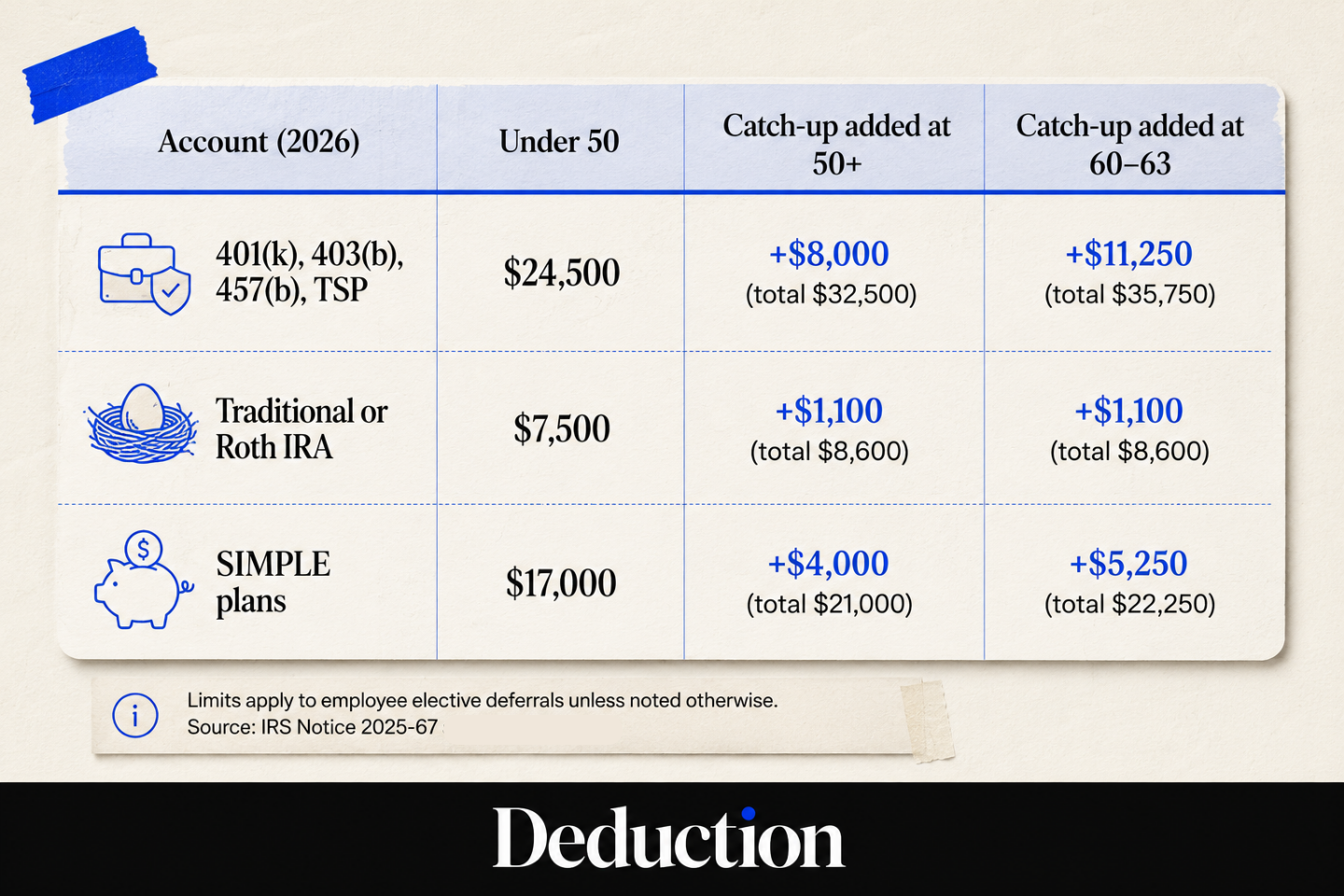
Source: IRS Notice 2025-67 and IR-2025-111 (Nov 13, 2025); IRC §§ 402(g), 408, 414(v). All figures confirmed, effective Jan 1, 2026.
401(k) and similar workplace plans. The $24,500 401(k) limit is your own elective deferral. Employer matching sits on top of it and doesn't count against that number, so a match is extra retirement money at no cost to your contribution room.
There is a ceiling on the combined total, though: everything you and your employer put in together can't exceed $72,000 for 2026
Traditional IRA. You can contribute $7,500 ($8,600 if you're 50 or older), but the deduction is where it gets conditional. If you or your spouse is covered by a workplace plan, your ability to deduct phases out as income rises, and above the top of the range you may get no deduction at all even though you can still contribute. The 2026 ranges:
- Single, covered by a work plan: deduction phases out from $81,000 to $91,000 of income.
- Married filing jointly, contributor covered: $129,000 to $149,000.
- Married, only your spouse is covered: $242,000 to $252,000.
SEP-IRA. For the self-employed and small business owners. The cap is the lesser of 25% of compensation or $72,000. One nuance the calculators trip on: if you're self-employed filing a Schedule C, your effective limit works out to roughly 20% of net earnings, not 25%, because the contribution itself reduces the base it's figured on. Retirement savings are just one of the tax deductions for 1099 workers to plan around if you are self-employed.
A note on Roth IRAs: their income limits (single: $153,000 to $168,000; married filing jointly: $242,000 to $252,000) decide whether you can contribute, not whether you get a deduction. Roth contributions never produce a deduction, so they sit outside the point of this article.
How to Get Pension-Related Tax Deductions?
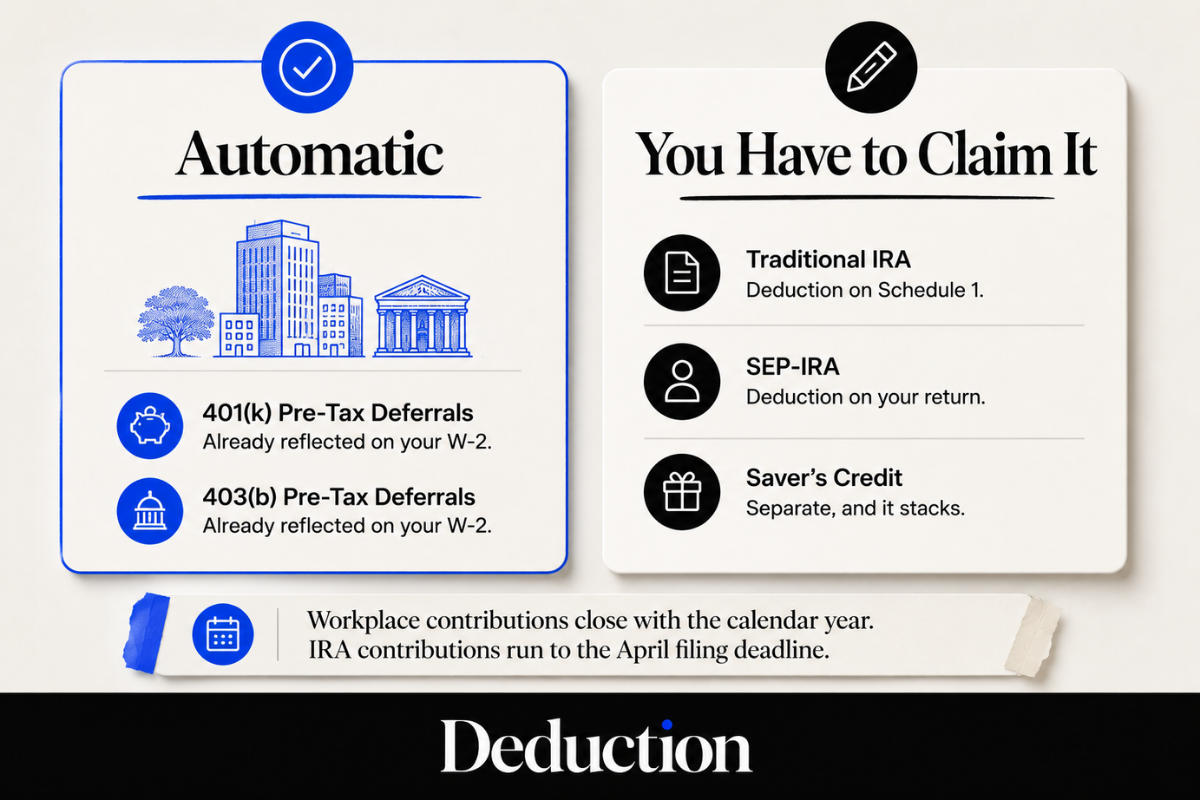
For most people, it's close to automatic. If you're eligible, the deduction largely takes care of itself, but a few steps need your attention.
- Contribute pre-tax through work first. Your 401(k) or 403(b) deferrals come out of your paycheck before tax is calculated, so your W-2 already shows the lower taxable figure. This one is automatic, with nothing extra to claim at filing.
- Add a traditional IRA contribution if you qualify. You claim this as an above-the-line deduction on your return (Schedule 1), but you only get the full amount if your income falls under the phase-out range for your situation.
- Deduct SEP-IRA contributions if you're self-employed. You take these on your return, which is what makes a SEP one of the larger deductions available to a small business owner.
- Check whether you qualify for the Saver's Credit. It's separate from the deduction and often better: a credit that cuts your tax bill dollar-for-dollar, aimed at low-to-moderate income savers, and it stacks on top of what you deduct.
- Mind the deadlines. Workplace contributions must happen during the calendar year, but you can make IRA contributions for the prior tax year right up to the April filing deadline, giving you a window to add a deduction after the year has ended. A tax deduction tracker helps you log contributions made after year-end so each one lands on the right year's return.
SEP contributions get even longer: if you file an extension, you have until your extended due date, which can push into October.
Do You Need a CPA to Find These Pension-Related Deductions for You?
No. The pension-related deductions covered here are among the more straightforward ones to claim on your own. Workplace pre-tax contributions land on your W-2 automatically, and a traditional IRA or SEP deduction is a single line on your return. Standard tax software walks you through all of it.
A CPA earns their fee when your situation gets complicated: you're self-employed and deciding between a SEP and a solo 401(k), you're near an income phase-out and want to time contributions, or your return has moving parts beyond retirement savings. In those cases, the tax they save you can outweigh what they charge.
So it comes down to complexity and time, not difficulty. If your finances are simple and you're willing to spend an hour with your return, you can capture these deductions yourself. If they're tangled or you'd rather not deal with it, paying for help is reasonable.
Let Deduction Find Your Pension Related Deductions in Minutes
You know the deduction is there. What's harder is knowing whether you're claiming all of it: are you under the IRA phase-out, is a SEP better than a solo 401(k), did last year's contribution actually get deducted? That's where most savers leave money behind.
Deduction handles that part for you as your AI tax deduction planner.
How it works:
- Upload your documents.
- The AI scans them and detects every deduction and credit you qualify for.
- A licensed CPA verifies everything, then files your return for you.
Every deduction is found by AI and checked by a CPA, so you get the speed of software with the confidence of a human expert signing off before anything reaches the IRS.
Start in a few minutes and see what you're owed.
Frequently Asked Questions about Pension Related Deduction
Here are some frequently asked questions about pension related deductions:
What deductions come off your pension?
Common deductions from a pension include federal and state income tax withholding, and sometimes health insurance premiums if your plan deducts them. The exact list depends on your plan and where you live. You can adjust federal withholding anytime by filing Form W-4P with your pension administrator.
How much is a pension deduction?
There's no single amount, because it depends on the deduction type. Tax withholding is based on your income and elections, while a retirement contribution deduction equals what you contributed pre-tax, up to the IRS limit. For 2026 that's up to $24,500 in a 401(k) or $7,500 in an IRA.
Why is pension deducted?
Deductions from a pension usually cover taxes you owe on that income, since most pension payments are taxable. Withholding lets you pay gradually instead of facing a large bill at filing. On the saving side, pre-tax contributions are deducted to lower your taxable income while you build the pension.
What is the deduction for pensioners?
Retirees don't get one universal pension deduction, but several breaks may apply. Many can take the higher standard deduction for those 65 and older, and some states exempt part of pension income from tax. Whether contributions are still deductible depends on having earned income during the year.
What deductions are taken out of my pension?
Typically federal income tax, possibly state income tax, and sometimes voluntary items like health premiums. Social Security and Medicare taxes are not withheld from pension payments, since those apply to earned wages, not retirement income.
What are three tax deductions for seniors?
Three common ones: the extra standard deduction for taxpayers 65 and older, deductible traditional IRA contributions if you still have earned income, and medical expenses above the IRS threshold if you itemize. State-level pension or retirement-income exclusions can add a fourth, depending on where you live.
How much of pension income is taxable?
Usually most or all of it, if your contributions were made pre-tax. Payments from a traditional pension or traditional 401(k) are generally fully taxable as ordinary income. If you made any after-tax contributions, the portion representing those is returned tax-free, so a small share may not be taxed.
What is the pension income amount deduction?
In the US there's no federal "pension income amount" deduction; that specific term is a Canadian credit. The closest US equivalents are the age-65 standard deduction boost and state-level exclusions that shield part of your pension income from state tax. Amounts and eligibility vary by state.