

Federal income tax is already enough to deal with. Add a tax-hungry state, and the layers pile up fast. Your city may take its own cut, and so might the income from a side hustle or family business.
Paying these taxes stings. Preparing them is worse. Miss one deduction and you overpay, or overprepare and create problems that follow you for years.
The SALT deduction is one way to claw some of that money back. This guide shows you what it covers, whether you qualify, and how to claim it without the hassle.
What Are State and Local Taxes
State and local taxes are the taxes your state, county, and city collect to fund things like schools, roads, and public services. They come in a few main forms: income tax on what you earn, property tax on real estate you own, and sales tax on what you buy. How much you pay depends on where you live, since every state and city sets its own rates.
What Is the SALT Deduction
The SALT deduction lets you subtract certain state and local taxes you already paid from your federal taxable income. "SALT" stands for state and local taxes. You can only claim it if you itemize rather than take the standard deduction, and a cap set by Congress limits the total.
It exists to soften double taxation. Without it, the same dollar of income gets taxed once by your state or city and again by the federal government. The deduction gives you a federal offset for money you already paid to local governments, so you are not fully taxed twice on the same income.
How much it is worth depends heavily on where you live and what you earn. Higher earners tend to pay more in state income, property, and sales taxes, so their deductions run larger.
The Congressional Research Service points to three reasons: higher incomes generate more state and local taxes, they make itemizing more worthwhile, and higher marginal rates make each deducted dollar more valuable.
Two facts also decide whether the deduction reaches you at all. First, few people itemize. Only about 9% of taxpayers claimed a SALT deduction in 2022, down from 31% in 2017, the last year before the cap took effect. Among the minority who do itemize, though, SALT is nearly universal: 98.8% of itemizers claimed it in 2023.
Also remember the deduction lowers your taxable income, not your tax bill directly, and that itemizing means giving up the standard deduction. So your real savings are the amount your itemized total beats the standard deduction by, times your tax bracket.
A single filer with $40,400 in SALT and nothing else to itemize clears the $16,100 standard deduction by $24,300, which in the 24% bracket is worth roughly $5,800 off what you owe.
One exception if you are in the top bracket: starting in 2026, a new limit trims the value of your itemized deductions, so the top dollar of deduction saves you 35 cents instead of 37. It kicks in once taxable income passes $640,600 for single filers or $768,700 for married couples filing jointly.
What is the SALT deduction cap?
The SALT cap is the most you can deduct in state and local taxes in a single year, no matter how much you actually paid. For 2025, it is $40,000 ($20,000 if married filing separately). Under the One Big Beautiful Bill Act, the cap rises 1% each year through 2029, then drops back to $10,000 in 2030.
The cap decides how much of your state and local tax burden actually counts. If you pay $30,000 in property and income taxes, the old $10,000 cap let you deduct only a third of it. The 2025 cap lets you deduct all of it. For homeowners in high-tax states, that difference can be worth thousands.
It also sets a deadline. The higher cap is temporary, so the tax years from 2025 through 2029 are the window where this matters most. High earners should note the benefit shrinks above $500,000 in income, covered in the next section.
A bigger cap only helps if itemizing beats the standard deduction. You claim one or the other, never both.
For 2026, it is $40,400 ($20,200 if married filing separately), up from $40,000 in 2025. High earners should note the benefit shrinks once modified adjusted gross income tops $505,000, covered in the next section
To benefit from SALT, your total itemized deductions (SALT plus mortgage interest, charitable gifts, and the rest) have to clear that number.
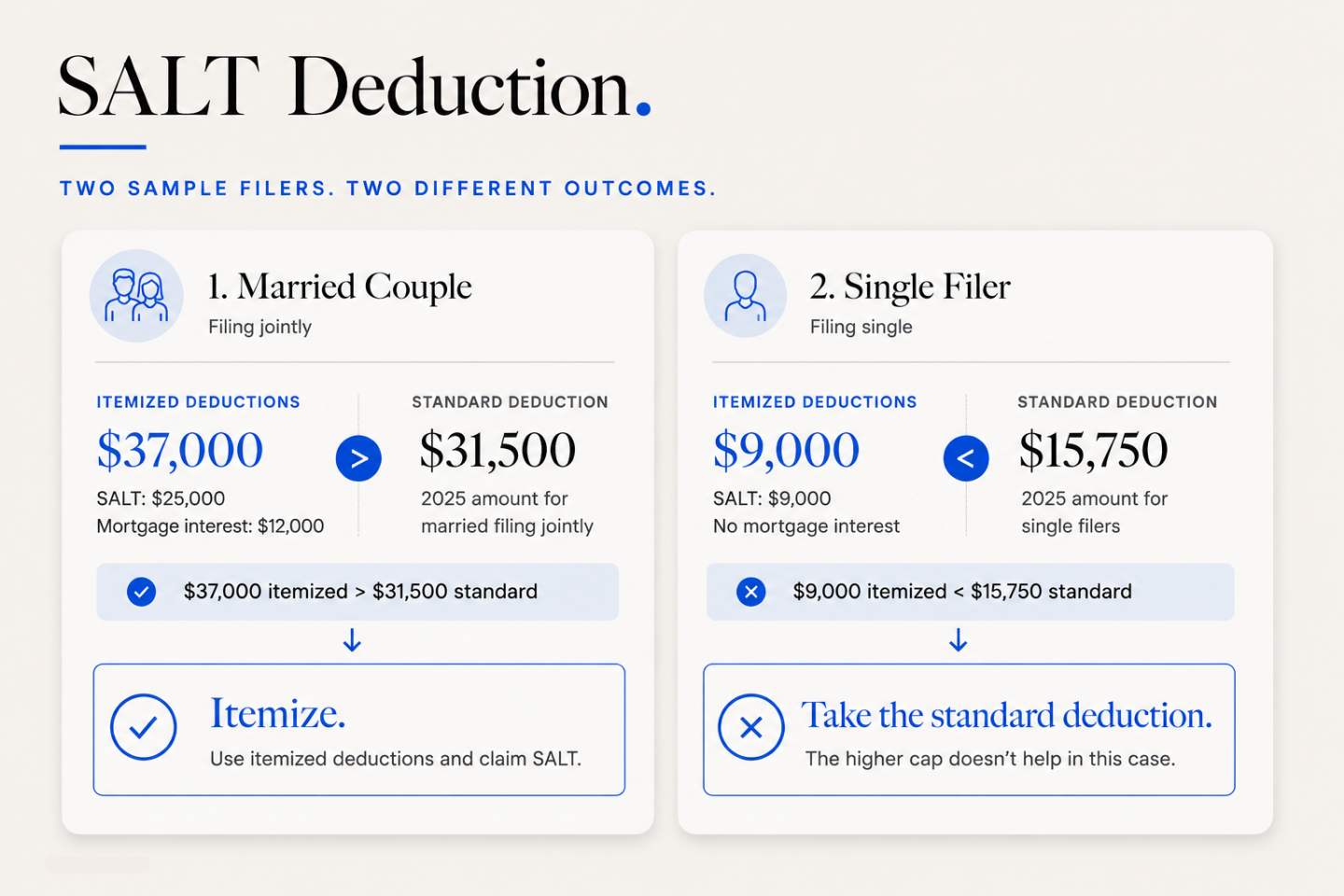
Here is the quick test. A married couple with $25,000 in SALT and $12,000 in mortgage interest has $37,000 in itemized deductions, which beats their $32,200 standard deduction, so they itemize and use SALT.
A single filer with $9,000 in SALT and no mortgage has $9,000 in itemized deductions, which falls short of the $16,100 standard deduction, so the higher cap does nothing for them.
What Fees and Taxes Are Covered by the SALT Deduction
Here are the taxes you can deduct through SALT:
- State and local income taxes: The income tax withheld from your paycheck or paid through estimated payments to your state and, in some places, your city or county.
- State and local general sales taxes: What you paid in sales tax on purchases during the year. You choose either income taxes or sales taxes, not both, so this option mainly helps people in states with no income tax.
- Real estate taxes: Property taxes on your home and any other real estate you own, as long as they are based on the property's assessed value.
- Personal property taxes: Annual taxes charged on the value of things you own, most commonly the value-based portion of your vehicle registration.
What Fees and Taxes Are Not Covered by the SALT Deduction
These common costs look like taxes but cannot be deducted through SALT:
- Federal income taxes: SALT only covers state and local taxes, so anything you pay to the IRS is off the table.
- Social Security and Medicare taxes: The payroll taxes withheld from your paycheck do not qualify.
- Transfer taxes: Taxes triggered by selling or transferring property, such as real estate transfer taxes, are excluded.
- Stamp taxes: Fees charged to make certain documents or transactions official do not count.
- Homeowners association (HOA) fees: These go to a private association, not a government, so they are never deductible.
- Estate and inheritance taxes: Taxes on money or property passed on after a death fall outside SALT.
- Service charges for water, sewer, or trash collection: These pay for a specific service you receive, so they are treated as fees, not taxes.
Who Benefits from Getting SALT Deduction
The SALT deduction is worth the most where state and local tax bills are high enough to approach the $40,000 cap. That takes some combination of a steep income tax and heavy property taxes. Homeowners in these states are the clearest winners.
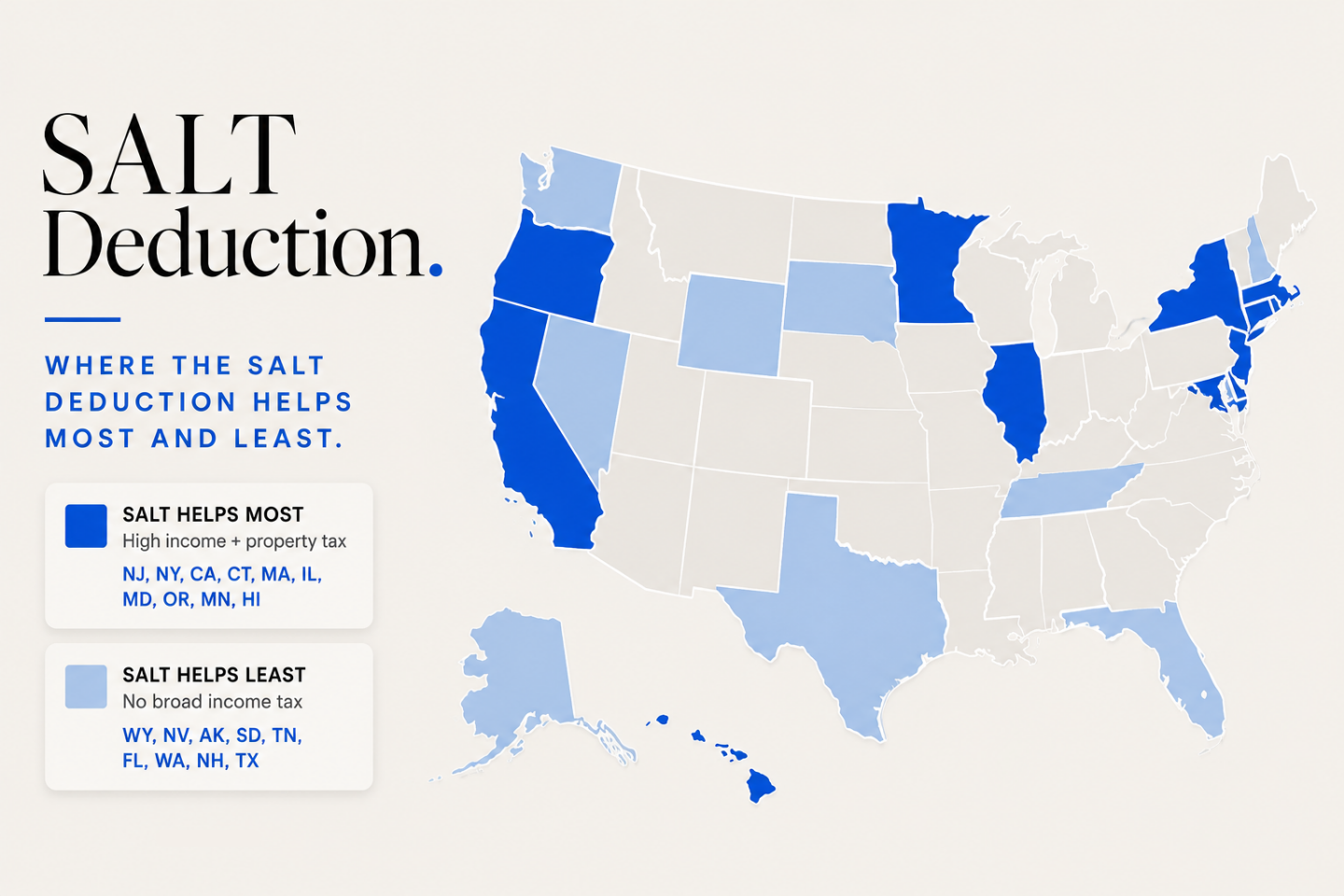
States where SALT helps most (high income tax plus high property taxes)
- New Jersey: Carries the highest effective property taxes in the country, layered on top of a graduated income tax that reaches 10.75% on income over $1 million. A typical homeowner here can hit the old $10,000 cap on property taxes alone, so the higher cap unlocks real value.
- New York: Combines a top state rate of 10.9% on very high incomes with something few states have: a separate local income tax for New York City residents. City dwellers stack state and city income tax before property taxes even enter the math.
- California: Has the highest top marginal rate in the nation at 13.3%, a 12.3% base plus a 1% Mental Health Services surcharge on income over $1 million. High earners generate large deductible income-tax bills, though the phaseout above $500,000 claws some of it back.
- Connecticut: Pairs a graduated income tax topping out near 7% with some of the heaviest property taxes in the Northeast. The two together push many households well past the old cap.
- Massachusetts: Long known as a flat-tax state at 5%, but a 4% surtax on income above $1 million now creates a 9% top rate for the highest earners. High earners with valuable homes benefit most.
- Illinois: Its income tax is a modest 4.95% flat rate, but property taxes rank among the highest in the country. For Illinois homeowners, the property-tax side alone often justifies itemizing.
- Maryland: One of the few states where counties levy their own income tax on top of the state's. That local layer, added to state income and property taxes, lifts total SALT bills higher than the headline state rate suggests.
- Oregon: Runs a high income tax topping out at 9.9% and has no sales tax. Residents can only deduct income (not sales) tax, but the income tax alone is large enough to matter.
- Minnesota: A top rate of 9.85% places it among the highest-taxed states, so high earners build sizable deductible income-tax bills.
- Hawaii: Carries an 11% top rate, second only to California, spread across an unusually large number of brackets. High earners reach deductible amounts quickly.
States where SALT helps least (no broad income tax)
These states levy no broad tax on wage income, so residents lose the single largest SALT component. The benefit is not zero, since property and sales taxes still count, but it is much smaller.
- Wyoming: No income tax and low property taxes, so there is little deductible SALT to claim in the first place.
- Nevada: No income tax and relatively low property taxes; sales tax is the main deductible item.
- Alaska: No income tax and no statewide sales tax, leaving only local property and sales taxes to deduct.
- South Dakota: No income tax and modest property taxes keep most residents well under the cap.
- Tennessee: No income tax and low property taxes, so few residents come close to itemizing on SALT alone.
- Florida: No income tax, but higher property taxes give homeowners a meaningful amount to deduct, softening the loss.
- Washington: No tax on wage income; it taxes only capital gains. Most residents deduct property and sales taxes instead.
- New Hampshire: No wage or sales tax, and it repealed its interest-and-dividends tax as of 2025. But high property taxes still give homeowners something substantial to deduct.
- Texas: No income tax, but very high property taxes mean homeowners can still rack up a large deduction, sometimes approaching the cap on property taxes alone.
Living in a high-tax state does not automatically mean SALT will help you. It only pays off if your total itemized deductions beat your standard deduction, and the phaseout above $500,000 in income complicates the math further. The interaction between the cap, the phaseout, and your other deductions can be hard to eyeball.
Before you change how you file, it is worth running the numbers with a CPA or qualified tax professional. They can tell you whether itemizing for SALT actually beats the standard deduction in your situation, and flag state-specific workarounds you might otherwise miss. This guide is general information, not tax advice.
How to Claim the SALT Deduction
Claiming SALT comes down to six steps. Take them in order, and you will know exactly what you can deduct and whether it is even worth doing.
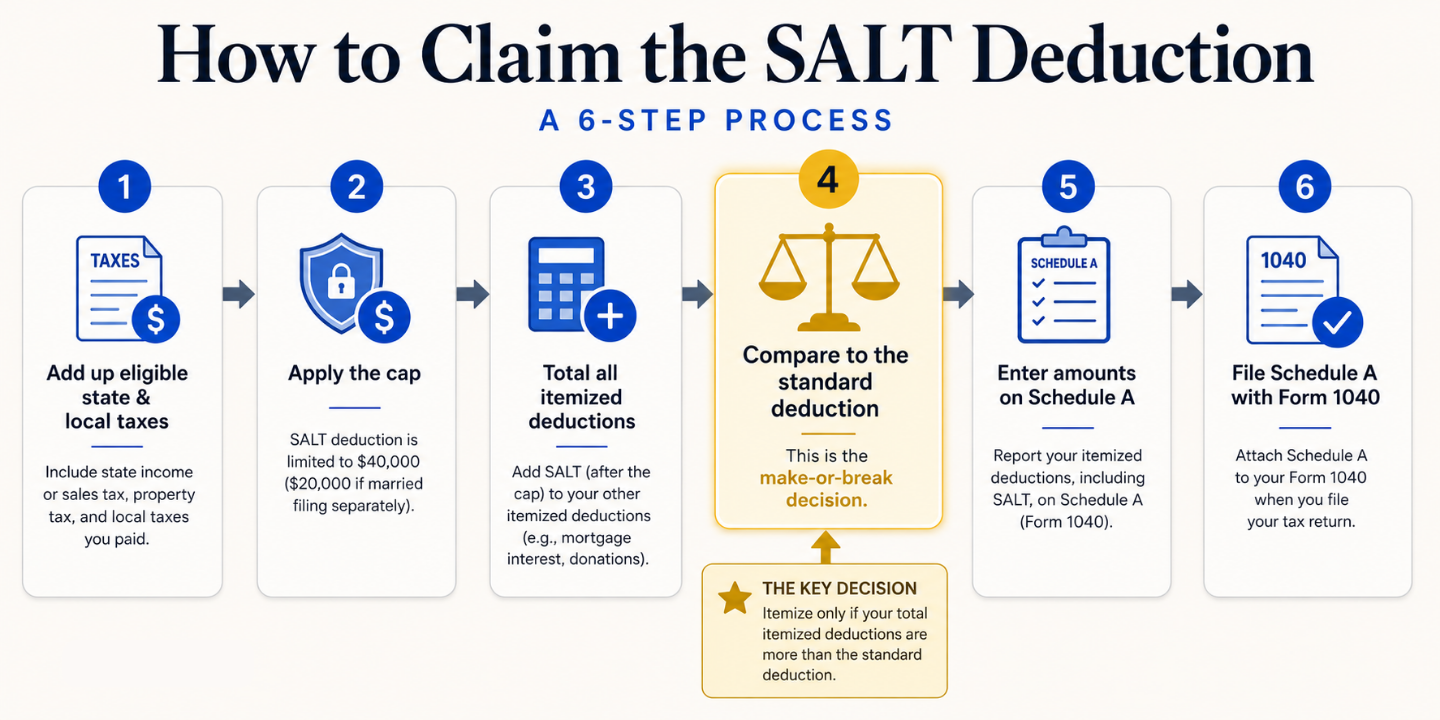
Step 1: Add up your eligible state and local taxes.
Gather what you paid in 2025. That means your state and local income taxes or your sales taxes, whichever is larger (you pick one, never both), plus your property taxes. Check your W-2, pay stubs, and property tax bills for the exact amounts.
Step 2: Apply the cap.
For 2026 you can deduct up to $40,400, or $20,200 if married filing separately, up from $40,000 and $20,000 in 2025. If your eligible taxes add up to more than that, you are capped there.
If your modified adjusted gross income tops $505,000 ($252,500 for MFS), the cap shrinks by 30 cents for every dollar above that line, but it never drops below $10,000 ($5,000 for MFS). For 2025 that phase-out started at $500,000 ($250,000 for MFS)
Step 3: Total all your itemized deductions.
Your SALT deduction is only one piece. Add it to your other itemized deductions, such as mortgage interest and charitable donations, to get your total itemized amount.
Step 4: Compare that total to the standard deduction.
This is the make-or-break step. For 2026 the standard deduction is $16,100 for single filers and $32,200 for married couples filing jointlyFor 2026, it is $40,400 ($20,200 if married filing separately), up from $40,000 in 2025.
Itemize only if your total from Step 3 beats that number. If it does not, SALT gives you nothing, and you should take the standard deduction instead.
Step 5: Enter the amounts on Schedule A.
If itemizing wins, record your SALT figures on Schedule A (Form 1040) on the lines for state and local taxes.
Step 6: File Schedule A with your Form 1040.
Attach the completed Schedule A to your regular tax return and file. That is it.
If juggling these steps sounds like a lot, you are not alone. This is exactly the kind of comparison that trips people up, and it is why many filers now let an AI tax deduction finder pull the numbers together, apply the cap, and run the standard-versus-itemized comparison automatically, so you can see in seconds whether itemizing for SALT actually pays off.
SALT Deduction Example Situation
Numbers make this easier to follow, so let's walk through a realistic case using the six steps from above. All figures here are estimates for illustration; your actual taxes depend on your county and your specific return.
The situation: You are single and live in South Carolina, managing a retail store and earning $85,000 a year. Your home is worth $450,000, and you have paid off about 30% of it, leaving a mortgage near $315,000.
Step 1: Add up your eligible state and local taxes.
Two pieces make up your SALT:
- State income tax: On $85,000 of income, South Carolina's graduated tax (topping out at 6%) works out to about $3,800.
- Home property tax: South Carolina taxes owner-occupied homes at an effective rate near 0.46%, one of the lowest in the country. On a $450,000 home, that is roughly $2,100.
That totals about $5,900 in eligible SALT.
Step 2: Apply the cap.
Here is the surprise: your $5,900 is well below the old $10,000 cap, let alone the new $40,000 one. So the higher cap does nothing for you. Whether the limit is $10,000 or $40,000, you deduct the same $5,900. The big headline about the expanded cap simply does not touch your situation.
Step 3: Total your itemized deductions.
Your mortgage interest on the $315,000 loan comes to about $21,000 for the year. Add your $5,900 SALT, and your itemized deductions total roughly $27,000.
Mortgage interest is one of the few kinds of interest you can deduct; our guide on whether personal loan interest is tax deductible covers the rest.
Step 4: Compare to the standard deduction.
The 2025 standard deduction for a single filer is $15,750. Your $27,000 in itemized deductions clears it comfortably, so you itemize.
The takeaway:
Two lessons hide in this example. First, your SALT alone ($5,900) would have fallen well short of the $15,750 standard deduction, so it was the mortgage interest that made itemizing worthwhile.
Second, the expanded cap that dominates the headlines changed nothing for you, because your tax bill in a low-tax state never came close to the old limit. The bigger cap rewards people with high state and local taxes, and not everyone qualifies.
Let Deduction Pinpoint Your SALT Deductions for You
Your situation is probably more tangled than the South Carolina example above. Multiple income sources, a spouse, several properties, or an income near the phaseout threshold can all cloud the one question that matters: is claiming SALT actually worth it for you?
Hiring a CPA from scratch can feel like added cost and added complication, especially if you just want a clear answer. That is where an AI tax planner earns its place.
With Deduction, you upload your documents, share a few details about your situation, and the AI does the heavy lifting:
- Adds up your eligible SALT and applies the cap and any phaseout automatically.
- Runs the itemize-versus-standard comparison so you instantly see whether SALT helps you at all.
- Flags deductions you might miss, from mortgage interest to charitable giving.
Then a real CPA reviews the results, so nothing rests on the software alone. You get the speed and low cost of automation with the confidence of professional sign-off, and a return that is ready to file.
Stop guessing whether SALT is worth it. Let Deduction show you in minutes.
Frequently Asked Questions about SALT Deduction
Here are some frequently asked questions about SALT Deduction.
What is the SALT deduction for the IRS?
The SALT deduction lets you subtract certain state and local taxes you already paid from your federal taxable income. It covers state and local income (or sales) taxes plus property taxes. You can only claim it if you itemize on Schedule A instead of taking the standard deduction, and it is limited by an annual cap.
Who benefits most from SALT deduction?
Homeowners in high-tax states benefit most, because they pay enough in state income and property taxes to approach the cap. Residents of New Jersey, New York, California, and Connecticut are prime examples. People in no-income-tax states or those whose tax deductions fall below the standard deduction see little or no benefit.
What are common SALT deduction mistakes?
The biggest mistake is itemizing when the standard deduction would save more. Others include deducting both income and sales taxes (you pick one), counting non-deductible items like HOA fees or federal taxes, and forgetting the cap.
What all deductions can be claimed?
Under SALT, you can claim state and local income taxes or general sales taxes (whichever is larger), real estate property taxes, and personal property taxes like the value-based portion of vehicle registration.
What is the SALT deduction for 2026?
For 2026 the SALT cap is $40,400 ($20,200 if married filing separately), up 1% from the 2025 cap of $40,000. The phaseout for high earners begins once modified adjusted gross income tops $505,000. The cap keeps rising 1% yearly through 2029, then drops back to $10,000 in 2030.
Why increase SALT deduction?
The cap was raised to ease the burden on taxpayers in high-tax states, who lost significant deductions under the $10,000 limit set in 2017. Lawmakers designed it as temporary relief, letting more middle- and upper-income homeowners deduct a larger share of the state and local taxes they already pay.
How will the increased SALT deduction benefit me in California?
California has the nation's highest top income tax rate, so residents often pay large state income and property taxes. The higher cap lets many Californians deduct far more than the old $10,000 allowed. But if your income exceeds $500,000, the phaseout may reduce your benefit toward the $10,000 floor.