

A tax deduction is one of the few tools that lets you legally keep more of what you earn, and every April a chunk of your money walks out the door because people miss them.
The tax code is packed with deductions, but they are buried in jargon and easy to overlook. So millions of filers quietly hand the IRS more than they owe, sometimes for years.
This guide breaks down how a tax deduction works, the difference between the standard and itemized routes, and the write-offs people most often miss for the 2025 tax year.
Key Takeaways
- A tax deduction lowers the income you are taxed on. It is not a dollar-for-dollar cut to your bill like a credit.
- You pick one path: the standard deduction or itemizing. You take whichever is larger, never both.
- For 2025, the standard deduction is $15,750 (single) and $31,500 (married filing jointly), now high enough that most people should take it.
- Above-the-line deductions like HSA and student loan interest count even if you do not itemize.
- The most-missed deductions are usually the above-the-line ones and small itemized items people forget to track.
What Are Tax Deductions?
A tax deduction is an expense you subtract from your income before your tax is figured. Lower the income that gets taxed, and you owe less.
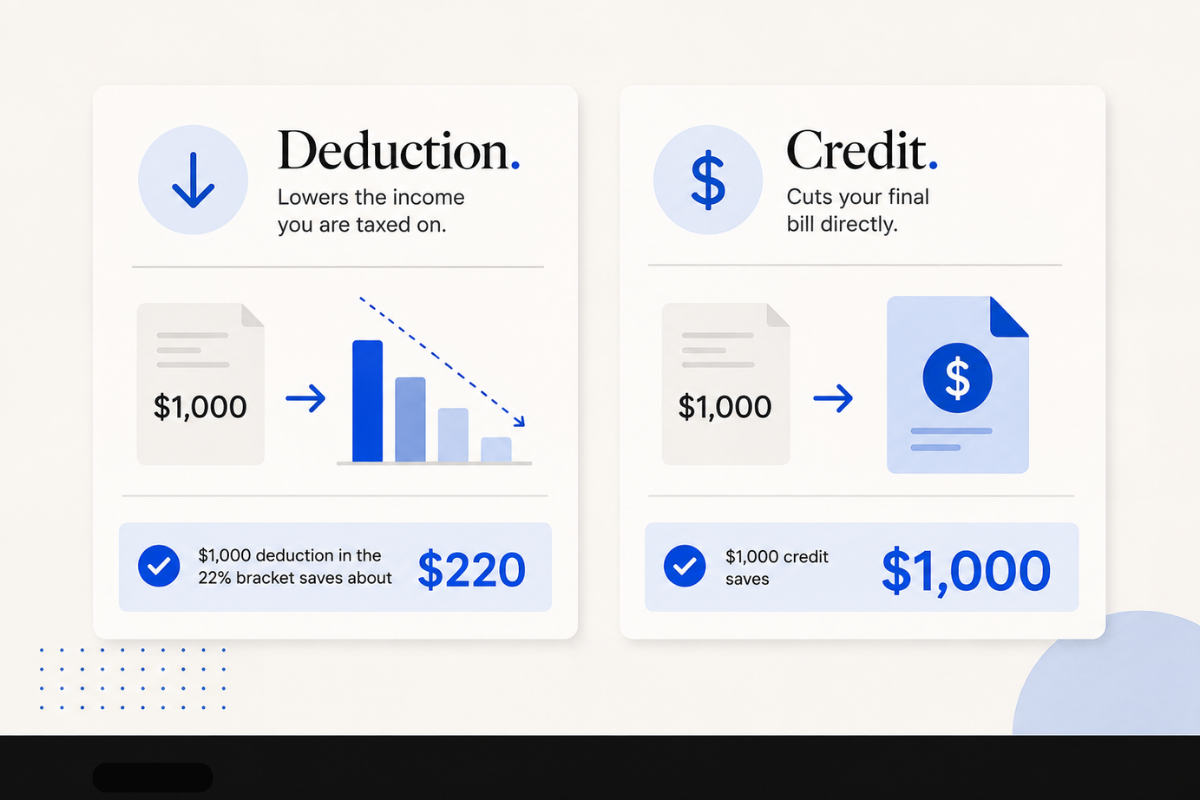
It is not the same as a tax credit. A deduction shrinks your taxable income, while a credit cuts your final bill directly. A deduction still saves real money, just scaled to your rate: a $1,000 deduction in the 22% bracket saves you about $220.
Why Are There Tax Deductions?
Deductions are not a loophole. They are built into the system on purpose, mostly for three reasons.
- Fairness in taxation: tax is meant to hit your net income, not every dollar that passes through your hands. A business has to buy inventory and supplies to earn a profit, so deducting those costs means you are taxed on what you actually take home.
- Encouraging good behavior: governments use deductions as a nudge. Rewarding charitable giving or student loan interest pushes people to support nonprofits and pursue education, and you get a break for doing it.
- Stimulating growth: letting businesses write off new equipment, research, and training encourages them to invest and hire. The lost tax revenue is the trade-off for a busier economy.
What Is a Standard Tax Deduction?
The standard deduction is a flat amount you subtract from your income without proving a single expense. Most people take it because it is simple and, for them, bigger than itemizing.
The amount depends on your filing status and rises a little each year. Here is 2025 next to 2026.
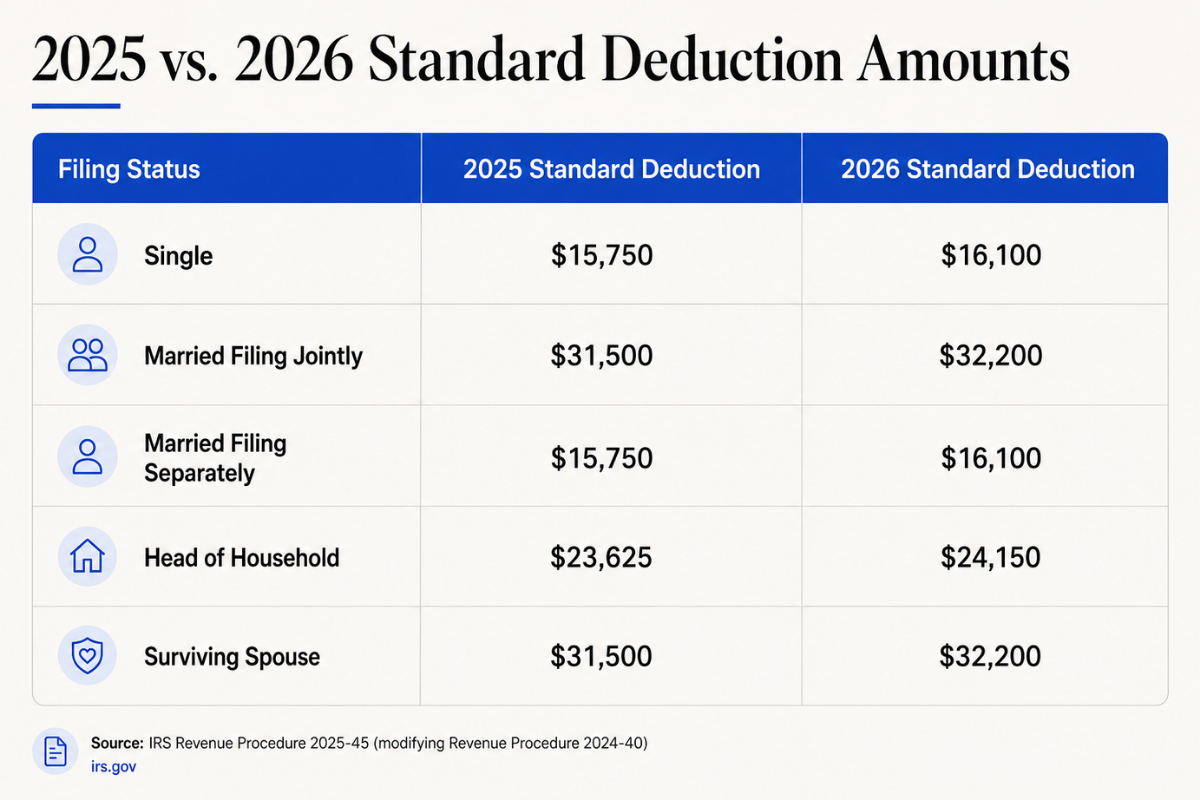
Source: IRS standard deduction amounts for 2025 (Publication 501) and 2026 (IRS inflation adjustments).
What Is an Itemized Tax Deduction?
Itemizing means listing your actual deductible expenses one by one on Schedule A instead of taking the flat standard amount. It only wins when those expenses add up to more than your standard deduction.
Examples of itemized tax deductions
- Mortgage interest: the interest on your home loan. The code rewards homeownership, so your lender reports it on a Form 1098 and you claim it on Schedule A, on up to $750,000 of loan balance for homes bought after 2017.
- State and local taxes (SALT): state income (or sales) taxes plus property taxes you already paid. It eases being taxed twice on the same income, but a federal cap limits the total to $40,000 for 2025.
- Charitable contributions: cash and property you give to qualified nonprofits. Keep a receipt for every gift; cash donations are deductible up to 60% of your AGI, with the extra carried forward.
- Medical and dental expenses: out-of-pocket health costs, deductible only for the portion above 7.5% of your AGI. Mileage to appointments counts, so it adds up faster than people expect in a heavy medical year.
- Property taxes: real estate taxes on your home, counted inside the SALT cap above rather than as a separate line.
- Investment interest expense: interest on money you borrowed to buy taxable investments, deductible up to the investment income it generated.
- Casualty and theft losses: damage to your property, but since 2018 personal losses only count if they come from a federally declared disaster. A random break-in no longer qualifies. Interest on other borrowing depends on what the money paid for, which is why only some personal loan interest is tax deductible.
Above-the-Line vs. Below-the-Line Deductions
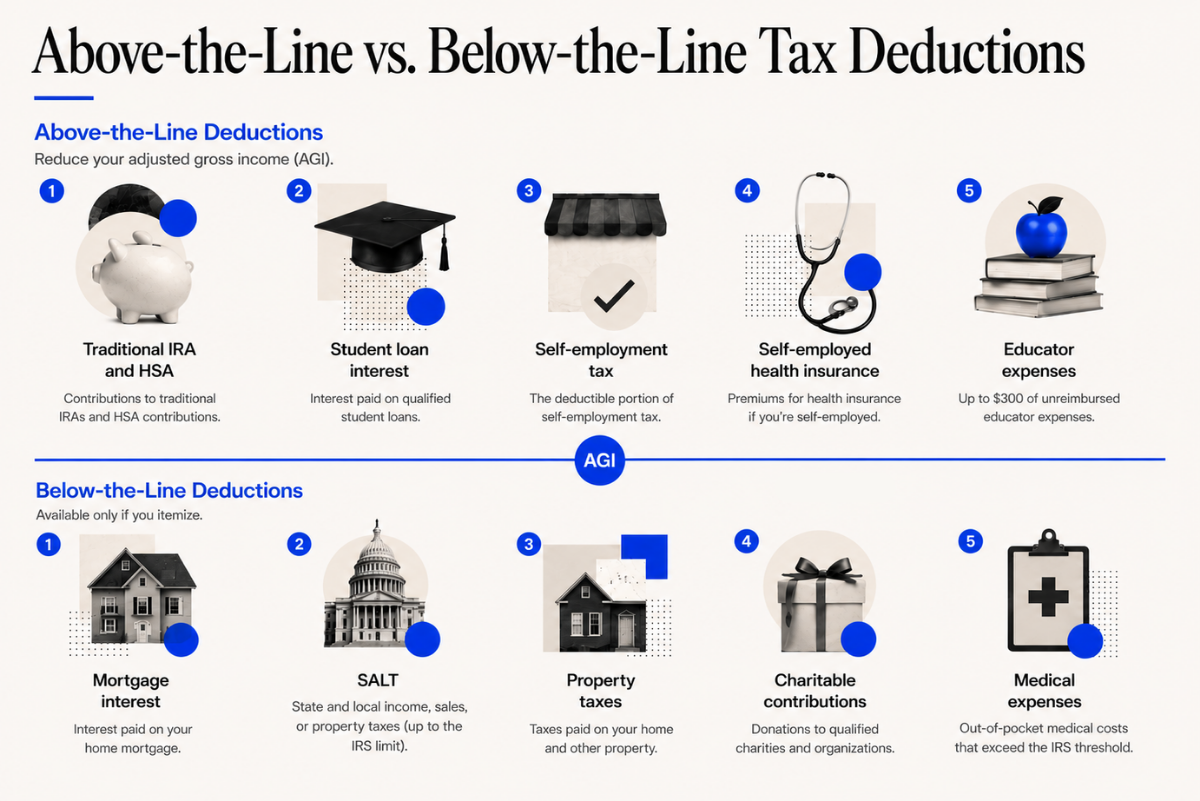
The "line" is your adjusted gross income (AGI). Above-the-line deductions come off first, and you get them whether or not you itemize. Below-the-line deductions are the itemized ones, useful only if you skip the standard deduction.
Examples of above-the-line deductions
- Traditional IRA and HSA contributions: money set aside for retirement or health costs comes off your income now, no itemizing needed.
- Student loan interest: up to $2,500 of interest paid, claimed directly on Schedule 1.
- Self-employment tax deduction: the self-employed deduct the employer-half of their payroll tax.
- Self-employed retirement and health insurance: plan contributions and premiums both come off the top.
- Educator expenses: teachers deduct up to $300 of out-of-pocket classroom costs.
- Alimony: deductible only for divorce agreements signed before 2019.
Examples of below-the-line deductions
These are the itemized deductions: state and local taxes, property taxes, mortgage interest, charitable contributions, and medical expenses. They only help if itemizing beats your standard deduction.
When to Choose the Standard or Itemized Deduction
You never get both, so the decision is a simple comparison:
- Add up your itemized deductions: mortgage interest, SALT (capped), charitable gifts, and medical costs above the 7.5% floor.
- Find your standard deduction for your filing status from the table above.
- Take whichever number is larger. If itemizing wins, you file Schedule A. If not, take the standard deduction.
- Either way, still claim your above-the-line deductions. They are yours regardless.
A quick example, with estimated numbers. Say you are married filing jointly and own a home: about $12,000 in mortgage interest, $9,000 in state and property taxes, and $2,000 in charitable gifts.
That totals roughly $23,000 in itemized deductions, but your 2025 standard deduction is $31,500. So even as homeowners with a mortgage, you come out ahead taking the standard deduction. That surprises people, and it is exactly why you run the comparison instead of assuming.

Gathering is far easier if you never let a year of it pile up in the first place. A tax deduction tracker logs each write-off as it happens, so filing season starts with a list you already have instead of twelve months of statements to rebuild.
How to File Your Tax Deductions
The mechanics come down to a few steps.
- Gather the paperwork behind each deduction: Form 1098 for mortgage interest, receipts for donations, medical bills, and so on.
- Claim your above-the-line deductions on Schedule 1, which you can do either way.
- If itemizing wins, list those deductions on Schedule A and file it with your Form 1040.
- Keep your records in case the IRS ever asks you to back up a deduction.
Do You Need a CPA to File for Tax Deductions?
Not always. If your return is simple and you take the standard deduction, tax software handles it fine.
A CPA earns their fee when things get tangled: self-employment income, several properties, a big life change, or a close call between itemizing and the standard deduction. The tax they save can outweigh what they charge.
This article is general information, not tax advice. Talk to a CPA about your specific situation before you file.
Let Deduction File Your Taxes for You
The hardest part of deductions is not the math. It is knowing which ones apply to you and catching the ones you would otherwise miss, year after year. And Deduction helps you have these for the tax year as an AI tax prep tool:
That is exactly what Deduction does. Here is how it works:
- Upload your forms and documents.
- Deduction scans them and flags every deduction and credit you qualify for.
- A licensed CPA reviews everything and files your return for you.
Every deduction is found by AI and checked by a real CPA, so you get the speed of software with the confidence of a human expert before anything reaches the IRS.
Frequently Asked Questions About Tax Deductions
Here are some frequently asked questions about tax deductions:
What Is the Most Overlooked Tax Deduction?
The self-employed health insurance deduction and educator expenses are among the most missed, along with state sales tax in no-income-tax states. Many people also skip above-the-line deductions like HSA and student loan interest, wrongly assuming they only count if you itemize.
What Deductions Can I Claim on Tax?
Common ones include mortgage interest, state and local taxes, charitable gifts, medical costs above 7.5% of your income, and IRA, HSA, and student loan interest. Some require itemizing; the above-the-line ones do not.
Can I Deduct My Medicare Premiums on My Taxes?
Often yes. Medicare premiums count as a medical expense, deductible on Schedule A to the extent your total medical costs top 7.5% of your AGI. If you are self-employed, you may be able to deduct them above the line instead.
What Are the Biggest Tax Write-Offs?
For homeowners, mortgage interest and state and local taxes are usually largest. For the self-employed, retirement contributions and health premiums can be huge. For most people, the standard deduction itself is the biggest write-off they take.
What Home Expenses Are Tax Deductible?
Mortgage interest and property taxes are the main ones, both claimed if you itemize. If you run a business from home, part of your housing costs may qualify for the home office deduction. General repairs and personal utilities are not deductible.
What Is Surprisingly Tax Deductible?
A few surprises: mileage driven for medical care or charity, the self-employment tax deduction, and state sales tax in some states. Job-related education and home office costs for the self-employed can also qualify, though the rules are specific.
What Tax Deductions Can You Claim Without Itemizing?
The above-the-line deductions: traditional IRA and HSA contributions, student loan interest, educator expenses, and self-employed health insurance. You claim them on Schedule 1 and keep your full standard deduction on top.