

Tax season rolls around, and you are staring at your income, wondering how much of it you actually get to keep.
The write-offs that could shrink that number feel locked behind itemizing, extra forms, and rules that seem written for accountants. Miss one and you quietly overpay, sometimes for years.
Above-the-line deductions are the friendly exception. You can claim them without itemizing, and they lower the income you are taxed on before anything else on your return. Here is what they are, who qualifies, and how to claim them.
Key Takeaways
- Above-the-line deductions lower your adjusted gross income (AGI), the number the rest of your return is built on.
- You can claim them whether you take the standard deduction or itemize, so almost everyone can use them.
- The common ones: traditional IRA, self-employed retirement plans, student loan interest, HSA contributions, and self-employed health insurance.
- You claim them on Schedule 1, and the total flows to Form 1040 to reduce your AGI.
- Alimony only counts if your divorce agreement was signed before 2019.
What Are Above-the-Line Tax Deductions
Above-the-line deductions are expenses you subtract from your gross income to reach your AGI. The name is literal: on Form 1040, they sit just above the line where your AGI gets calculated.
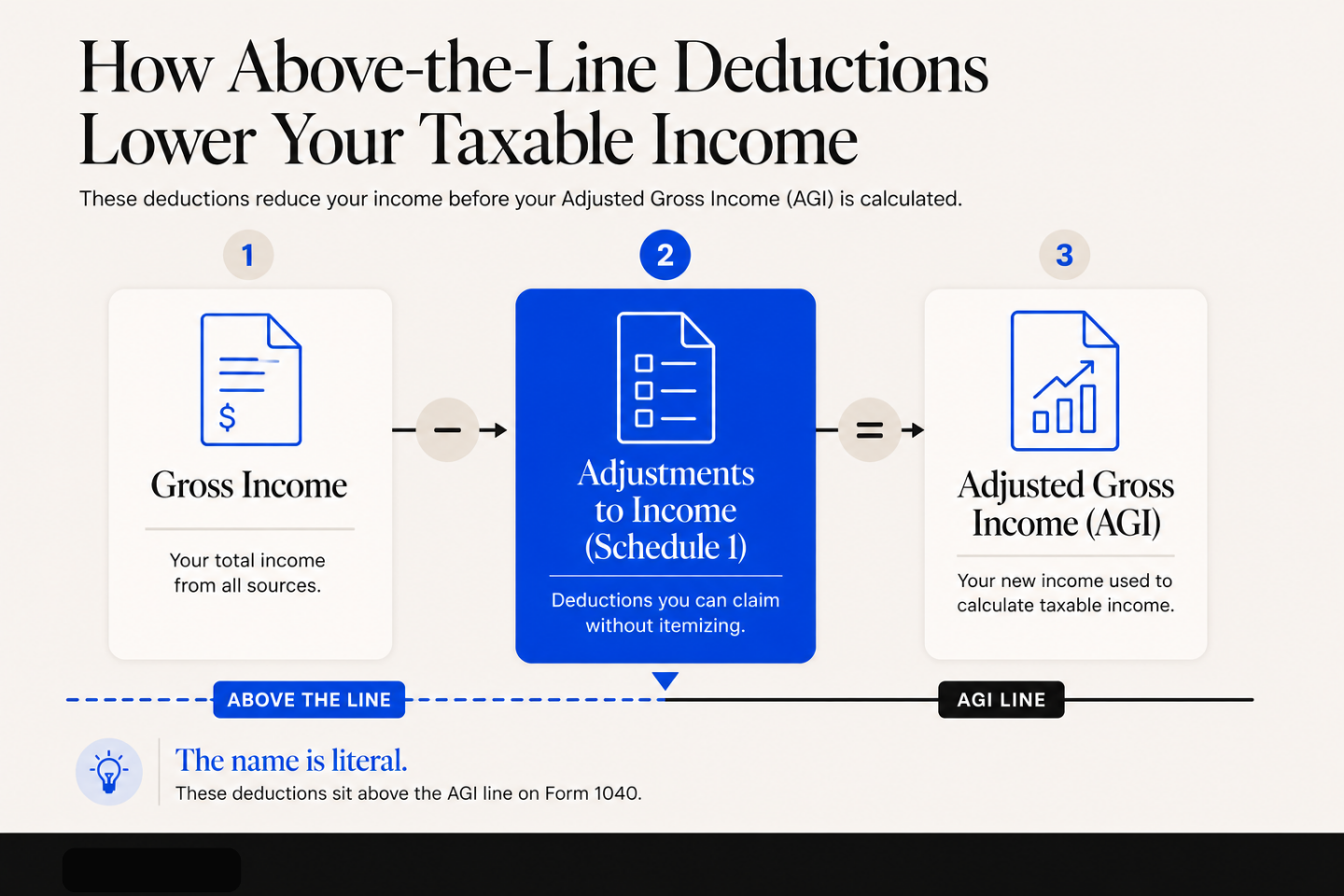
The big perk is that you can take them without giving up the standard deduction. Officially, they are called adjustments to income, and most of them live on Schedule 1. Think retirement contributions, student loan interest, and HSA deposits.
Why Above-the-Line Deductions Are Worth Chasing
Three things make these deductions punch above their weight. Here is why they matter before we get into the list.
They're Available to Everyone
You can claim these whether you itemize or not. Most write-offs only pay off if your itemized total beats the standard deduction, which rules them out for the large majority of filers who take the standard deduction.
Above-the-line deductions skip that hurdle entirely. For a lot of people, they are the only write-offs they can actually use.
You Don't Have to Itemize
There is no Schedule A involved. You list these on Schedule 1 and still pocket your full standard deduction.
That means you get the write-off and the standard deduction at the same time, not one or the other.
They Lower Your AGI
Your AGI is the number the rest of your return keys off, and plenty of other tax breaks phase out as it climbs. Shrinking your AGI can quietly open the door to credits and deductions you would otherwise miss.
A lower AGI can even trim how much of your Social Security gets taxed. That ripple effect is why these deductions are worth more than they look.
Common Above-the-Line Deductions You Can Claim

These are the ones most people can actually use. Find yourself in the list below.
Traditional IRA Contributions
You can deduct traditional IRA contributions up to $7,000 for 2025, or $8,000 if you are 50 or older. The full deduction is yours if neither you nor your spouse has a workplace retirement plan.
If you are covered by a plan at work, the deduction starts phasing out around $79,000 of income for single filers and $126,000 for joint filers. Roth IRA contributions, for the record, are not deductible.
For how 401(k), SEP-IRA, and other retirement contributions are treated, see our guide to pension-related deductions.
Self-Employed Retirement Plans
Work for yourself? A SEP-IRA or solo 401(k) can be deducted, and the ceilings are much higher. A SEP-IRA caps at the lesser of 25% of your compensation or $70,000 for 2025.
A solo 401(k) reaches the same total through a personal contribution plus an employer piece. For a lot of small business owners, this is the single biggest tax deduction on the return.
Student Loan Interest
You can deduct up to $2,500 of interest paid on a qualified student loan, no itemizing required.
The deduction fades out once your income passes $85,000 (single) or $170,000 (joint), and disappears above $100,000 and $200,000. One catch: you cannot claim it if you file married filing separately.
Other borrowing follows different rules, so check whether personal loan interest is tax deductible before you count on it.
Alimony
Here is where people trip up. Alimony is only deductible if your divorce or separation agreement was signed before January 1, 2019.
For those older agreements, the payer deducts it and the recipient reports it as income. Sign anything in 2019 or later and the deduction is gone, so check your agreement date before you count on it.
Health Savings Account (HSA) Contributions
If you have a qualifying high-deductible health plan, your HSA contributions are deductible. For 2025 that is up to $4,300 for self-only coverage and $8,550 for family coverage, plus an extra $1,000 if you are 55 or older.
It even counts for money you put in on your own, outside your paycheck. You report it on Form 8889.
Self-Employed Health Insurance
If you are self-employed and turned a profit, you can deduct the premiums you pay for health, dental, and qualifying long-term care coverage for yourself and your family.
The deduction cannot top your net self-employment income, and it is off the table for any month you could have joined an employer plan through yourself or a spouse.
How to File for Above-the-Line Deductions
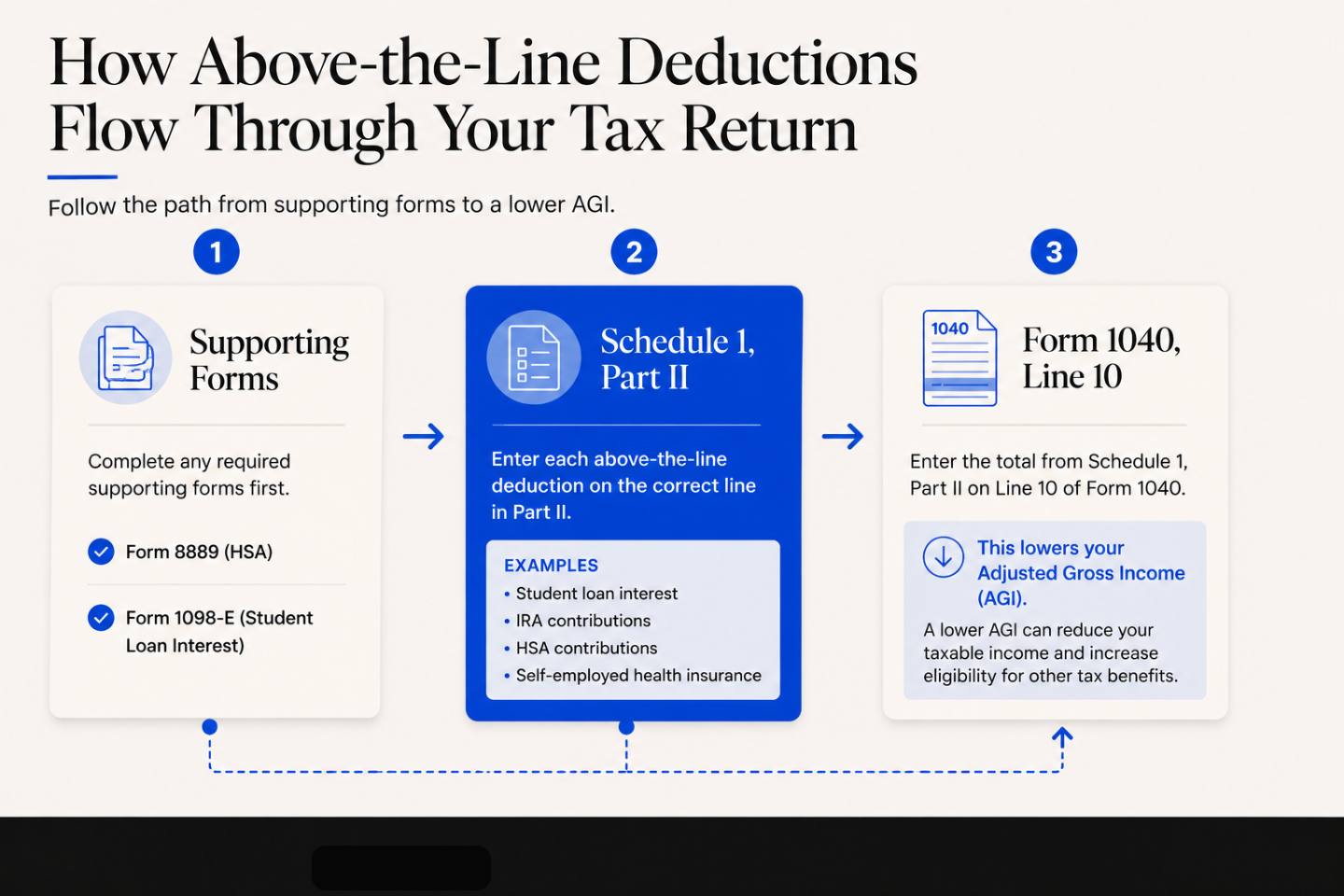
It comes down to six steps. Take them in order, and the numbers fall into place.
- Start with Form 1040, the main return where you report income and figure what you owe.
- Fill out any supporting forms first, like Form 8889 for HSA contributions, so your figures are ready to carry over.
- Go to Schedule 1 (Additional Income and Adjustments to Income). No Schedule A needed.
- Enter each deduction on its line in Part II of Schedule 1, such as student loan interest, IRA, and HSA contributions.
- Total your adjustments. That number flows to Line 10 of Form 1040 and lowers your AGI.
- Keep your paperwork, like Form 1098-E for student loan interest and Form 5498-SA for HSA contributions, in case you need to back it up.
This article is general information, not tax advice. Talk to a tax professional about your specific situation before you file.
Let Deduction Find These Tax Deductions for You
Above-the-line deductions are scattered across half a dozen forms, each with its own limit and eligibility test. The hard part is not any single one. It is knowing which apply to you and catching the ones you would otherwise miss.
That is where Deduction as tax deduction finder comes in. Here is how it works:
- Upload your documents.
- Deduction scans them and flags every deduction and credit you qualify for.
- A licensed CPA reviews the results and files your return for you.
Every deduction is found by AI and checked by a real CPA, so you get the speed of software with the confidence of a human expert before anything reaches the IRS.
Frequently Asked Questions about Above-the-Line Deductions
Here are some frequently asked questions about above-the-line deductions:
What Is the Meaning of Above-the-Line Deductions?
They are expenses you subtract from gross income to reach your AGI, named for sitting above the AGI line on Form 1040. You can claim them without itemizing, which is what makes them available to nearly every taxpayer.
What Is an Example of an Above-the-Line Deduction?
A traditional IRA contribution is the classic one. You can deduct up to $7,000 for 2025 and report it on Schedule 1 without itemizing. Student loan interest and HSA contributions are other common examples.
What Are Above and Below-the-Line Deductions?
Above-the-line deductions come off your income before AGI is set and are available whether or not you itemize. Below-the-line deductions are the itemized ones on Schedule A, which only help if their total beats your standard deduction.
How Do You Claim an Above-the-Line Deduction?
Report it in Part II of Schedule 1, on the line for that deduction. Total your adjustments, carry the sum to Line 10 of Form 1040, and hang on to your supporting documents. No Schedule A required.
What Are the Benefits of Above-the-Line Deductions?
The main win is a lower AGI, which cuts your taxable income and can widen your eligibility for other AGI-based tax breaks. And because you do not itemize, you keep your full standard deduction on top.
What Is the Maximum Above-the-Line Deduction?
There is no single cap, since each deduction has its own limit. A SEP-IRA can reach $70,000 for 2025, while student loan interest tops out at $2,500. Your total depends on which ones you qualify for.