
If you took out a personal loan to consolidate credit cards, cover a move, or pay for a wedding, you've watched the interest show up on every statement. It's natural to wonder whether personal loan interest is tax deductible, the way mortgage interest can be.
Usually it isn't, because the IRS looks at what you spent the money on, not what the loan is called. The same personal loan can produce interest you can't deduct if it paid for a vacation, and interest you may be able to deduct if it went into a business, a rental, or a taxable investment.
Below is when personal loan interest can qualify, plus 15 loans whose interest you may be able to deduct in 2026, where you claim each one, and the debts that don't qualify at all.
Loans With Tax-Deductible Interest at a Glance
Here's where each loan's interest goes on your return and the main limit that applies. The details for each one follow below.
When Is Personal Loan Interest Tax Deductible?
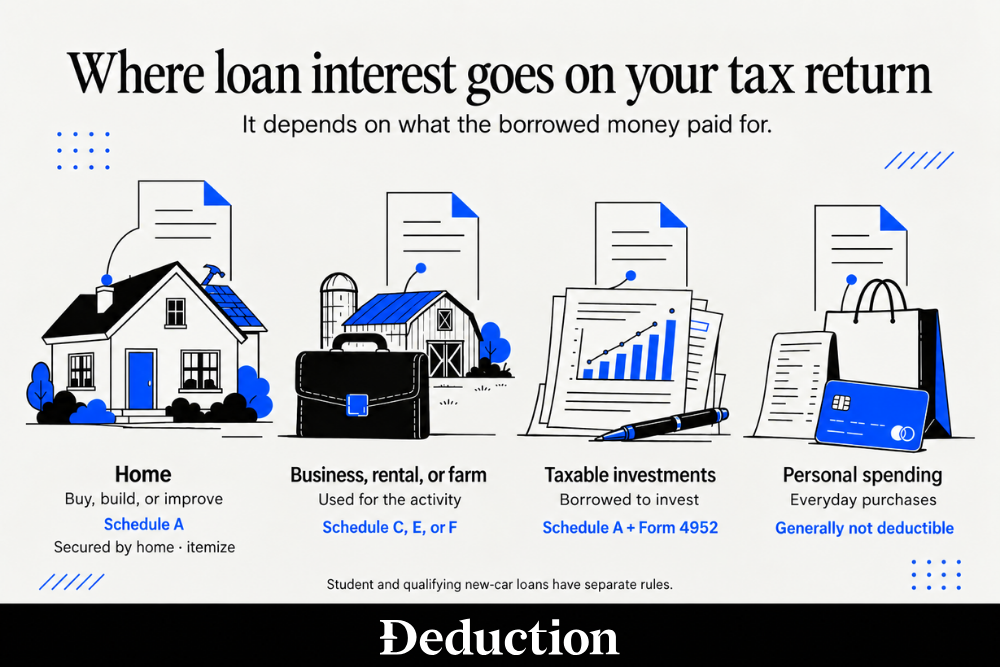
Personal loan interest is tax deductible only when the money goes into your business, a rental property, taxable investments, or, in some cases, college costs. Borrowing for a wedding, a vacation, or credit card payoff creates "personal interest," which you can't deduct.
What matters is what's being used with the money; any labels won't dictate any changes. The IRS follows the borrowed money wherever it ends up, and it treats the interest the same way.
Say you take out a $20,000 personal loan and use it to buy equipment for your side business. That interest can be a business expense. If you use it to buy stocks in a regular brokerage account instead, it can count as investment interest.
Similarly, a loan backed by your house can still produce interest you can't deduct if you use the money for a vacation.
The easiest way to protect yourself is to keep borrowed money separate. If a business loan lands in your personal checking account and mixes with your grocery money, it's much harder to show where it went. Deposit it into a business account and pay business expenses from there to keep a clear record
Household Loans With Deductible Interest
Mortgage and home equity interest can lower your tax bill only if you itemize. Student loan interest and interest on a qualifying new car loan can help even if you take the standard deduction. Here's the list of the types:
1. Mortgage on Your Main Home
If you have a mortgage on the home you live in, you can usually deduct the interest. The loan has to have been used to buy, build, or substantially improve that home, and the home has to secure the loan. Your main home can be a house, condo, co-op, mobile home, or even a boat, as long as it has a place to sleep, cook, and a bathroom.
How much of the loan counts depends on when you took it out:
2. Mortgage on a Second Home
If you also own a vacation home, you can deduct the mortgage interest on one second home. The $750,000 limit doesn't double, though. It covers your main home and your second home together.
If you rent the second home out part of the year, you have to use it yourself for more than 14 days, or more than 10% of the days it's rented at a fair price, whichever is longer. If you don't, the IRS treats it as a rental rather than a second home, and generally only the rental share of the interest is deductible (see number 13).
If you own more than one vacation property, only one can count as your second home in a given year.
3. Home Construction Loan
If you're building a home instead of buying one, interest on the construction loan can count as mortgage interest for up to 24 months while it's being built. The home has to become your main or second home once it's ready to live in, and the loan has to be secured by the property.
The construction loan counts toward the same $750,000 limit as mortgages on your main and second homes. You can treat the property as a qualified home for up to 24 months during construction. Interest paid outside that period before the home is ready generally isn’t deductible as home mortgage interest.
Once it’s ready to be your main or second home, the usual mortgage rules from number 1 apply.
4. Mortgage Refinance
Refinancing to a lower rate doesn’t cost you the deduction. Interest on the part of the new loan that replaces your old mortgage can still qualify. If you owed $300,000 and refinance into a new $300,000 loan, all of the new interest can qualify.
With a cash-out refinance, the interest depends on how you use the money. If you owed $300,000 and refinanced for $350,000, interest on the $300,000 that replaced your old mortgage can still qualify. Interest on the extra $50,000 can qualify too if you use it to buy, build, or substantially improve the home. Spend that extra money on a car, a vacation, or credit card bills, and the interest on that portion generally doesn’t qualify.
Mortgage points on a refinance usually can’t be deducted all at once. You spread them over the life of the loan, which works out to one-thirtieth for each full year on a 30-year mortgage. If you pay off the loan early or refinance with a different lender, you can generally deduct the remaining points that year.
5. Home Equity Loan or HELOC
Home equity interest is deductible only when the money goes into the home that backs the loan, meaning you used it to buy, build, or substantially improve that home.
Say you draw $50,000 from a home equity line of credit (HELOC), spend $30,000 on a new kitchen, and use $20,000 to pay off personal credit cards. Only the interest on the $30,000 can count, even though your house backs the whole line.
A "substantial" improvement adds value, makes the home last longer, or adapts it to a new use, such as a new roof or a garage extension. Routine upkeep like repainting doesn't count on its own.
The home equity debt also counts toward the $750,000 limit together with your mortgage. Save the receipts and contractor invoices for each draw. Your lender’s Form 1098 shows the interest you paid, but not what you spent the borrowed money on.
6. Reverse Mortgage
Reverse mortgage interest is generally not deductible. The IRS treats it as interest on home equity debt, so money used for living costs generally won’t qualify for the mortgage interest deduction
There's a narrow exception for the part of the loan that is used to buy, build, or substantially improve the home, or to pay off a mortgage that did. Even then, you can deduct the interest only in the year it's paid. With a reverse mortgage, that usually means when the loan is paid off, often when the home is sold.
If you're paying off a reverse mortgage, or handling one for a parent's estate, ask a tax professional how much of the built-up interest counts.
7. Student Loan
If you're paying off student loans, you can deduct up to $2,500 a year of the interest, even if you take the standard deduction. It's an above-the-line tax deduction claimed on Schedule 1, which lowers your AGI directly.
The loan must have been taken out only to pay qualifying higher education costs for you, your spouse, or someone who was your dependent at the time. Federal and private student loans can both qualify. Money borrowed from certain relatives or from your employer’s retirement plan doesn’t qualify.
The deduction shrinks as your income rises and disappears above these ranges of modified adjusted gross income (MAGI). For most people, MAGI is your AGI before you subtract the student loan interest.
You can’t claim the deduction if you’re married filing separately or if someone else claims you as a dependent. Your loan servicer sends you Form 1098-E if you paid $600 or more in interest.
8. New Car Loan (2025 to 2028)
If you finance a new car between 2025 and 2028, you may be able to deduct up to $10,000 a year of the loan interest through 2028, whether or not you itemize. It’s a new deduction from the One Big Beautiful Bill Act, and the car and the loan both have to meet these conditions:
- New, not used: You have to be the first person to take delivery of the car after it’s sold, titled, or registered. Used cars don’t qualify. A dealer loaner may qualify if the dealer didn’t title or register it and your loan treats it as new.
- Assembled in the US: The car’s final assembly has to take place in the United States.
- Right kind of vehicle: Cars, minivans, vans, SUVs, pickup trucks, and motorcycles can qualify if their gross vehicle weight rating is under 14,000 pounds.
- Right kind of loan: The loan has to start after December 31, 2024, and be secured by a first lien on the car. Loans from a close relative or a business you control don’t count, and neither do leases.
- Mostly personal driving: When you take out the loan, you have to expect that you, your spouse, or certain relatives such as a child, parent, or sibling will use the car for personal driving more than half the time. Some business driving is fine.
The deduction shrinks once your MAGI passes $100,000 ($200,000 for joint filers). You subtract $200 for every $1,000 over that line, or part of $1,000, from the interest you can deduct.
For example, if you’re single with MAGI of $120,000 and paid $7,000 in qualifying interest, the $4,000 phaseout leaves you with a $3,000 deduction. The deduction disappears entirely at MAGI of $150,000 for single filers or $250,000 for joint filers.
The $10,000 limit is per return, so a married couple filing jointly shares one limit. You claim it on Schedule 1-A and list the car's vehicle identification number (VIN). If you refinance a qualifying loan, the interest generally still counts, but only on what you still owed on the old loan.

Investment Loans With Deductible Interest
If you borrow money to invest, the interest can be deductible, but only if you itemize and only up to what your investments earned that year.
9. Margin Loan or Securities-Based Line of Credit
A margin loan is money your brokerage lends you against the investments already in your account. If you use it to buy more stocks, bonds, or funds in a regular taxable account, you can deduct the interest as investment interest if you itemize on Schedule A.
You can’t deduct more investment interest in a year than your net investment income. That generally includes taxable interest, dividends that aren’t “qualified” (your Form 1099-DIV shows which is which), and net short-term gains. If you paid more interest than you can deduct, the extra carries forward to the next year. You generally figure the deduction on Form 4952.
A securities-based line of credit (SBLOC) also lets you borrow against your investments, but you can’t use it to buy or trade securities. If you use the money for a renovation, a car, or living costs, the interest generally isn’t deductible.
The exception is when you use the money for something with its own deduction. If it pays for your business, rental, or farm, you may deduct the interest there. If it buys an investment the loan allows, such as land held for investment, the interest can count as investment interest.
Business and Rental Loans With Deductible Interest
If you borrow for a business, a rental, or a farm, the interest is usually a business cost that goes on the tax form for that activity. You don't need to itemize, and the $750,000 home limit doesn't apply.
10. Business Term Loan, SBA Loan, or Line of Credit
If you run a business or a side hustle and borrow for it, whether through a bank loan, an SBA loan, or a line of credit, you can generally deduct the interest. Sole proprietors and single-member LLCs report it in the interest section of Schedule C.
What you spend the money on decides how much counts. If you draw $40,000 on a business line of credit and use $10,000 of it for a family trip, only three-quarters of the interest is a business expense.
Very large businesses, those averaging more than $32 million a year in gross receipts over the past three years, face an extra business interest expense limitation for 2026. Most small businesses don't.
11. Business Credit Card
You can deduct interest on a credit card balance that comes from business purchases. The card doesn't have to say "business" on it, but using a separate card for business makes it much easier to show where the interest came from.
If you put business and personal charges on the same card, only the interest tied to the business charges counts, and you need a reasonable way to split it. Personal purchases stay personal, even on a card in your business's name.
12. Business Equipment or Vehicle Financing
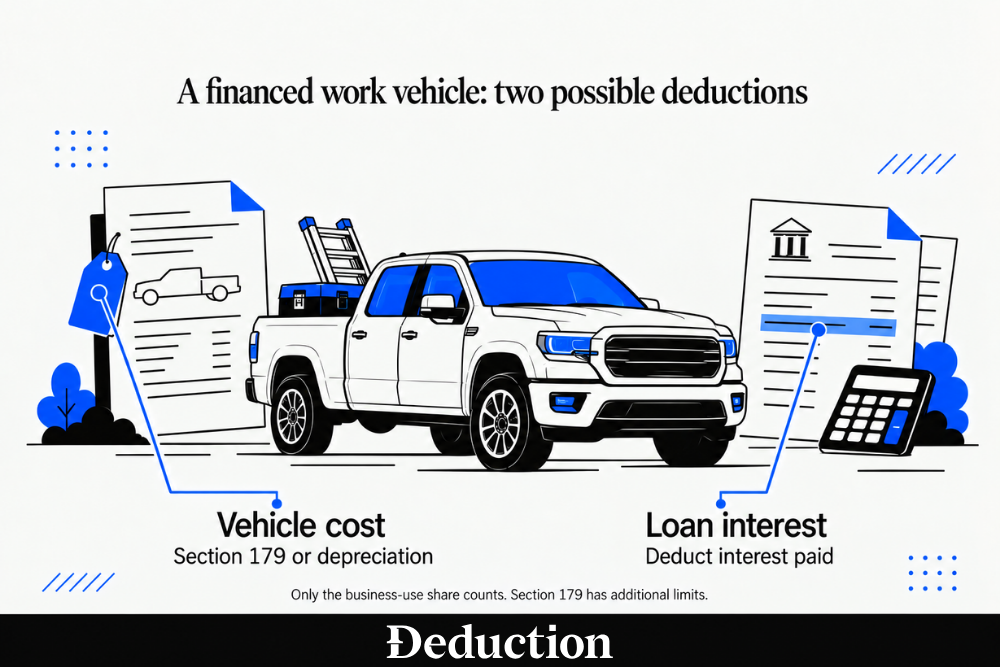
When you finance a work truck, a van, machinery, or computers for your business, you can deduct the interest as you pay it. The cost of the equipment itself is deducted separately, through depreciation or Section 179.
If you drive a vehicle for both work and personal trips, only the business share of the interest counts. If you're self-employed, you can deduct that share even if you use the standard mileage rate. Employees can't deduct car loan interest as a work expense.
A new car you also drive for work can qualify for the new car loan deduction, but only if you expected to use it for personal driving more than half the time when you took out the loan. If it qualifies, you can claim the interest on Schedule 1-A, subject to that deduction’s limits. If you’re self-employed, you can instead split it between Schedule C and Schedule 1-A. You just can’t deduct the same interest twice.
13. Rental Property Mortgage
If you own a rental, its mortgage interest is a rental expense you deduct on Schedule E. The $750,000 home limit doesn't apply, and you don't need to itemize.
The same goes for other borrowing that pays for the rental. If you use a HELOC on your own home to renovate a rental unit, the interest can generally go on Schedule E, since the money went into the rental.
If your rental costs, including interest, add up to more than the rent you collect, you may not be able to use all of that loss to lower the tax on your other income this year. It depends on your income and how involved you are in running the rental.
14. Farm Loan
If you farm, interest on farm loans, including mortgages on farmland and farm buildings, operating loans, and equipment financing, goes on Schedule F.
If the loan also financed the farmhouse you live in, the share of interest tied to your home generally goes on Schedule A if you itemize. Interest you pay ahead for a future year can’t be deducted until that year.
15. Loan to Buy Into a Business
If you borrow to buy a business, or a share of one, the interest can be deductible. Where it goes depends on what you bought:
- A business you run yourself: If you buy a business's assets and run it as a sole proprietor, the interest is a business expense on Schedule C.
- A share of a partnership or S corporation: The interest is generally split based on what the company owns. The part tied to its business goes on Schedule E, and the part tied to its investments counts as investment interest.
- Stock in a regular corporation: Interest on a loan to buy C corporation stock is generally investment interest, deductible on Schedule A if you itemize, up to your net investment income.
If you don’t materially participate in the partnership or S corporation’s business, the business part of the interest may be limited under the passive activity rules. Keep the loan papers and the company’s asset breakdown, because this split is hard to rebuild years later.
Loans With Interest You Can't Deduct
Here are common kinds of interest you generally can’t deduct:
- Personal credit cards: Interest on everyday purchases, travel, and other personal balances isn’t deductible.
- Personal loans for personal costs: Unsecured loans used for debt consolidation, a wedding, medical bills, or a vacation produce personal interest.
- Used car loans: The new car loan deduction covers only new vehicles. Interest on a used car you bought for personal use isn’t deductible.
- Other personal car loans: Loans taken out before 2025, loans on vehicles assembled outside the US, and lease payments don’t qualify either.
- Home equity debt used for personal costs: A HELOC or cash-out refinance spent on anything other than buying, building, or substantially improving the home securing the loan isn’t deductible as mortgage interest. If the money went to a personal car or credit card debt, the interest usually isn’t deductible at all.
- Loans to buy tax-exempt investments: You can’t deduct interest on money borrowed to buy tax-exempt securities, such as municipal bonds.
- Life insurance policy loans: Interest on a loan against your policy is generally personal interest when you spend the money on personal costs.
- Unpaid income tax: Interest the IRS charges individuals on late income tax is personal interest, even if the tax came from business income.
Do You Need to Itemize to Deduct Loan Interest?
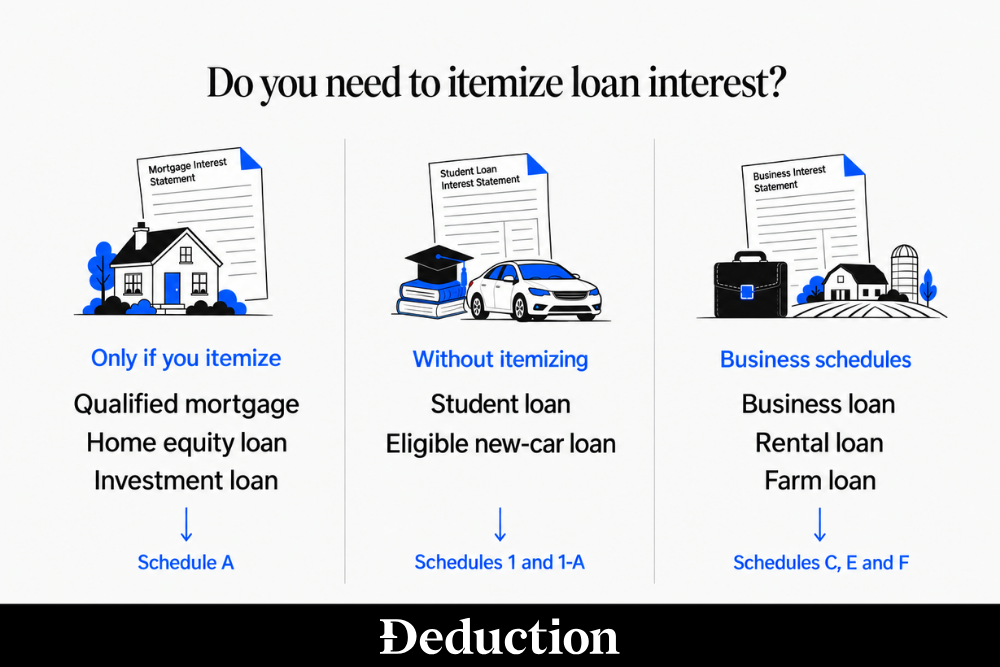
It depends on the loan. Loan interest falls into three groups:
- Itemize on Schedule A: Mortgage, second home, construction, refinance, home equity, and investment interest only help if your itemized deductions add up to more than your standard deduction.
- No itemizing needed: Student loan interest on Schedule 1 and new car loan interest on Schedule 1-A come off whether you itemize or not.
- Business schedules: Business, rental, and farm interest go on Schedule C, E, or F. They reduce the income from that activity and don't depend on whether you itemize.
For 2026, the standard deduction is $16,100 for single filers and $32,200 for married couples filing jointly. Mortgage interest alone often falls short of that, especially several years into a loan when more of each payment goes to principal.
Itemizing usually pays off when mortgage interest combines with the SALT deduction and charitable gifts. If your total stays below the standard deduction, your mortgage interest doesn't lower your tax at all.
This article is general information, not tax advice. Rules depend on your facts, so check with a CPA or tax professional before claiming any of these deductions.
Find Every Deductible Interest Payment With Deduction
Every lender sends you a form with a number on it: Form 1098 from the mortgage company, Form 1098-E from the student loan servicer, a year-end statement from the brokerage. None of them tells you how much of that interest you can deduct.
That depends on what each dollar paid for. The HELOC draw that went to a new roof counts, and the one that cleared a credit card doesn't. The business line of credit you tapped for a family trip is only partly deductible.
Deduction's AI tax agent, Taylor, goes through each of your loans with you, including what the money was paid for, and a licensed tax professional reviews the return before it's filed. It works in three steps:
- Upload your loan documents: Add Forms 1098 and 1098-E and your loan and brokerage statements to your Vault, forward emails, or let Taylor pull them in.
- Taylor sorts the interest: It works out which schedule each loan's interest belongs on, asks about loans where the money went to more than one use, and checks the limits that apply to you.
- A CPA reviews and files: A licensed tax professional checks every number and form before anything goes to the IRS.
You can ask Taylor questions and upload documents for free all year. You pay only when you're ready to file or need a licensed professional to review a high-impact decision, and the Personal plan is $499 a year for federal and state filing.
Frequently Asked Questions About Loan Interest Deductions
What Interest Is Tax Deductible?
Interest on mortgages and qualifying home equity debt, student loans, new US-assembled car loans (2025 to 2028), investment loans, and loans used for a business, rental, or farm can be deductible. Each has its own limits. Interest on money borrowed for personal spending, such as credit cards and most personal loans, generally isn't.
Can You Still Deduct Mortgage Interest in 2026?
Yes. You can deduct interest on up to $750,000 of mortgage debt on your main and second home ($375,000 if married filing separately), and the One Big Beautiful Bill Act made that limit permanent. Loans taken out before December 16, 2017, keep the $1 million limit. You have to itemize to claim it.
Can I Deduct $10,000 of Car Loan Interest on My Taxes?
Only if you paid that much interest on a qualifying loan and your income is low enough. The $10,000 is a yearly cap for 2025 through 2028 on loans for new, US-assembled vehicles bought for personal use. It shrinks once MAGI passes $100,000 ($200,000 joint) and is gone by $150,000 ($250,000 joint).
Can I Deduct Student Loan Interest If I Earn Over $100,000?
Not if you're single and your MAGI is $100,000 or more, since the 2026 phase-out for single filers runs from $85,000 to $100,000. Married couples filing jointly can claim the full $2,500 below $175,000 of MAGI and part of it up to $205,000.
Is HELOC Interest Tax Deductible?
Only if you use the money to buy, build, or substantially improve the home that secures the HELOC, and only if you itemize. The HELOC counts toward the $750,000 mortgage cap. HELOC money spent on a car, a vacation, or credit card debt doesn't qualify, even though your home backs the loan.
Is Loan Interest Tax Deductible for Businesses?
Generally, yes. Interest on money you borrow and use in your business is a deductible business expense, reported on Schedule C if you're a sole proprietor. An extra cap mainly applies to businesses averaging more than $32 million a year in gross receipts (2026). Interest on business-loan money you spend personally isn't deductible.