
Tax deductions for S corp owners are split across two returns: your company’s and your own. Some come off the business income before anything reaches you, while others go through your personal return.
That split is where deductions go missing. A cost you paid out of your own pocket that belonged on the company books, or a company expense that only counts once it reaches your W-2, never shows up as an error. It just sits in the tax you paid.
Here are 19 deductions, grouped by which return they belong to, with the 2026 figures and the form each one lands on.
Operating Expenses
These are your S corp’s ordinary running costs, and they come off business income before anything passes through to you:
1. Owner’s Reasonable Salary
What your S corp pays you in W-2 wages is deductible by the company. The IRS requires an S corp to pay reasonable compensation for services before non-wage distributions, and it can reclassify distributions as wages when the salary is too low.
A bigger salary does not cut your total tax. It moves money out of a category that skips payroll tax into one that does not. What makes the deduction matter is that distributions are not deductible at all.
There is no safe harbor and no 60/40 rule. The IRS weighs your duties, your hours, your training, what your S corp pays other employees, and what comparable businesses pay for the same work.
2. Employee Wages, Payroll Taxes, and Bonuses
Everything your S corp pays its team is deductible: wages, commissions, overtime, and bonuses. The standard is a reasonable allowance for services performed.
The employer half of Social Security, Medicare, and federal unemployment tax is deductible too. On the cash method, you deduct a bonus when you pay it.
On the accrual method, a bonus to a regular employee can be accrued in December if the amount is fixed and unconditional by December 31 and the employee receives it within two and a half months. Your own bonus has to be paid, not accrued.
3. Health Insurance for More-Than-2% Shareholders
Your own health insurance is deductible if you run it through the right framework. Your S corp pays or reimburses the premiums, deducts them as wages, and reports the amount in Box 1 of your W-2 rather than Boxes 3 and 5.
The plan has to be established by the S corporation. Buy a policy yourself, pay for it yourself, and put nothing on the W-2, and nobody gets a deduction.
You then claim the same amount as an above the line tax deduction, figured on Form 7206 and carried to Schedule 1 of your Form 1040, so you do not have to itemize.
4. Health and Life Insurance for Non-Owner Employees
Premiums your S corp pays for your employees’ accident and health coverage are deductible by the company and excluded from those employees’ wages. It is the cleanest benefit deduction available to you.
Family is the exception. Your spouse, children, and parents count as owning your shares, though a grandchild does not. That makes them more-than-2% shareholders too, so they go through Deduction 3 with you.
Group-term life insurance works up to a ceiling. Your S corp deducts the premiums, and the employee excludes the cost of the first $50,000 of coverage, with the cost above that added to their wages.
And if your company is a beneficiary of a policy, directly or indirectly, the premiums are not deductible at all.
5. Retirement Plan Contributions
Contributions your S corp makes to a retirement plan are deductible, and for most profitable S corps this is the largest deduction on the return.
For 2026, you can defer $24,500 of your salary into a 401(k), plus $8,000 more at 50 and over or $11,250 between 60 and 63, and company contributions stack on top up to a combined $72,000 per person.
The catch-up sits outside that ceiling, so your real total is $80,000 at 50 and over and $83,250 between 60 and 63. The solo 401(k) employer contribution is capped at 25% of your W-2 wages, and distributions do not count.
Company contributions are deductible for a tax year if the money reaches the plan by your return due date, including extensions. Your own salary deferral has to be elected by December 31, though you can fund it later.
And if your 2025 W-2 wages from the company were above $150,000, your 2026 catch-up has to go in as Roth money, and Roth contributions are not deductible.
6. Independent Contractor and Freelance Payments
Payments your S corp makes to contractors, freelancers, designers, and agencies are deductible in full, with no payroll tax on top.
For 2026, the reporting threshold changed. You file a Form 1099-NEC for anyone you paid at least $2,000 for services, up from $600 through 2025, and it goes to the contractor and the IRS by January 31.
The risk here is classification of the service provider. If someone works set hours under your direction with your tools, the IRS may treat them as your employee, and your S corp would owe payroll tax plus penalties.
7. Training and Education
Education your S corp pays for is deductible when it maintains or improves the skills your business already requires, or when a rule requires it to keep your license current.
Two kinds do not qualify, however useful they are: study that meets the minimum requirements to enter your field, and study that qualifies you for a new trade or business.
A written educational assistance program is the second route. Your S corp can pay up to $5,250 per employee per year tax-free, and that money does not have to relate to the job at all.
Student loan principal and interest count toward the same $5,250 instead of adding to it. But if you are the only person on the payroll, no more than 5% of a program’s annual payout can go to owners, so it will not work for you.
8. Professional Services
Accounting, bookkeeping, payroll processing, legal work, and business consulting are deductible by your S corp. So is the fee for preparing Form 1120-S, the return your company files each year.
The fee for your personal Form 1040 is not. It was a miscellaneous itemized deduction, and those have now been repealed permanently, so ask your preparer to bill the two jobs separately.
Legal fees have one exception. Fees paid to acquire a property, or to defend or perfect title to it, are not current expenses. They get added to the cost of the asset and recovered through depreciation or on sale.
Home Office
The home office deduction works differently for an S corp than for a sole proprietor.. There is no home office line on your company return and no Form 8829 for you to file.
9. Home Office Costs Reimbursed Through an Accountable Plan
In an S Corp setting, you are an employee of your own corporation, and employees cannot deduct home office costs on their own return. The route that works is a reimbursement.
Your S corp adopts an accountable plan. You submit your workspace costs with the date, amount, and business purpose; you return anything advanced beyond what you spent, and the company pays you back and deducts it.

The amount is a share of what you already pay for the home office. This involves the workspace square footage over the home’s square footage, then applying that percentage to rent or mortgage interest, utilities, insurance, and whole-house repairs.
The space has to be used regularly and only for business, and it has to be your main place of business, a place where you regularly meet clients, or a separate structure not attached to the house.
Because you are an employee of your own company, the use also has to be for the employer’s convenience rather than your own preference. And do not rent the space to your own S corp: Section 280A(c)(6) kills the offsetting expenses, so you keep the taxable rent and lose the deduction.
Vehicle and Travel
Travel is where recordkeeping decides everything. The rules are generous, and almost every disallowed travel deduction fails on evidence rather than on principle.
10. Vehicle Costs
In 2026, the business mileage rate changed in the middle of the year. It is 72.5 cents a mile from January 1 through June 30, and 76 cents from July 1 through December 31.
So a full-year log has to be split at July 1. Drive 6,000 business miles in the first half and 5,000 in the second, and the deduction is $4,350 plus $3,800, or $8,150. All figures here are estimates for illustration.
The alternative method for deduction is tracking each cost. These are fuel or charging, car insurance, maintenance, repairs, registration, tires, parking, tolls, and depreciation, all multiplied by your business use percentage.
Commuting between home and your regular workplace does not count since only business purposes are recognized.
Only one method is applicable for every vehicle.
You have to use the per-mile rate in the first year a car you own is available for business if you ever want it, claiming Section 179 or bonus depreciation rules it out for good, and a leased car keeps one method for the whole lease.
Who owns the car changes the mechanics. If it is yours, your S corp reimburses you under the accountable plan from Deduction 9. If your company owns it, the company deducts the costs and reports your personal use as wages.
Depreciation on an ordinary car is capped at $20,300 in the first year with bonus depreciation and $12,300 without it. An SUV rated above 6,000 pounds and not more than 14,000 pounds is capped at $32,000 of Section 179.
11. Travel Away From Home
Travel is deductible when work keeps you away from your tax home overnight, or long enough that you need sleep or rest. Your "tax home" is the general area where you normally work, which is not always where you live.
Airfare, train and bus fares, rental cars, rideshares, baggage fees, lodging, laundry on the trip, and tips all come through. Meals are subject to the 50% limit below.
But there are two things that make travel not deductible. A work assignment expected to last more than a year is indefinite, and travel for it is not deductible at all. On a personal trip, the cost of getting there is not deductible either.
If tracking receipts is troublesome, the high-low per diem method allows $319 a day in a high-cost locality and $225 elsewhere through September 30, 2026. But if you own more than 10% of the stock, your S corp cannot use it to reimburse you, so keep the hotel receipts.
12. Business Meals
A business meal is 50% deductible, and there are four conditions:
- It has to be an ordinary business expense.
- It cannot be extravagant.
- You or an employee has to be present.
- The food has to go to you or a business associate, meaning a client, customer, supplier, employee, agent, partner, or adviser.
So a meal you eat alone on a business trip still counts. Entertainment does not: tickets, rounds of golf, and box seats are not deductible in any amount.
New for 2026. Your S corp can no longer deduct meals it provides to its own staff through a company canteen facility, or meals provided for the employer’s convenience.
That was a scheduled change written into the 2017 tax law, and it took effect for amounts paid after 2025. A staff holiday party is still 100% deductible when it is primarily for rank-and-file staff rather than highly compensated ones, meaning anyone who owns more than 5% or was paid over $160,000 last year.

Capital Assets
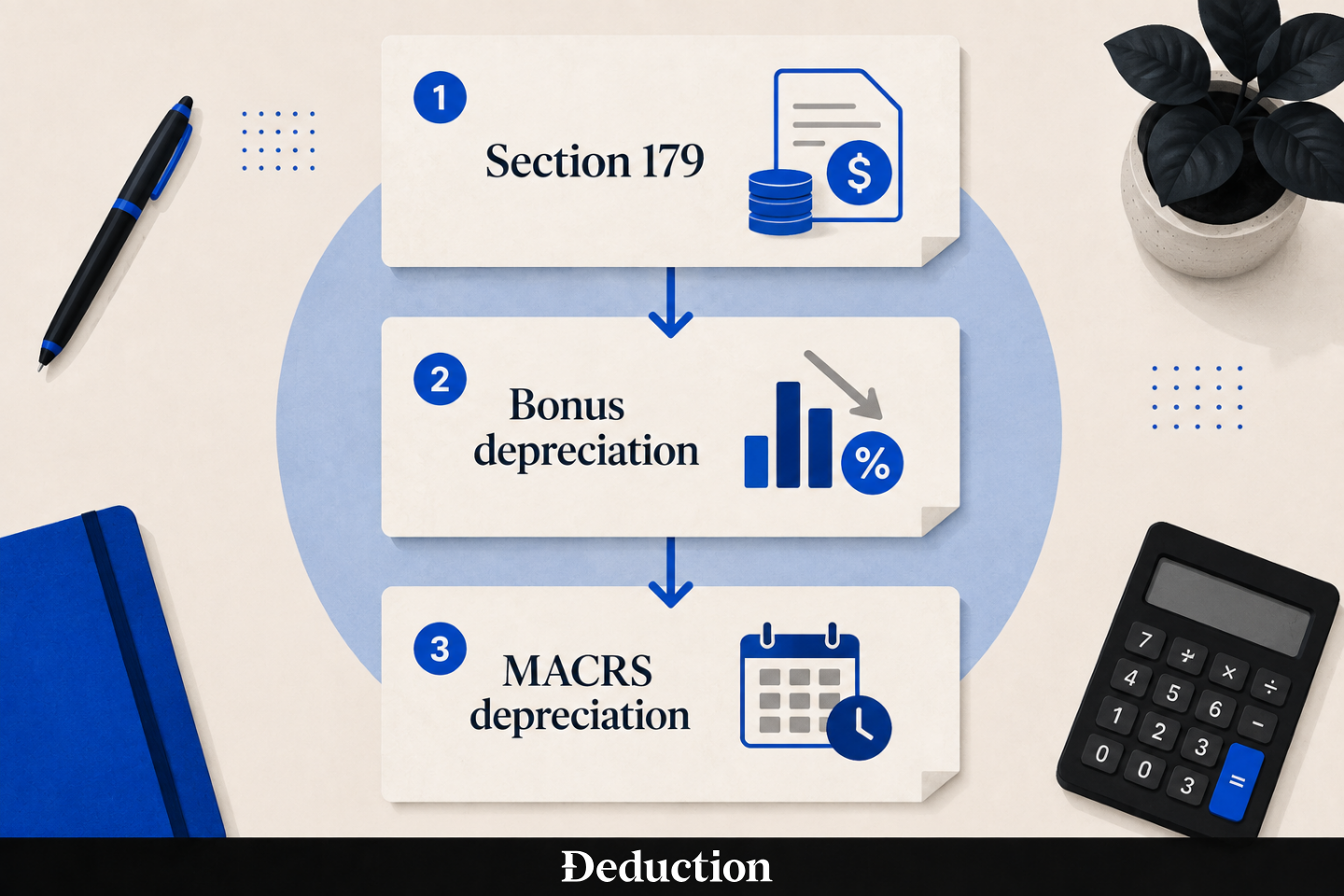
When your S corp buys something that lasts more than a year, you generally cannot deduct it all as an expense. You recover the cost through one of three routes, and they apply in a fixed order.
13. Depreciation
Depreciation spreads an asset’s cost across the years your S corp uses it. Most business property runs on a system called MACRS, which assigns each type of asset a recovery period.
The depreciation schedule for computers, office machinery, and cars generally runs five years, and office furniture seven. It all goes on Form 4562, titled Depreciation and Amortization, filed with your 1120-S.
Who owns the asset decides how mixed use is handled. If you own it personally and your company reimburses you, only the business share is deductible. If your S corp owns it, the company depreciates the cost.
14. Section 179 Expensing
Section 179 lets your S corp deduct the full cost of qualifying equipment in the year it goes into service instead of spreading it out. For 2026, the limit is $2,560,000, phasing down once purchases pass $4,090,000.
Almost no small S corp reaches those ceilings. The limit that bites is that the deduction cannot exceed income from actively conducting the business, and for an S corp that test applies twice.
It applies once at the company, and again on each shareholder’s own return. Anything blocked becomes a Section 179 carryforward to the next year.
Property used 50% or less for business does not qualify at all, and above that line you only get Section 179 on the business share, so a $4,000 laptop used 70% for the company gives you $2,800.
Vehicles carry their own weight-based caps, so check which vehicles qualify for Section 179 before your company buys one.
15. Bonus Depreciation
Bonus depreciation is the other fast write-off, and right now it is the more generous of the two. It is 100% and permanent for property acquired after January 19, 2025, with no dollar cap and no business income limit.
If your S corp contracted to buy a property before January 20, 2025, it sits under the old phase-down schedule and gets 20% if it is in service during 2026.
You do not elect into bonus depreciation. You get it automatically and have to elect out, class of property by class of property, on a timely filed return.
First Year Startup Costs
Money you spend before your S corp opens its doors is not immediately deductible as a business expense. There is a specific allowance for it, and it only appears in one year.
16. Startup and Organizational Costs
Your company can deduct up to $5,000 of startup costs in the year the business becomes active, plus a separate $5,000 for setting the company up, such as incorporation and state filing fees.
Startup costs are the getting-ready expenses: market research, travel to look at locations or suppliers, advertising before opening, and training staff before the first sale. Anything above the caps is amortized over 180 months.
Each $5,000 shrinks dollar for dollar once that category of spending passes $50,000. At $53,000 of startup costs, you deduct $2,000 now, and at $55,000 or more, you deduct nothing now.
Pass-Through Deduction
The last three are personal rather than your company’s. They show up on your Form 1040, and your S corp’s job is to report the numbers you need on your Schedule K-1.
17. The Qualified Business Income Deduction
The qualified business income deduction lets you deduct up to 20% of the profit that passes through from your S corp. It is permanent now and does not require itemizing.
Yes, it applies to you: the ordinary business income on your Schedule K-1 is what it is measured against. The deduction is also capped at 20% of your taxable income after net capital gain comes out.
One exclusion matters for S corp owners. The W-2 wages your company pays you do not count as qualified business income, so a higher salary is deductible by the company and shrinks the profit your 20% is calculated on.
Below $201,750 of taxable income filing single, or $403,500 filing jointly, that trade-off is the only complication, since the type of business does not matter down there.
Above those figures, limits phase in over the next $75,000 of income for single filers and $150,000 for joint filers, and the deduction starts depending on the wages your company paid and the property it owns.
Specified service trades or businesses get nothing above the top of that range: health, law, accounting, actuarial science, performing arts, consulting, athletics, financial services, brokerage, and trading.
Engineering and architecture are not on that list. With at least $1,000 of active qualified business income, you get a minimum deduction of $400, figured on Form 8995 or Form 8995-A.
18. Interest on Shareholder Loans
Lending money to your own S corp does not create a deduction, and neither does the company repaying you, since a repayment is a return of capital.
The only thing that's deductible is the interest. Your company deducts it, and you report it as interest income, so the loan needs the paperwork of a real loan: a written note, a rate, and a repayment schedule.
19. Charitable Contributions
Charitable contributions your S corporation makes are not deducted on the company return. They are reported separately on your Schedule K-1, and you claim your share on your own Schedule A.
So that route only works if you itemize. If you do, you can only deduct contributions above 0.5% of your adjusted gross income, new for 2026, and the amount below that floor is lost.
On $300,000 of adjusted gross income, the floor is $1,500, so a modest amount passed through on a K-1 may now produce no deduction at all.
There is also a new deduction of up to $1,000, or $2,000 on a joint return, for cash gifts by people who do not itemize. Whether a pass-through amount from your S corp qualifies is not something the IRS has addressed.
How Are S Corporations Taxed?
An S corp is a pass-through. Your company files a return but generally pays no federal income tax itself. Income, losses, deductions, and credits pass through to the shareholders, who pay tax at their own rates.
Three filing schedules run at once. The first and third belong to your company, and the middle one is yours:
- The company return. Form 1120-S plus a Schedule K-1 for each shareholder, due the fifteenth day of the third month after year end, so March 15 for a calendar-year company.
- Your estimated payments. For 2026 they fall on April 15, June 15, September 15, and January 15, 2027.
- Payroll. Form 941 each quarter, covering the income tax withheld from your salary plus both halves of Social Security and Medicare, then Form 940 and your W-2 by January 31.
Your K-1 numbers go onto your Form 1040 whether or not the company distributed any cash to you. A profitable year can produce a tax bill on money you never received.
Distributions reach you with no withholding, so the tax on your share of the profit is yours to pay. Hitting the safe harbor for estimated taxes is what keeps an underpayment penalty off your return.
The payroll tax split is the reason most owners elect S corp status in the first place. Your salary is subject to Social Security and Medicare tax, and the profit distributed to you on top of that salary is not.
Roadblocks When Finding Tax Deductions for S Corp Owners
These deductions are not usually lost because an owner did not know about them. They are lost because the records cannot support them.
- No proper accounting records: Without dated records showing the amount, place, and business purpose, a deduction fails on evidence even when it was a real business cost. Travel, meals, and vehicle use are held to a stricter standard.
- Mixed books and personal accounts: Paying for groceries from the business account turns every deduction on the return into an argument. Open a separate business checking account before anything else.
- Undocumented shareholder loans: Money moving between you and your company without a note, a rate, or a schedule invites the IRS to call it wages or a taxable distribution.
- Health insurance handled the wrong way: Premiums for a more-than-2% shareholder that never reach the W-2 produce no deduction for anyone. It is usually fixable before year end.
- A salary set below market: An artificially low salary is the most examined item on an S corp return. It also quietly caps the retirement contribution in Deduction 5.
Best Tax Filing Software and Service for S Corps
These six get grouped in search results, and they are not solving the same problem. The dividing line that matters to you is whether the product files an entity return for your company or only handles your personal one.
- Deduction: An AI tax prep software whose work is reviewed by licensed CPAs, with year-round questions included instead of billed by the hour. It is built for individuals and solo businesses, at $499 a year for a personal return and $999 for a single-owner S corp.
- FlyFin: An AI deduction tracker with CPA-prepared filing, sold as a subscription instead of per return. Both published plans say they cover filing for all entities including S corps, at $16 a month for the standard tier and $29 for premium.
- Everlance: A GPS mileage tracker before it is anything else, and the best fit here for the vehicle records behind Deduction 10. It does not file an entity return, and the filing on its top plan at $119.99 a year is individual only.
- Keeper: Expense tracking with filing reviewed by an assigned tax professional, at $199 and $399 for its two personal plans. Neither tier includes an S corp return. The business plan at $1,199 a year bundles one.
- Bloomberg Tax: Professional research and workflow software for tax departments, law firms, and advisors. It publishes no pricing and files nothing, so it suits your accountant instead of you.
- 1-800Accountant: A virtual accounting firm rather than software, pairing a dedicated accountant with bookkeeping and payroll. Its Starter plan at $299 a month billed annually includes one entity return such as an 1120-S.
Let Deduction Find Every Tax Deduction for Your S Corporation
You can have a payroll service running, a bookkeeper reconciling every month, and a folder of receipts sorted by category, and still not know whether the salary you set in January will hold up.
No amount of searching answers it, because the answer depends on your hours, your role, and what your industry pays for that work. Here is how Deduction’s tax deduction tracker works:
- Upload your documents: Statements, W-2s, K-1s, and receipts go into one place, and you can forward them in rather than filling out forms.
- The AI finds the deductions: It reviews the year against current rules and surfaces what applies to your situation, including the ones owners routinely miss.
- A real CPA reviews and files: A licensed CPA checks the work before anything is filed, and you can ask questions all year rather than only in March.
Frequently Asked Questions About S Corp Tax Deductions
Here are frequently asked questions about tax deductions for S Corp owners
What are the best tax deductions for S corp businesses?
The largest are usually retirement plan contributions, capital equipment written off through Section 179 or bonus depreciation, and the qualified business income deduction. Health insurance for a more-than-2% shareholder and a reimbursed home office are most often left on the table.
What are the 10 most overlooked tax deductions?
For S corp owners: home office reimbursement, shareholder health insurance, retirement contributions, business mileage, professional fees, training, startup costs, qualified business income, interest on shareholder loans, and the employer share of payroll tax.
What are common S corp mistakes to avoid?
Setting your salary below market, mixing personal and business accounts, moving money in and out as undocumented loans, and paying shareholder health premiums without putting them on your W-2. Each one either creates audit exposure or destroys a deduction.
What expenses can I run through my S corp?
Ordinary and necessary business costs: wages, benefits, rent, supplies, software, professional fees, business travel, and equipment. Personal costs do not qualify, and running them through the company puts every other deduction in question.
How to avoid taxes with S corp?
You cannot avoid tax, and the framing is worth dropping. What an S corp does is reduce Social Security and Medicare tax on the profit above a reasonable salary. Beyond that, the tax you save comes from claiming real deductions you can document.
What is the downside of being an S corp?
Cost and scrutiny. You take on payroll filings, a separate company return, and higher preparation fees. At lower profit those can outweigh the savings. You also inherit the reasonable compensation judgment.
Why is S corp better than LLC for taxes?
It often is not. An S corp election can save payroll tax once profit comfortably exceeds a reasonable salary, but below that the added payroll and filing costs usually exceed the saving.
This article is general information, not tax advice. Tax rules change and how they apply depends on your specific facts. Check your situation with a CPA before acting on anything here, and confirm current software pricing with the vendor.