
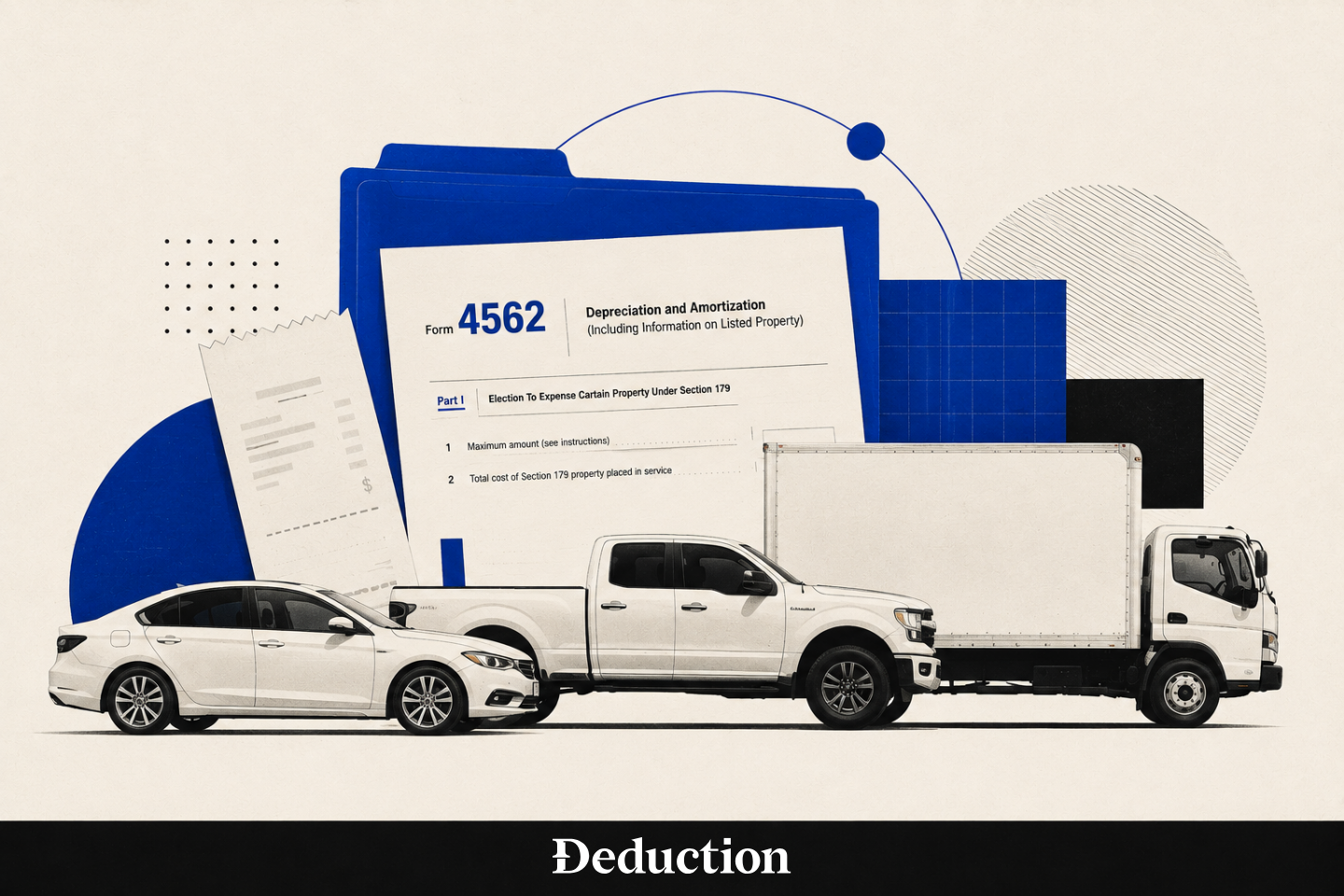
You have a car, you have a business, and somewhere online you have seen someone write off an SUV against their taxes. It is real; you can drive it around flex but not all the time, literally. Section 179 lets a business deduct the cost of a vehicle in the year it puts that vehicle to work, and on the right vehicle that runs into tens of thousands of dollars.
The thing is that the vehicles qualifying for the Section 179 deduction are a narrower group than people suggest. We work with people who bought a car expecting a full write-off and learned at filing time that it was the wrong weight, or they did not drive it enough for the business, or they leased it.
So here are the vehicles that qualify, the 2026 caps, and how to claim it.
Key Takeaways
- Most personal cars get very little. At 6,000 pounds or less, your 2026 first-year write-off stops at $12,300, or $20,300 if bonus depreciation applies.
- The deduction gets large above 6,000 pounds. SUVs in that range have a $32,000 Section 179 ceiling, and bonus depreciation can cover the rest of the cost.
- Work vehicles over 14,000 pounds, and things like dump trucks and cement mixers, have no vehicle-specific cap at all.
- Business use has to be more than half your miles, and you deduct only that share of the cost.
What Is the Section 179 Tax Deduction for Vehicles Used for Business?
Section 179 lets a business deduct the cost of a qualifying vehicle in the year it is put to work, instead of spreading that deduction across several years.
Normally you have to "depreciate" a vehicle, which means claiming a piece of the cost each year over a five-year MACRS recovery period. Section 179 collapses that into one year, so your taxable income drops while you are still feeling the purchase.
Timing is stricter than people expect. The vehicle has to be placed in service during the tax year you claim it, and placed in service means ready and available for business use, not just paid for.
A truck you buy in December and take delivery of in January is next year's deduction.
Qualifying Characteristics for a Vehicle Under Section 179
Before weight comes into it, the purchase has to clear four tests:
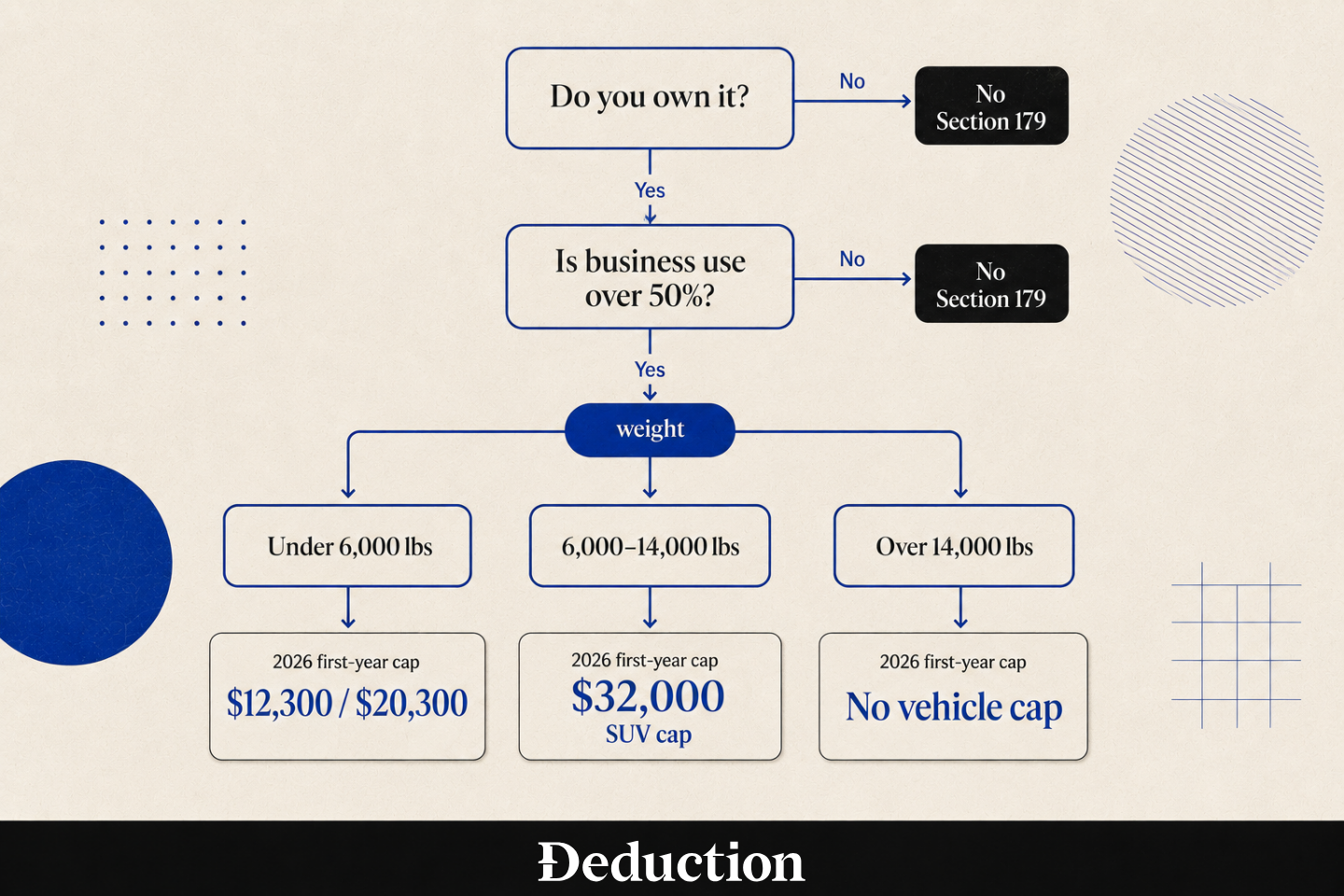
- You have to own it. Bought outright or financed, new or used, all fine. Leases are not allowed. That also rules out a vehicle you were given or inherited, or one you bought from your spouse, a parent or grandparent, a child or grandchild, or a business you control.
- Business use has to be more than 50%. This is where the "solely for business" line people repeat online is wrong in both directions. You do not need 100%, but you do need more than half, measured in miles.
- You only deduct the business share. A $60,000 truck used 70% for business gives you $42,000 to work with, not $60,000.
- You need records. Most vehicles are "listed property," an IRS category for things that slide easily into personal use, and it carries a higher documentation standard. Mileage logs, job addresses, delivery records.
You do not need an LLC for any of this. A sole proprietor filing Schedule C can claim Section 179 on a vehicle used in that business.
If you do run a corporation, keep the paperwork straight: the entity claiming the deduction has to be the one that bought the vehicle.
Vehicles Qualified for Section 179 Tax Deductions
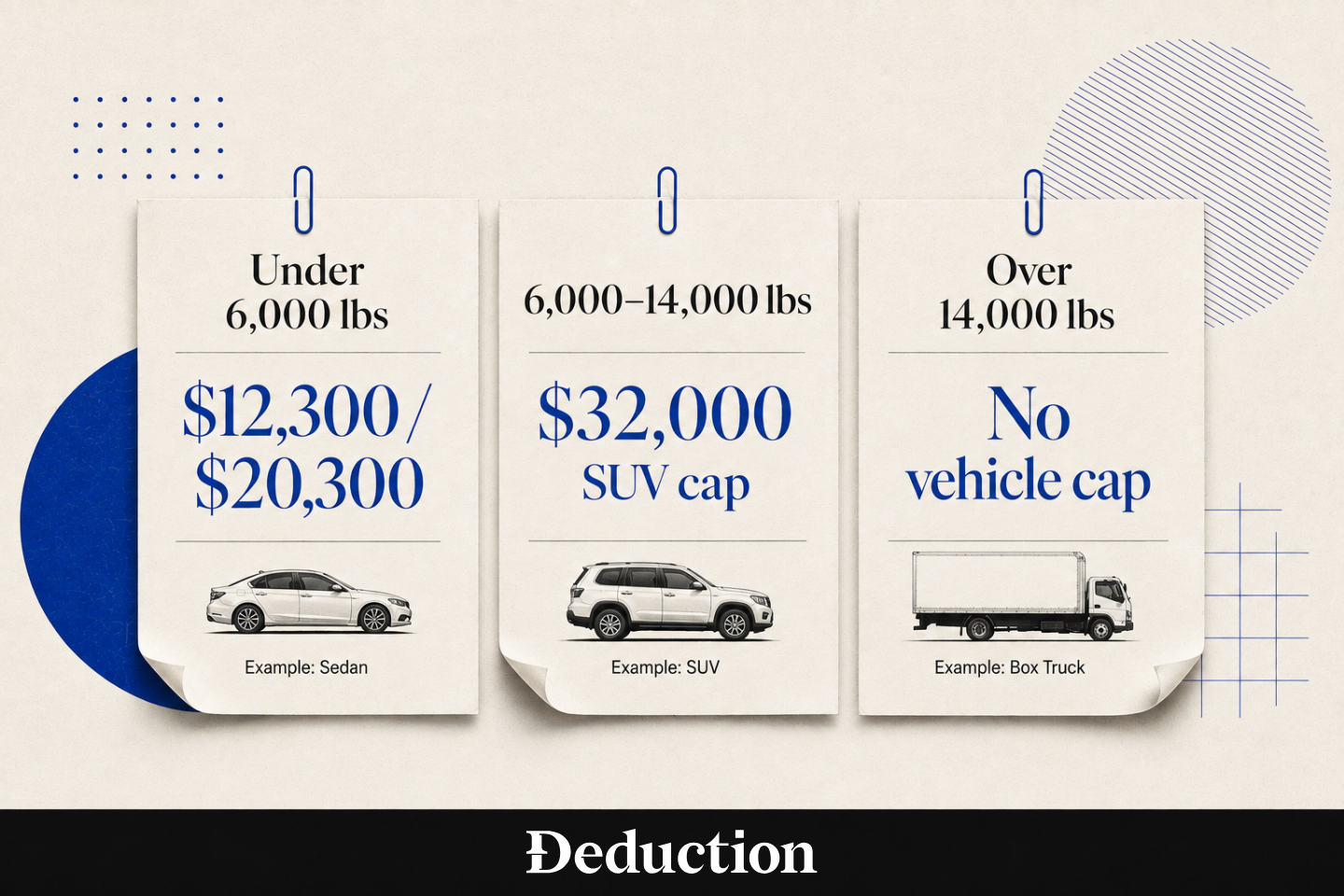
Three weight classes decide how much you get in year one, and weight is what sorts you into them. For a truck, van, or SUV that number is the gross vehicle weight rating, or GVWR, the manufacturer's maximum loaded weight, printed on a sticker inside the driver's door frame.
For a car, it is the unloaded weight instead, which runs well below the GVWR on that same sticker.
Go and find what's on your vehicle’s sticker before you read on. It settles most of what follows.
Light Vehicles: 6,000 Pounds and Under
Most personal cars land here, and it is where the write-off is smallest. A four-wheeled vehicle built for the road that comes in at 6,000 pounds or less is a "passenger automobile" in the tax code, and passenger automobiles have their own annual ceiling that Section 179 cannot get you past.
For one placed in service in 2026, the most you can write off in the first year is $12,300, or $20,300 if bonus depreciation applies to it.
That figure covers Section 179 and depreciation together, and it gets prorated by your business-use percentage.
Ambulances, hearses, and for-hire transport vehicles used directly in a business sit outside these rules, and so do the work trucks and vans covered further down.
Heavy Vehicles: Over 6,000 Up to 14,000 Pounds GVWR
Above 6,000 pounds GVWR, a truck or SUV stops being a passenger automobile, and that ceiling disappears. This is the tier the online advice is talking about.
A cap still applies, and it is a far higher one. For a sport utility vehicle placed in service in a tax year beginning in 2026, Section 179 stops at $32,000.
Whatever the vehicle costs above $32,000 is not lost, because bonus depreciation is back at 100% for property acquired after January 19, 2025. You take $32,000 under Section 179 and write off the remaining business-use cost with bonus in the same year.
Three vehicle types skip the $32,000 cap at this weight and get the full Section 179 limit instead:
- A vehicle designed to seat more than nine people behind the driver, which covers shuttle and 15-passenger vans.
- A pickup with a cargo area at least six feet in interior length, either open or capped but not reachable directly from the cab.
- A van with no seating behind the driver, a fully enclosed driver and cargo compartment, and no body protruding more than 30 inches ahead of the leading edge of the windshield.
That last test rules out most conventional-nose cargo vans.
Other Section 179 Vehicles: Over 14,000 Pounds or Built for Nonpersonal Use
Above 14,000 pounds GVWR, and for vehicles whose design makes personal use impractical, there is no vehicle-specific cap. These count as business equipment.
What is left is the overall 2026 Section 179 limit of $2,560,000, which starts shrinking above $4,090,000 of equipment in a year, and your business income, since Section 179 cannot exceed what your active businesses earned.
That second group is called "qualified nonpersonal use vehicles," and the IRS list runs to about twenty categories.
Ambulances and hearses, dump trucks, flatbeds, cement mixers, cranes and derricks, bucket trucks, forklifts, combines, refrigerated trucks, qualified moving vans, school buses, buses seating 20 or more, farm tractors, marked police and fire vehicles, and delivery trucks seating only the driver or the driver plus a folding jump seat.
Being on that list also lifts the strict recordkeeping rules that apply to cars.
Are Construction Vehicles Included for Section 179?
Yes. Excavators, forklifts, cranes, cement mixers, backhoes, and skid steers all qualify, and they sit in that last group with no vehicle-specific cap. They do not even have to be road vehicles, since Section 179 covers business equipment generally.
What does trip people up is the difference between a machine and an attachment. A truck with a cement mixer mounted on it is one asset. A pickup pulling a trailer-mounted mixer is two, depreciated separately, and the pickup is judged on its own weight rating.
If that pickup comes in under 6,000 pounds, the trailer does not rescue it.
Can an Electric Vehicle Under Section 179 Claim Both the Deduction and the Credit?
Short answer: not for a vehicle bought now. The federal clean vehicle credits ended for vehicles acquired after September 30, 2025, including the commercial credit business buyers used.
If you had a written binding contract in place and had made a payment by that date, the rule turns on acquisition, not delivery. You can still claim it on the return for the year you placed the vehicle in service, whether that is 2025 or 2026.
If the credit did apply, it reduces your basis in the vehicle. A $7,500 credit on a $60,000 EV leaves you depreciating $52,500.
Being electric changes nothing else about the weight rules. An electric sedan under 6,000 pounds hits the same ceiling as any sedan, and an electric pickup above it sits in the heavy tier like any pickup.
Effects of the One Big Beautiful Bill on the Section 179 Deduction
The One Big Beautiful Bill Act, signed in July 2025, made two changes that reach vehicles.
It raised the Section 179 ceiling to $2.5 million for tax years beginning in 2025 and made it permanent with inflation adjustments, which gives $2,560,000 for 2026. For most vehicle buyers, that is theoretical, since the old cap was already $1,250,000 and few small businesses were near it.
It also made 100% bonus depreciation permanent for property acquired after January 19, 2025, replacing a phase-down that would have cut federal bonus depreciation in 2025 to 40%.
That second change is the one to care about. Full bonus depreciation is what carries a heavy SUV past the $32,000 Section 179 ceiling in year one.
What the law did not touch is the SUV cap or the passenger automobile caps. Those are still the reason a sedan cannot be fully expensed.
Types of Businesses That Can Qualify for This Easily
The vehicles that clear these tests without much argument belong to businesses where driving is the work.
Logistics and Movers
Moving trucks, box trucks, and semis are not passenger vehicles, so the SUV cap does not reach them, and a qualified moving van is named on the IRS list.
Trades or Blue Collar
Construction, HVAC, plumbing, electrical, landscaping. A pickup over 6,000 pounds with a six-foot bed skips the SUV cap, and the equipment riding in it qualifies on its own.
Clinics
Human and veterinary practices running home visits or patient transport. An ambulance is a named nonpersonal use vehicle with no cap on it. The crossover a doctor also drives to the grocery store is an ordinary passenger automobile.
Firms
Accounting and law firms. Driving to a courthouse, a client's office, or a conference is business use. The drive from home to a regular office is not, unless your home is your principal place of business.
Restaurants and Food Trucks
Delivery vehicles for supplies and customer orders, and not only cars. Motorcycles and e-bikes used in the business can be expensed too, and motorcycles avoid the passenger automobile caps entirely, since those only reach four-wheeled vehicles.
Food trucks qualify as well, and most sit on a chassis heavy enough to fall outside the passenger automobile rules.
Section 179 for the Self-Employed With Multi-Purpose Vehicles
Most readers are in this position: one vehicle, one household, and a business running alongside a day job.
Add up every mile you drove the vehicle for the year, then work out what share was business miles. More than half has to be business, and you deduct only that share of the cost.
Commuting is often mistaken for business use. Driving from home to a regular workplace is personal mileage no matter how far it is, unless your home is your principal place of business.
A trip that mixes personal and business use also gets split rather than counted as one.
A worked example. All figures here are estimates for illustration.
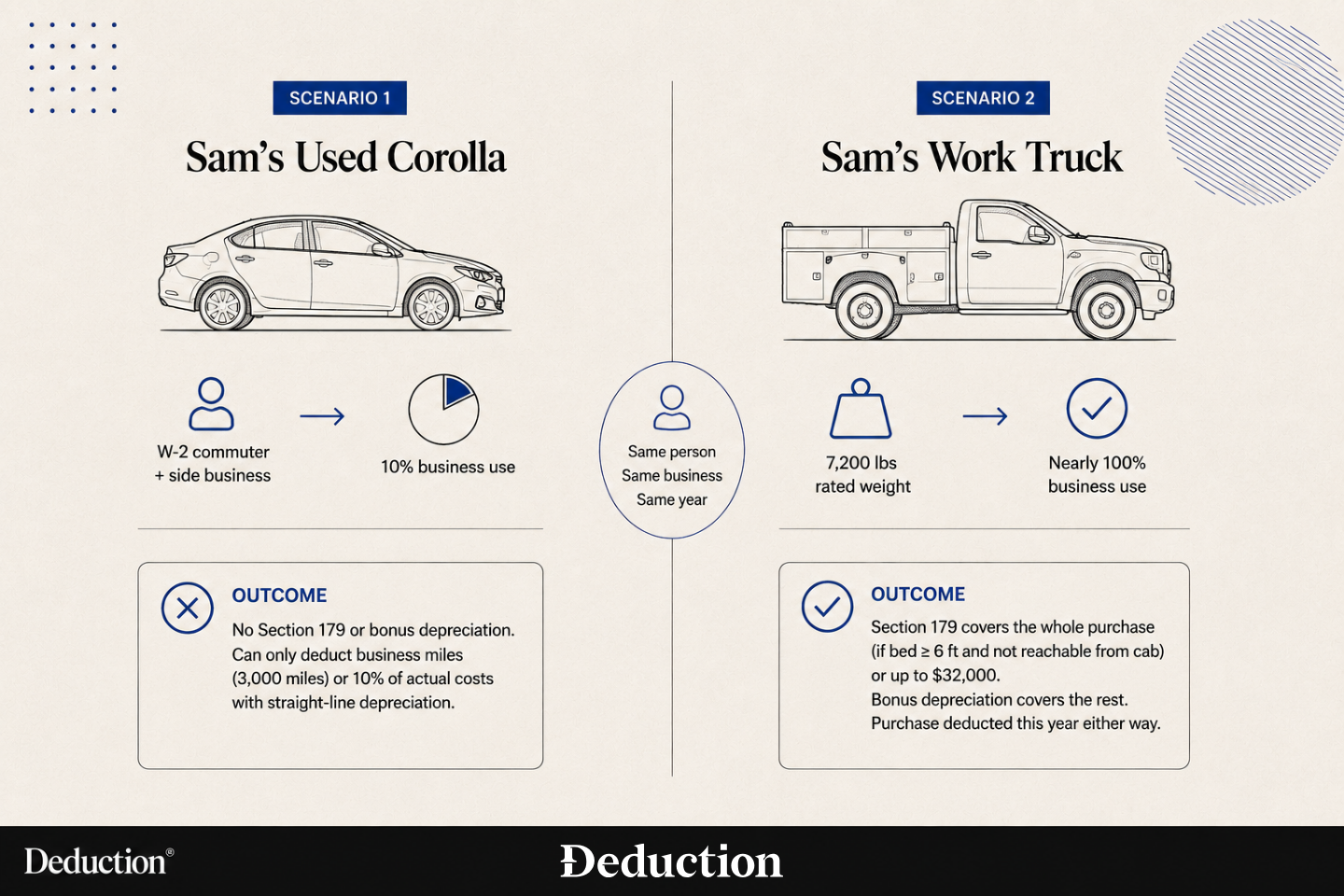
Sam has a W-2 job as a chemical engineer and a small pest control business on the side. He bought a used Corolla, and he drives 90 minutes each way to the engineering job.
Over the year, he puts 30,000 miles on it. Roughly 22,000 are the commute, 5,000 are personal, and 3,000 are driving to pest control jobs.
That is 10% business use. The commute is what sinks him, because it is not mileage for the pest control business, and commuting to a W-2 job is not deductible in the first place.
Section 179 and bonus depreciation are both out on the Corolla. Sam can still deduct those 3,000 business miles, either at the standard mileage rate or as 10% of his real costs with straight-line depreciation.
Now change one fact. He buys a used work truck rated at 7,200 pounds, fits it out for hauling chemicals, and drives it only to jobs.
It is over 6,000 pounds, so the passenger automobile ceiling is gone, and business use is close to 100%.
If the bed is at least six feet and not reachable from the cab, Section 179 covers the whole thing. If it is shorter, Section 179 stops at $32,000 and bonus depreciation picks up the rest. Either way, the purchase comes off this year.
Same person, same business, same year.
How to Claim Section 179
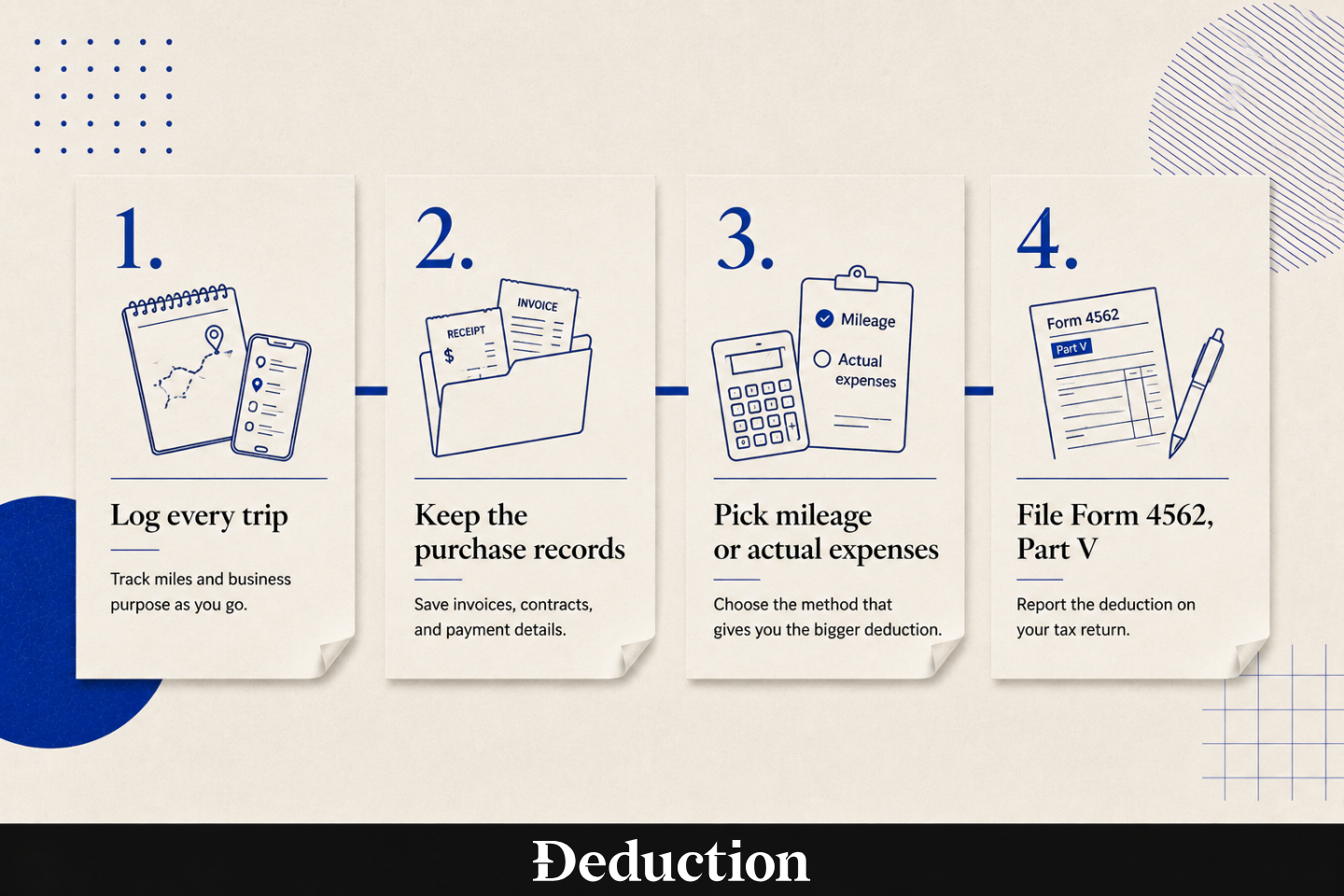
Four things, in order, and the first one starts long before you file:
- Track your mileage as it happens: Date, miles, and business purpose for every trip. Reconstructing it in April does not work, and it is the record that decides whether you clear the 50% line.
- Keep the purchase records: The bill of sale or finance agreement, the sticker or spec sheet showing GVWR, plus fuel, repair, and car insurance receipts.
- Choose between the standard mileage rate and actual expenses: If you take the standard mileage rate on a car, you cannot also take Section 179 or depreciation on it, because the per-mile rate already includes depreciation.
- File Form 4562 with your return: Section 179 on a car, SUV, or pickup goes in Part V of Form 4562, where listed property is reported. A vehicle that is not listed property, like a semi or a dump truck, goes on line 6 in Part I instead.
If you go with the per-mile rate, 2026 needs two calculations instead of one. The business rate is 72.5 cents a mile through June 30 and 76 cents from July 1, so a full-year log has to be split at the changeover.
Deciding between the two is a bigger call than it looks, because it locks in. For a car you own, you have to use the standard rate in the first year the car is available for business if you want the option of using it in later years.
If you take Section 179 or your actual costs in year one instead, that door is closed for that vehicle. Which way it pays tends to follow the vehicle: a cheap car covering a lot of business miles does well on the per-mile rate, while an expensive heavy vehicle covering fewer miles is where Section 179 and actual costs earn their keep.
Section 179 also cannot exceed the income from businesses you actively conduct that year. For an individual, W-2 wages count toward that figure, so a side business with a day job behind it has more room than most owners expect.
Why You Should Combine Section 179 and Bonus Depreciation
They do different jobs, and each one's limit is the other one's way out:
- Section 179 stops at your business income. It cannot create a loss. If you elect more than your active business income, the excess becomes a Section 179 carryforward instead of coming off this year's return.
- Bonus depreciation has no income limit. It can push you into a loss, which may be what you want in a year with a large purchase and thin income.
- Section 179 is selective. You pick which assets to elect on and how much on each. Bonus applies to whole classes of property by default unless you elect out.
On a heavy vehicle, the usual order is Section 179 first, up to the $32,000 SUV limit, then bonus depreciation on the remaining business-use cost.
Let Deduction File All Your Deductions, Including 179 Vehicles
You can have a truck ready, a mileage app running since January, and every fuel receipt in a folder, and still not know whether to elect Section 179 on the truck this year or spread the deduction out.
That depends on what your income does next year and what else you bought. It is not a question you can look up.
Deduction is built for that. It tracks deductions across your financial documents through the year and files the return at the end of it, with AI doing the finding and a licensed CPA reviewing the result before anything goes to the IRS.
Here is how it works:
- Upload your documents: Bank and card statements, the vehicle paperwork, your mileage records, and your personal tax documents.
- The AI finds your deductions: It reads across your income and expenses and flags what is deductible, including vehicle purchases that qualify for Section 179.
- A CPA reviews and files: A real tax professional checks the return, including the elections on the vehicle, and files it for you.
This article is general information, not tax advice. Section 179 interacts with your income, your entity type, and your state's rules, so run your own situation past a CPA before you file.
Frequently Asked Questions About Section 179 Vehicles
Here are some frequently asked questions about Section 179 vehicles:
Which Vehicles Are Eligible for the 179 Tax Deduction?
Any vehicle you buy and use more than 50% for business. Weight sets the ceiling: 6,000 pounds or less caps your 2026 write-off at $12,300, or $20,300 with bonus depreciation. Heavier SUVs cap at $32,000. Trucks over 14,000 pounds and nonpersonal use vehicles have no cap.
What Are the Rules for Section 179 Deduction on Vehicles?
Buy the vehicle rather than lease it, place it in service during the tax year, and use it more than 50% for business. You deduct only the business-use share, you keep mileage records, and the deduction cannot exceed your active business income for the year.
What Is Not Eligible for Section 179?
Leased vehicles, vehicles used 50% or less for business, and vehicles you did not buy: gifts, inherited vehicles, or anything from your spouse, a parent or grandparent, a child or grandchild, or a business you control. Commuting-only vehicles are out, as is property held for investment and inventory you mean to resell.
What Are Common Section 179 Mistakes?
Assuming any large SUV gets a full write-off, when the $32,000 cap usually applies. Counting commuting miles as business miles. Claiming the full purchase price instead of the business-use share. Taking the standard mileage rate and Section 179 on the same car.
What Is the Most Overlooked Tax Deduction?
For vehicle owners, the running costs rather than the purchase. Fuel, car repairs, tires, insurance, and registration are deductible at your business-use percentage under the actual expense method. Parking, tolls, and the business share of your car loan interest come off even in a standard mileage year.
Can I Write Off a Luxury SUV Under Section 179?
Yes, if it is rated over 6,000 pounds GVWR and used more than 50% for business, but the Section 179 piece stops at $32,000 for 2026. Bonus depreciation can cover the rest. Under 6,000 pounds it is a passenger automobile, capped at $20,300 with bonus depreciation or $12,300 without.
Is It Better to Take Section 179 or Bonus Depreciation?
Use both. Section 179 gives you control over which assets and how much, but it cannot create a loss. Bonus depreciation has no income limit and applies automatically to whole asset classes. On a heavy vehicle, most businesses take Section 179 to $32,000, then bonus on the rest.
How Long Do You Have to Keep a Vehicle Under Section 179?
Business use has to stay above 50% for the vehicle's recovery period, five years for most vehicles. If it falls to 50% or less, or you convert it to personal use, you figure recapture in Part IV of Form 4797. Selling works differently: your gain is ordinary income up to the depreciation already claimed.
Which SUV Is Best for a Business Write-Off Under Section 179?
The one your business needs that is rated over 6,000 pounds GVWR. Check the sticker inside the driver's door frame rather than trusting a list, since GVWR varies by trim and model year. Buying a heavier vehicle purely for the deduction rarely beats keeping the cash.