

Getting paid on a 1099 feels great, because nothing is taken out before the money reaches you. Then the tax bill lands. Nobody withheld anything for you, so the whole amount comes due at once, and every expense you forgot to track is money you handed the IRS for no reason.
The tax deductions for 1099 income are the one thing here you fully control, and most self-employed people use maybe half of them. This guide walks through 18 1099 tax deductions worth checking before you file: what each one covers, who it helps, and who it will not.
Figures are for tax year 2026, with 2025 numbers alongside for anyone still finishing that return.
At a Glance
And here are the figures that changed between the two tax years, so you can check you are working from the right set.
Home Office Deductions
If you run your business from home, a portion of your housing costs becomes a business expense. The catch is the word "exclusively." The space has to be used only for work and used regularly, so the kitchen table where your kids do homework does not count. It does not have to be a whole room, though. A clearly defined corner works, as long as nothing personal happens in it.
You have two ways to claim it, and you can switch between them from one year to the next.
The simple way pays $5 per square foot, up to 300 square feet, which caps your deduction at $1,500. There is nothing to track and no extra paperwork.
The detailed way works out what percentage of your home the office takes up, then lets you deduct that percentage of your rent or mortgage interest, utilities, insurance, and repairs. If you pay real rent in a real city, this usually beats $1,500 by a wide margin.
Renters can qualify. Employees working from home cannot, which surprises a lot of people who split their week between a job and a side business. If you have both, only the self-employed part of your work counts.
Self-Employment Tax (Yes, the 1099 Tax Itself)
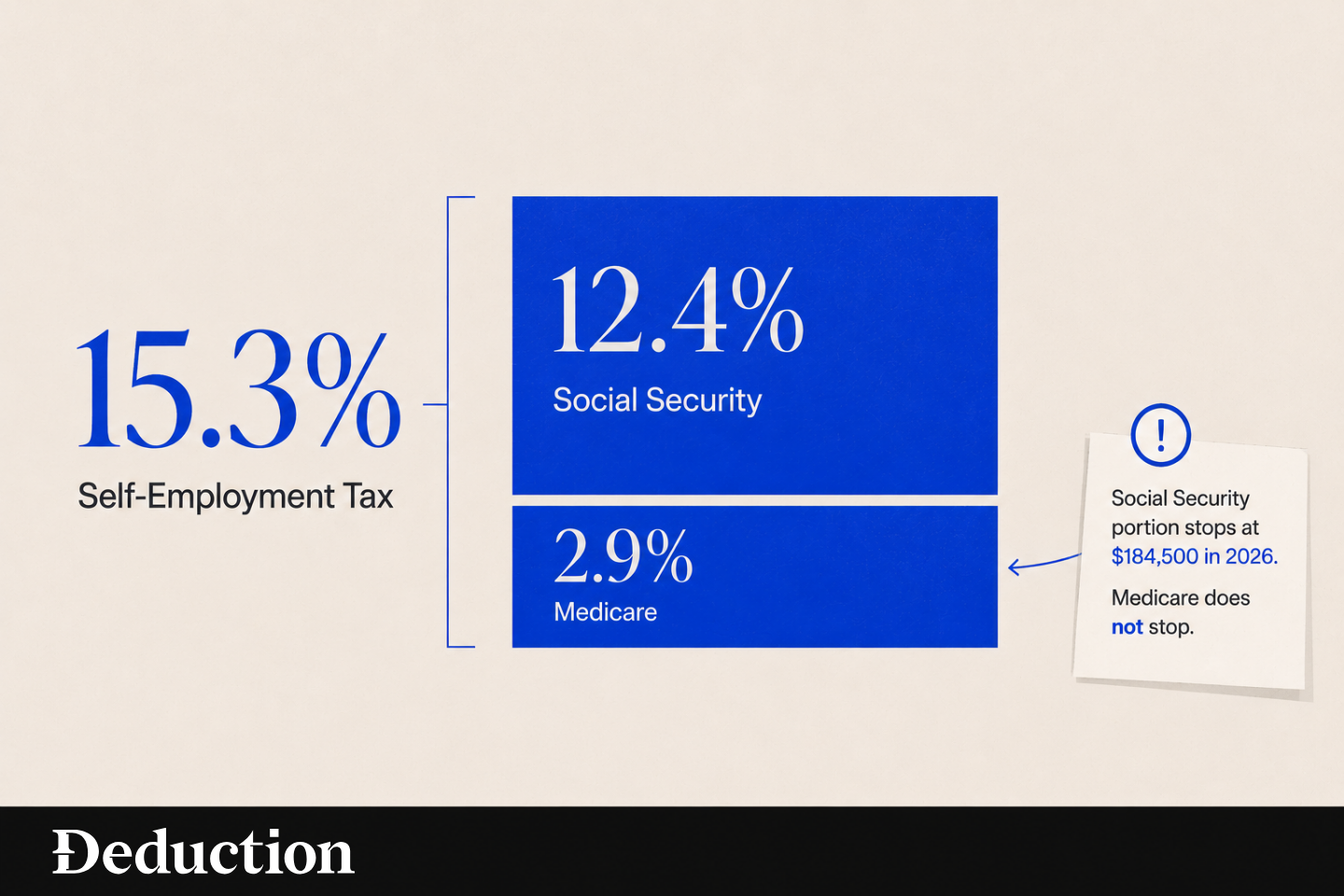
This is the one that blindsides new freelancers. Self-employment tax is 15.3% of your net earnings, which covers Social Security and Medicare. As an employee, you paid half, and your employer paid the other half. On a 1099, you pay both halves.
The relief is that you get to deduct half of it. That half is an above-the-line tax deduction, so it comes off your income before income tax is worked out, and you get it whether you itemize or not. You do not have to spend a dollar to claim it.
It helps to know what the 15.3% applies to. Not what your clients paid you, but your net profit, meaning your income minus every business expense you claim. Every deduction in this article lowers that number, which is why business expenses are worth more to you now than they ever were on a W-2.
The tax starts once your net earnings reach $400, which is a very low bar to clear. Once profits are steady, some owners elect S corp status to reduce this tax, which moves most deductions onto a company return; our guide to tax deductions for S corp owners covers that setup.
Office Supplies
These are the everyday costs of running your workspace: pens, paper, printer ink, folders, postage, and the small items that keep a desk working. You deduct them in full in the year you buy them.
The line people blur is supplies versus equipment. A $12 box of pens is an office expense. A $2,000 laptop is equipment, but you are usually not stuck writing it off slowly, because a rule called the de minimis safe harbor lets you deduct anything costing up to $2,500 per item in the year you buy it. You need a consistent policy of expensing items at or under that amount, in place before the tax year starts and followed in your books, plus a short election statement attached to your return. The policy does not have to be written down if you have no audited financial statements, which most solo filers do not, though putting it in writing is the safer move.
If you make or resell physical products, the raw materials that go into what you sell are counted separately as part of your cost of goods sold. The flour a baker buys belongs there, not with office supplies.
Keep the receipts. Small recurring purchases are the easiest category to lose track of, and the easiest for an auditor to throw out.
Start Up Costs
Money you spent before the business opened its doors is not lost. You can deduct up to $5,000 of startup costs in year one, and spread anything left over across the following 15 years. That $5,000 shrinks dollar for dollar once your total startup costs pass $50,000, and disappears entirely by $55,000.
Pre-launch spending falls into three groups, and only the first two do anything for your return:
- Business costs: Market research, prototype testing, pre-launch advertising, and consultant fees paid to shape the business plan.
- Formation costs (companies only): Legal fees for incorporation papers, state filings, and partnership setup. There is a second $5,000 allowance for these, but it only applies to corporations and partnerships, so a solo freelancer has nothing to claim here.
- Never deductible: Personal purchases, fines and penalties, lobbying and political contributions, and money spent while you were still browsing business ideas without a plan.
For most solo 1099 filers the startup number stays small. Claim it anyway, and remember that the part you spread over later years keeps showing up on your returns long after launch.
Travel, Mileage and Vehicular Expense
Two separate deductions sit under this heading, and mixing them up is how people get into trouble.
Travel means being away from your tax home overnight, long enough that you need sleep or rest. Your "tax home" is the general area where you normally do business, which is not always where you live. When a trip qualifies, you can deduct airfare, hotels, rental cars, taxis, baggage fees, laundry, business calls, and 50% of your meals. A long day trip across town is not travel, no matter how far you drove.
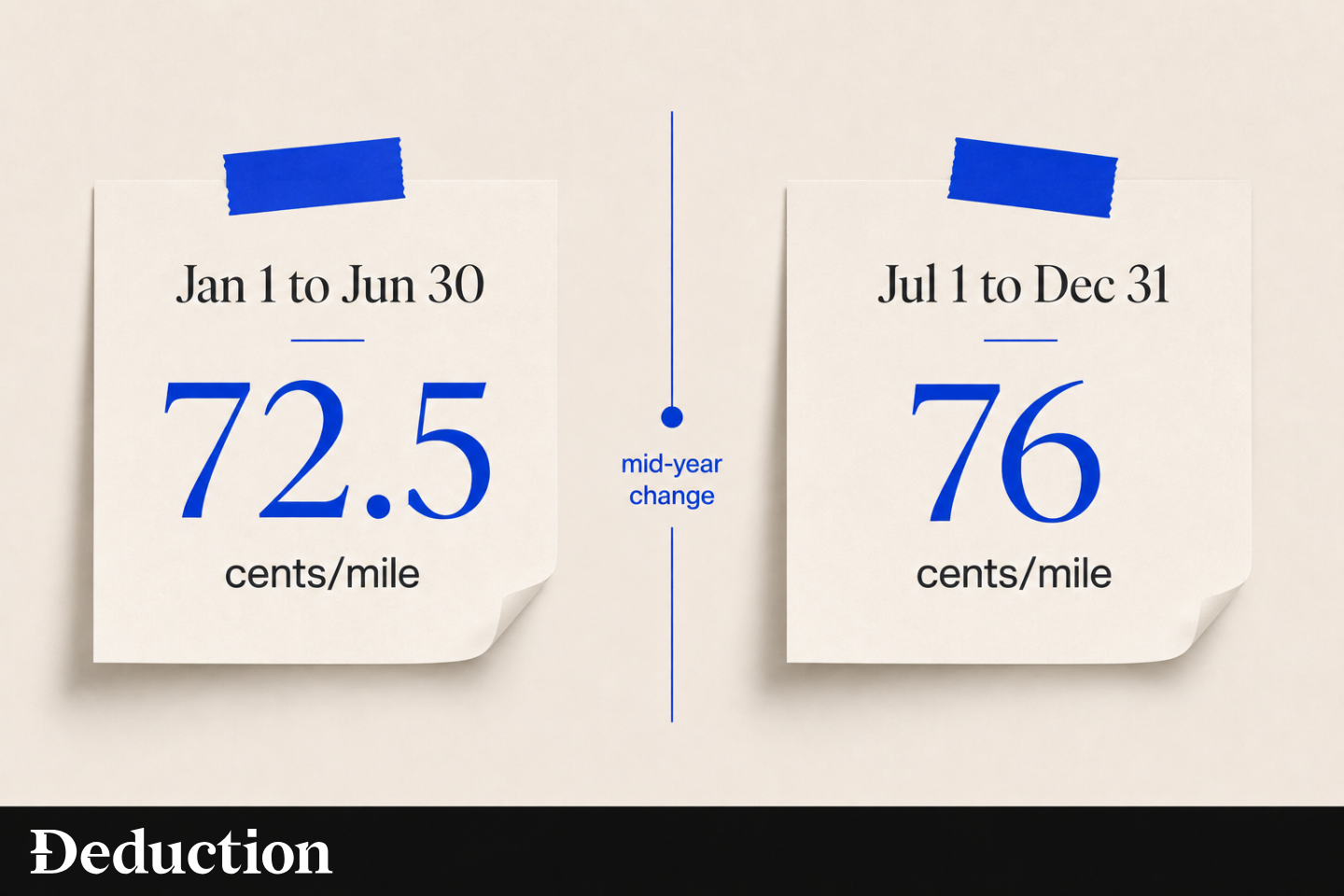
Mileage is the vehicle piece, and this is where 2026 gets unusual. The IRS normally sets one business mileage rate for the whole year. For 2026, it set two: 72.5 cents per mile from January 1 through June 30, and 76 cents from July 1 through December 31. If you drove for business across the full year, a single annual mileage total will give you the wrong answer.
The difference is not trivial. At 76 cents a mile, 5,000 business miles in the second half of the year comes to $3,800 of deduction on its own.
You also have a choice of methods. The standard mileage rate bundles fuel, insurance, repairs, and wear on the car into one per-mile figure. The actual expense method tracks each of those separately and deducts your business-use share. If you own the car, picking the standard rate in the first year you use it for business keeps your freedom to switch later. Choose the other way round, and you are locked in.
If you are weighing the actual expense method so you can write off a new vehicle up front, check which vehicles qualify for Section 179 first.
Commuting from home to a regular workplace never counts, which catches people out. Driving from a qualifying home office to a client site does count, and so does driving between two work locations in the same day.
Whichever method you use, log the date, the miles, and the business purpose of every trip. The law requires that log, and it is the first thing asked for if the deduction is ever questioned.
Accounting and Legal Services
Money you pay professionals to keep the business running is deductible. That covers your CPA, a bookkeeper, a lawyer reviewing client contracts, and the self-employed tax software or preparer who handles your business return.
Only the business portion counts. If your preparer charges $600 and $200 of that covers your personal return, you deduct $400. Ask for an itemized invoice, because the split is much easier to defend when the preparer wrote it down than when you estimated it later.
Legal fees to run or defend the business are deductible. Legal fees for a divorce, a personal injury claim, or buying a house are not, even when you pay them from the business account.
Equipment and Big Purchases
Equipment that lasts more than a year is normally written off over several years rather than all at once. That process is called depreciation, and it covers computers, cameras, tools, furniture, and vehicles.
For a 1099 filer, the useful part is that you usually do not have to wait. Two rules let you take the whole cost in year one.
The first is Section 179, which lets you expense the full cost up to $2,560,000 for 2026. That ceiling is no constraint for a solo operator, but two smaller limits are. Property you use for business half the time or less does not qualify at all. And your deduction cannot exceed your income from work, which includes wages from a W-2 job and, on a joint return, your spouse's wages. Anything you cannot use this year carries forward.
The second is bonus depreciation, which currently allows 100% of the cost for qualifying property and does not need business income behind it. That makes it the better option in a year when profit is thin.
Business and Health Insurance
Two different deductions sit under this heading. Both matter to a 1099 filer, because nobody is providing either kind of cover on your behalf.
Business insurance is the protection you buy for the work itself: general liability, professional indemnity, errors and omissions, and business property coverage. Vehicle insurance is the exception. It counts as a car expense, and if you use the standard mileage rate you cannot deduct it separately at all, because the rate already includes it.
If you use the actual expense method instead, whether car insurance is tax-deductible comes down to your business-use percentage.
Health insurance is the bigger one. On a 1099, you buy the whole policy yourself, and you can deduct 100% of premiums for yourself, your spouse, your dependents, and your children under 27. It comes off your income before tax is calculated, so you get it whether you itemize or not.
Two limits matter. The deduction cannot exceed what you earned from the business the plan is tied to. And you lose it for any month you were eligible for a subsidized employer plan, including one offered through a spouse, whether or not you took it.
One more thing if you buy your plan through the Marketplace and get a subsidy. You can only deduct what you actually paid, not the part the premium tax credit covered, and the two get calculated together. IRS Publication 974 walks through that one.
QBI Deduction
Yes, this one applies to you. If you are self-employed, your business profit counts as qualified business income, so the QBI deduction is available to almost every 1099 filer reading this. Like the half-of-your-SE-tax deduction, it costs you nothing to claim.
It gives you a deduction of up to 20% of your business profit, on top of every business expense you have already claimed. It reduces income tax only, not self-employment tax.
Below the 2026 threshold of $201,750 single or $403,500 joint, the math is close to simple: 20% of your profit after subtracting the half of your SE tax you deducted, your health insurance deduction, and your retirement contribution.
There is a second ceiling that catches lower earners by surprise. The deduction also cannot exceed 20% of your taxable income, worked out with your net capital gain taken out first, meaning long-term gains plus qualified dividends. At modest income levels that is usually the limit that decides your number, and selling stock during the year pulls it down further than you might expect.
Above the threshold, extra limits come into play. If you work in a service field such as health, law, accounting, consulting, financial services, performing arts, or athletics, the deduction shrinks gradually past the threshold and hits zero at $276,750 single or $553,500 joint in 2026. Between those two points you still get part of it, so a consultant or therapist just over the line has not lost the whole thing.
New for 2026, there is a minimum $400 deduction if you have at least $1,000 of qualified business income from a business you actively work in.
Business Meals
Yes, this is a valid deduction, with conditions attached. You can deduct 50% of a business meal when you or an employee is present, the meal is not lavish, and there is a real business purpose behind it. Client lunches, meals with a prospect, and food while travelling for work all qualify.
The 50% limit is not something you can work around. It applies whether the meal cost $20 or $200. The temporary 100% restaurant deduction from 2021 and 2022 has expired, so if you are working from an old checklist you will overclaim.
Two things are not business meals, despite how often they get claimed. Eating alone at your desk does not count, because there is no business contact present. Dinner with a friend who happens to also be self-employed does not count either, unless you can point to real business that was discussed.
Write it on the receipt at the time: who you ate with and what you discussed. Reconstructing that a year later rarely convinces anyone.
Retirement Contributions
This is the deduction most 1099 filers never use, and it is usually the largest one available to them. A self-employed retirement account moves a big chunk of profit off your taxable income, and unlike every other deduction here, the money stays yours instead of being spent.
You have two main options as a sole proprietor.
A SEP IRA takes up to 25% of your compensation, capped at $72,000 for 2026. For a sole proprietor that works out closer to 20% of your net earnings once the calculation is done. SEPs are simple to open and, for most people, come with no annual filing of their own.
A solo 401(k) reaches the same $72,000 by a different route, combining a $24,500 contribution as the employee with a further contribution as the employer. If you are 50 or older you can add $8,000 on top, or $11,250 if you turn 60 through 63 during 2026. It lets you put away more at lower income levels than a SEP does, because that $24,500 is not tied to a percentage of your profit.
Neither one reduces self-employment tax. They cut income tax only, which is a common misunderstanding.
The timing is what makes this unusual. SEP contributions can be made right up to your filing deadline, including extensions, so this is one of the very few moves still available after the tax year has ended.
Marketing and Advertising
Advertising is 100% deductible under the ordinary and necessary standard, with no percentage limit and no cap. It covers more than most people claim: your website and hosting, domain renewals, business cards, logo design, paid search and social ads, sponsorships, email marketing tools, printed flyers, and vehicle signage.
The test is whether the spending promotes the business or brings in customers. Sponsoring a local team qualifies, because your name goes on the shirt. A straight donation with no promotional element is a charitable contribution instead, which follows different rules.
One exclusion is worth knowing. Lobbying and political contributions are never deductible, no matter how business-adjacent they feel.
Trainings and Professional Development
Education that keeps your existing skills sharp is deductible. Education that qualifies you for a new line of work is not, and that distinction is where most claims fail.
A web developer taking an advanced React course can deduct it, because it improves a skill already used in the business. That same developer paying for law school cannot, even if a law degree would eventually help, because it opens the door to a new profession. The IRS is explicit in Publication 970 that bar review and CPA exam prep do not qualify for the same reason.
What does qualify: conferences and the travel to reach them, industry workshops, online courses, professional books, trade journal subscriptions, and any continuing education your field requires.
Other Industry-Specific Deductions You Can Claim
The 13 deductions above apply to almost any 1099 filer. The five below are narrower and tied to particular kinds of work, and they are the ones most often left unclaimed, because generic tax software never thinks to ask about them. Skip to whichever one matches what you do.
Board Certification and Recertification
If your work requires a credential to stay legal, the cost of keeping that credential is a business expense. Examples include licensure renewal for a therapist, board recertification for a physician, a state license for a nurse, and bar dues for an attorney.
This is separate from professional development. Development improves your skills, while certification is the price of being allowed to practice at all, so you can claim both in the same year.
Trade Tools, Uniform, and Machinery
Tradespeople carry deductions most desk workers never see. Hand tools, power tools, safety gear, blades, and consumables are deductible in the year you buy them. Anything expensive and long-lived counts as equipment instead.
Uniforms are quite tricky. Clothing is deductible only if your work specifically requires it and it is not something you could wear in everyday life. Both parts have to be true. Steel-toe boots, flame-resistant coveralls, and a hard hat are valid, because nobody wears them off the job. Plain jeans and a work shirt do not qualify, even if a client requires them, because they remain ordinary clothing.
Subcontractor and Contract Labor
Plenty of 1099 filers hire other 1099 filers, and paying another contractor to handle part of a job is deductible. The one thing to watch is double counting, because a payment you have already deducted as a professional fee or a repair does not also go down as contract labor.
The reporting threshold changed for 2026. You now issue a Form 1099-NEC once you have paid a contractor $2,000 in the year, up from $600 previously.
Classification is the real risk here. If you control how and when the work gets done, the IRS may treat that person as your employee rather than a contractor, and back employment taxes follow.
Job-Site and Disposal Costs
The unglamorous costs of working on location are deductible: dumpster rentals, debris hauling, portable toilets, temporary power, site cleanup, and the permits a job requires.
Watch the line between an expense and an improvement. Hauling away waste comes off this year's return. Building something permanent on a property is an improvement, which gets written off gradually instead. Keep the invoices separated by job where you can.
Booth and Temporary Space Rentals
Renting space at an expo, trade show, craft fair, or pop-up market is deductible, along with the booth build, banners, samples, and the cost of shipping your display to the venue. Travel to the event follows the standard travel rules, and meals there are still capped at 50%.
Conventions held outside North America carry an extra burden, because you have to show the meeting was directly related to your business and that holding it there was as reasonable as holding it closer to home. The defined area is wider than the continent, so a show in Puerto Rico or Bermuda is unaffected.
Do You Need Schedule C and Schedule A for Filing 1099 Taxes?
For almost every 1099 filer the answer is Schedule C, and probably not Schedule A.
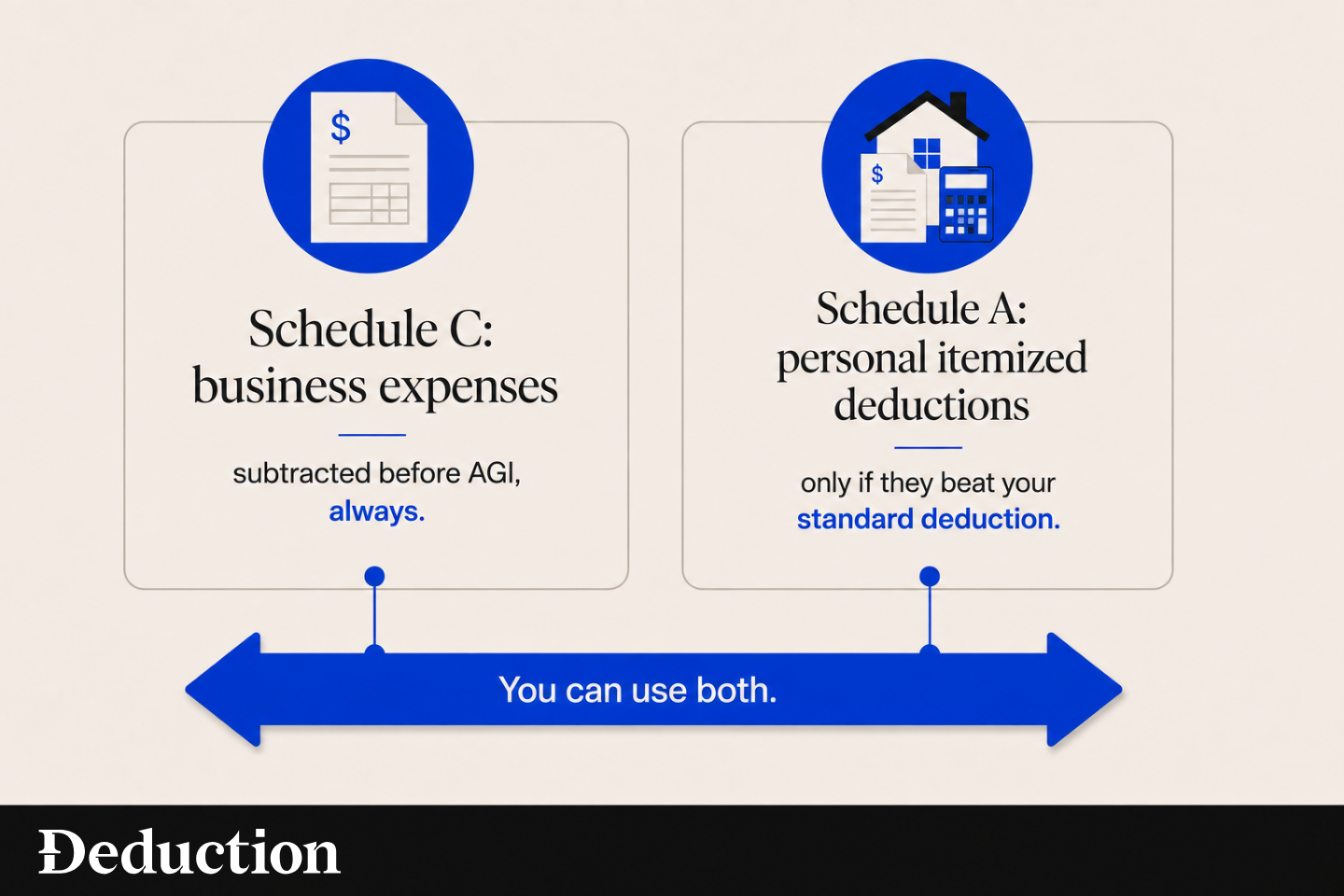
Schedule C is where your business income and every business expense go. It reduces your income before anything else is calculated, and it has nothing to do with itemizing.
Schedule A is for personal itemized deductions: mortgage interest, state and local tax deductions up to $40,400 in 2026, charitable giving, and large medical bills. You only file it when those add up to more than your standard deduction. That $40,400 cap starts shrinking once your income passes $505,000, though it never drops below $10,000.
So you can take the full standard deduction and still write off every business expense. They are not alternatives, and choosing one does not cost you the other.
One change to know about if you do itemize in 2026: you can only deduct the charitable giving that goes above 0.5% of your adjusted gross income, so on $200,000 of income the first $1,000 you give does not count.
If you take the standard deduction, 2026 adds something new. You can deduct up to $1,000 of cash giving, or $2,000 on a joint return, without filing Schedule A at all.
Do You Have to Pay Quarterly or Annually for 1099?
Technically, nobody forces you to pay quarterly. Practically, skipping it costs you money.
The IRS charges a penalty if the tax on your return, minus anything that was withheld for you, comes to $1,000 or more and you did not pay enough during the year. It builds up like interest, quarter by quarter, so one large payment in April does not undo a year of paying nothing.
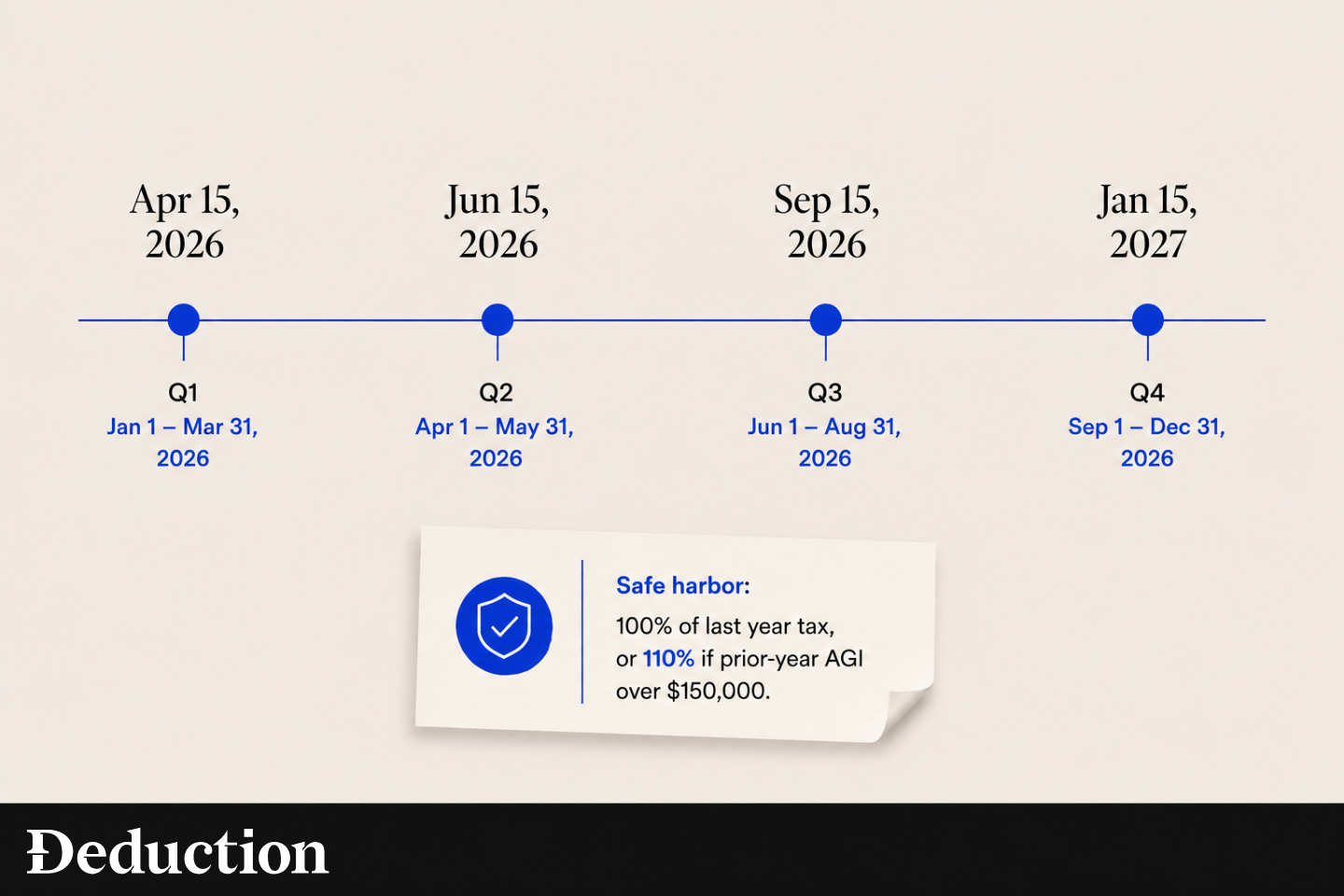
For the 2026 tax year, the due dates are April 15, June 15, September 15, and January 15, 2027. They are not evenly spaced, which catches people out.
You are safe from the penalty if you pay 90% of this year's tax or 100% of last year's tax, whichever is smaller. If your income last year topped $150,000, that second figure rises to 110%.
Paying against last year's number is usually the easier target, because you already know what it was.
Where Each Deduction Goes on Your Return
You do not need to memorize any of this, and your software or your CPA will handle most of it. But if you want to check that nothing was missed, here is where each deduction lands.
One more form to know about: once your net earnings reach $400, you file Schedule SE alongside your return to report self-employment tax.
How to Keep Track of Your Taxes and Deductions as a 1099 Filer
None of the 18 tax deductions above survive without records. The IRS position is straightforward: if you cannot substantiate it, you cannot deduct it.
Here are the steps to track your taxes and deductions through the year:
- Open a dedicated business checking account and card, so you are not reconstructing personal statements in April.
- Photograph or forward every receipt the day it happens, and note the business purpose on meals and travel while you still remember it.
- Tag every logged trip as falling before or after July 1, because 2026 runs two different mileage rates.
- Separate your recurring costs from your one-off ones. Software and insurance are easy to remember, while a conference or a new piece of equipment is what gets forgotten.
- Store everything in one secured cloud folder, organized by month, rather than a shoebox or scattered email attachments.
- Keep your own copy after you file, because none of these records go to the IRS with the return. Hold them for three years from the date you file, and six years if you left out a significant amount of income.
Do this, and your CPA spends their time on strategy instead of chasing your bank statements. A tax document organizer that collects everything through the year means filing season starts with an upload instead of a search.
Let Deduction File Your 1099 Tax Deductions for You
The hard part of 1099 taxes is not the calculations. It is knowing which of these 18 deductions apply to you, catching the industry-specific ones nobody asks about, and still having the records to back them up eleven months after the fact. Having an AI tax deduction finder will help you find these tax deductions from all the documents you uploaded.
Deduction handles both sides of that problem.
- Upload your documents. Receipts, 1099s, and bank exports all go into one place through the year.
- The AI reviews everything and surfaces the deductions and credits that fit your situation, including the narrow ones generic software skips.
- A licensed CPA reviews the return before anything gets filed.
You get the thoroughness of AI with the judgment of a real accountant on top, which is the combination that keeps an aggressive deduction from becoming a problem later.
Frequently Asked Questions for Tax Deductions for 1099
Here are frequently asked questions about tax deductions for 1099:
How to Reduce Taxes on 1099 Income?
Claim every business expense first, because those cut both income tax and self-employment tax. Then stack the deductions that only reduce income tax: retirement contributions, health insurance, half of your SE tax, and QBI. Retirement contributions usually do the most for a profitable freelancer.
What Are the 10 Most Overlooked Tax Deductions?
For 1099 filers: home office, business use of a personal phone and internet, mileage to client sites, professional license renewals, continuing education, software subscriptions, bank and payment processor fees, business insurance, startup costs still being written off, and half of the self-employment tax. That last one is frequently missed on self-prepared returns.
What Can You Write Off 100% as an Independent Contractor?
Advertising, office supplies, software subscriptions, professional fees, business insurance other than vehicle cover, and contract labor are all fully deductible with no percentage limit. Health insurance premiums are deductible in full too, but only up to what you earned from the business the policy is tied to. Business meals are the main exception at 50%.
How Much Tax Will I Pay if I Earn $30,000 Self-Employed?
On $30,000 of net profit, self-employment tax runs roughly $4,239. Federal income tax adds about $940 once the $16,100 standard deduction, the half-SE-tax adjustment, and QBI are applied, which lands a single filer near $5,180 in total. State tax is extra. These are illustrative estimates.
What Is the Best Way to Pay Taxes as a 1099 Employee?
Pay quarterly estimates electronically through IRS Direct Pay or EFTPS, using the safe harbor of 100% of your prior-year tax, or 110% if your prior-year income exceeded $150,000. This only protects you if you make each of the four payments on time. Set aside 25% to 30% of each client payment the day it lands.
What Deductions Can I Put on My 1099?
None, because deductions do not go on the 1099 itself. A Form 1099-NEC only reports what a client paid you. Your deductions go on your business return, where you subtract every ordinary and necessary business expense from that gross figure. The resulting net profit is the number that gets taxed.
What Is the Standard Deduction for 1099 Workers?
The same as everyone else: $16,100 single and $32,200 married filing jointly for 2026, up from $15,750 and $31,500 in 2025. Being self-employed does not change it. You claim the standard deduction on top of your business expenses, not instead of them.
What Expenses Can Self-Employed People Deduct?
Any expense that is ordinary and necessary for your trade or business. In practice, that means home office, mileage and travel, supplies and equipment, insurance, professional fees, advertising, contract labor, education, and software. Personal expenses, commuting, fines, and political contributions never qualify, regardless of which account paid for them.
This article is general information, not tax advice. Tax rules change, and every situation is different, so confirm how these deductions apply to you with a CPA or qualified tax professional before you file. All figures were verified against IRS and SSA sources as of August 2026.