
Tax deductions for truck drivers are spread across every mile you run. The fuel refills you get mid-transit, the tire that needs replacement, the load board subscription billing your personal card, the motel you paid for because the shipper had nowhere to park overnight.
These deductions are often all over the place. Settlement statements net out charges without explaining them, receipts fade in the door pocket, and one phone runs your dispatch and your personal matters. What you don't claim is tax you paid on money you never kept.
This guide covers the 12 deductions drivers claim most, and what changes when you're a company driver on a W-2 instead of an owner-operator.
The 12 Deductions at a Glance
One thing to take note of before the list. Almost every deduction below belongs to a driver who is self-employed, which means an owner-operator, a lease-operator, or anyone paid on a Form 1099.
If you’re a company driver on a W-2, the federal deduction for out-of-pocket job expenses is gone permanently. The section on W-2 drivers further down covers what you have instead.
Here is what each deduction covers and where it lands on your return. Every line number refers to Schedule C, the form sole proprietors and single-member LLCs use to report business profit or loss.
If you set your operation up as an S corporation or a multi-member LLC, the same costs still come off, but they go on Form 1120-S or Form 1065 instead. Read the line numbers below as the category rather than the exact box.
1. Fuel (Diesel, DEF)
Diesel is the largest single line on most owner-operator returns, and all of it comes off. That covers what you pump into the tank, diesel exhaust fluid, reefer fuel for a refrigerated trailer, and the federal and state fuel taxes already built into the price at the pump.
There’s no shortcut version of this deduction. The IRS standard mileage rate, which lets other business drivers deduct a flat amount per mile instead of tracking costs, applies only to automobiles, vans, pickups and panel trucks.
A Class 8 tractor is none of those. You deduct the fuel cost, and you keep the receipts and settlement statements that prove it.
If you run in two or more IFTA member jurisdictions, your quarterly fuel tax filing is separate from your income tax return but useful to it. The miles-by-state and gallons-by-state figures you already report there are the cleanest record you will have of where the truck went and what it burned.
2. Repairs and Maintenance (Oil Changes, Tires, Brakes, Engine Work)
Keeping the truck running is fully deductible. Oil and filter changes, tires, brakes, belts, hoses, DPF cleaning, alignments, truck washes, and the shop labor to do any of it. So is the roadside call at two in the morning and the tow that follows it.
The distinction to keep in mind is between a repair and an improvement. Routine work you expect to do more than once over the life of the truck (oil and filters, tires, brakes and belts) is deductible this tax year.
Work that leaves you with something better than you had, an engine overhaul or a rebuilt transmission that adds years of life, is treated as an asset and recovered through depreciation instead.
So is work that brings the truck back from a state of disrepair where it wasn’t usable anymore, even though that only returns it to the condition it was in before.
In practice, that distinction rarely changes your total, because Section 179 and bonus depreciation usually let you deduct the improvement in year one anyway. But the paperwork you will need changes.
Keep invoices with the unit number and the odometer reading on them, because a folder of parts-counter receipts with no vehicle named on them is how a real expense turns into an argument.
3. Meals / Per Diem While Away From Tax Home Overnight
This is the deduction drivers ask about most, and it works differently from the rest of the deductions.
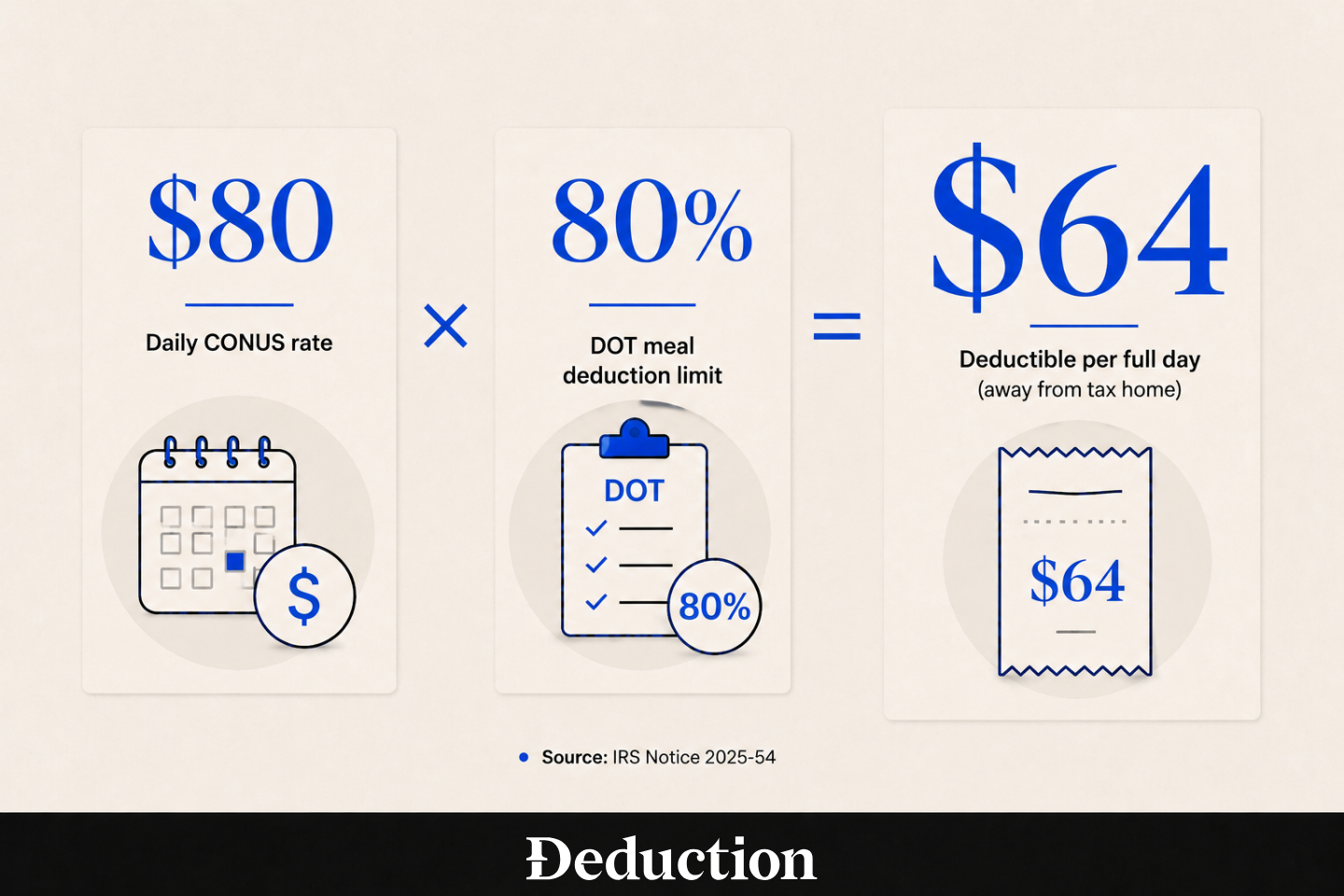
Instead of saving every meal receipt, you claim a flat daily allowance: $80 for each full day in the continental United States and $86 outside it, through September 30, 2026. The IRS resets the figure each fall, so check it before you file.
If your driving puts you under the Department of Transportation’s hours-of-service limits, which covers interstate truck operators, your meals are 80% deductible rather than the usual 50%, so $80 a day becomes $64 of deduction.
If you run only inside one state, outside those federal limits, you’re back to 50%.
Departure and return days can be claimed at three-quarters of the rate. If you use the special rate on one trip, you have to use it on every trip that year, instead of dropping back to the ordinary locality rates.
There are two conditions you have to take in mind for this deduction.
The trip has to take you away from your “tax home,” meaning the general area where you normally do business, and it has to be long enough that you need sleep or rest. That’s why a local run ending in your own bed doesn’t qualify, no matter how long the day was.
The $80 itself is a special transportation industry rate, and you use it only if your work moves goods or people and your trips regularly have you stopping in places that carry different federal meal rates. A driver working one short repeating lane uses the ordinary locality rates instead.
The second condition is the one that catches full-time drivers. If you gave up your residence and effectively live in the truck, the IRS treats you as itinerant, with no tax home at all. The per diem deduction doesn’t shrink in that case. It goes to zero.
4. Lodging and Hotel Stays on the Road
When a trip keeps you away from your tax home overnight, what you pay for a place to sleep comes off in full. That means motels, the occasional sleeper rental, paid parking where you shut down, and your laundry and dry cleaning on the road.
Lodging has no flat allowance. The per diem shortcut covers meals and incidental expenses only, so there’s no standard lodging amount, and your deduction is what you spent. Keep the folio, not just the card charge, because the folio is what shows the dates and the city.
The same overnight test applies here as with meals. A night in your own bunk isn’t lodging you paid for, so there’s nothing to deduct for it. Truck stop showers are a real cost of being out there, and drivers commonly claim them under the catch-all for other ordinary travel expenses, though the IRS has never named them, so keep the receipts.
5. Licenses, Permits and CDL Renewal Fees
The cost of staying legal on the road is deductible. Your CDL renewal and endorsements, your IRP apportioned plates, state and oversize permits, the Unified Carrier Registration fee, your USDOT and MC numbers, and your IFTA license all belong on line 23, “Taxes and licenses.”
Form 2290 goes here too. If your truck's taxable gross weight is 55,000 pounds or more, you’re in heavy highway vehicle use tax territory, and the period runs July 1 through June 30 rather than by calendar year. The tax itself is a business cost you deduct.
If you expect to run the truck 5,000 miles or less on public highways during that period, or 7,500 miles or less for an agricultural vehicle, the tax is suspended. You still file Form 2290 and list the truck as suspended.
What isn’t deductible is the CDL school that got you started. The tax code allows a deduction for education that maintains or improves skills in a business you’re already in, but not for education that qualifies you for a new trade. A first CDL is the ticket into the trade, so it fails on both counts.
A license renewal fee, a hazmat endorsement, or refresher training for a driver already hauling freight passes.
6. Insurance Premiums (Commercial Liability, Cargo, Property Damage)
Every insurance policy the truck needs is deductible. Commercial auto liability, cargo, physical damage on the tractor and trailer, bobtail and non-trucking liability, general liability, and occupational accident coverage if you carry that instead of workers' compensation. These go on line 15, “Insurance (other than health).”
Health insurance is the only exception. Your own health premiums don’t belong on Schedule C at all. They come off on Schedule 1, computed on the document Form 7206, and the deduction cannot exceed the earnings of the business the plan is tied to.
You lose the health insurance deduction for any month you were eligible for a subsidized plan through an employer or your spouse’s employer, and eligibility is what counts. A driver whose spouse has family coverage available at work usually can’t take it.
7. Cell Phone and Internet, Business Portion
Your phone is a dispatch radio, a navigation system, a scanner for bills of lading, and the way your family reaches you at 11 pm. Only the business share of your phone activity is deductible, and the same split applies to in-cab data, a hotspot, or satellite internet.
You have to be able to show how you got that percentage. A stretch of your carrier’s call and data records is the usual way, though one month only holds up if that month looks like your year, so spread the sample across a few months if your lanes change. Whatever basis you use, write it down and apply it the same way all year.
Claiming the whole bill is what gets thrown out, because a phone your family also calls you on is not a business-only phone.
Cell phones came out of the “listed property” rules in 2010, so the heightened recordkeeping standard that used to apply is gone. Ordinary substantiation still applies. And if you keep a landline at home, the base charge on the first line into the house is personal no matter how much business goes over it.
8. Home Office Expenses
Most drivers never claim this one, and the sleeper berth isn’t a way in. The IRS hasn’t published anything treating a truck cab as a home office, and you don’t need one, because the truck is already business property whose fuel, repairs, insurance and depreciation you deduct directly.
What can qualify is a room in your actual home you use only for the business and use regularly, for dispatch, logs, invoicing and books. You get in through the administrative-use test, so that room has to be where the admin side happens, and you can’t have another fixed location where you do a substantial amount of that work.
A little of it elsewhere won’t sink you, and a truck isn’t a fixed location, which is what makes the test workable for a driver.
There are two ways to figure the number. The simplified method pays $5 per square foot up to 300 square feet, so $1,500 at most, with no receipts to keep. The regular method uses the document Form 8829 for the business share of rent or mortgage interest, utilities, insurance and repairs.
Both are capped at what the home office side of the business earned after your other business costs come off, and only the regular method lets you carry the disallowed part into a later year.
Once you’ve identified a qualifying space at home, you still have two ways to calculate the deduction. Deduction’s free home office deduction calculator lets you compare them.
9. Software and Subscriptions (Load Boards, Accounting, Dispatch, Navigation)
The software that finds and moves your freight is a deductible business expense. Load board subscriptions, your ELD service, dispatch and TMS software, trucking accounting apps, fuel-price and truck-legal routing, and document scanning. Monthly and annual subscriptions come off in the year you pay them.
The IRS doesn’t spell out a line for subscriptions, and line 18 is defined narrowly as office supplies and postage. The cleaner home for a load board or ELD subscription is “other expenses” in Part V, which carries to line 27b.
Software you buy outright rather than subscribe to is treated as an asset, though off-the-shelf software qualifies for Section 179, so you can usually still deduct the whole cost up front.
Split anything that isn’t purely business. A satellite radio subscription is a personal expense even though you only ever hear it in the truck, and a general cloud storage plan is deductible in the share you use for business paperwork.
10. Truck Loan Interest
If you financed the tractor, the interest on that note is deductible even though the principal isn’t. Principal payments buy the truck, and you recover that through depreciation or Section 179 instead. The interest is a separate business cost, and on the 2026 draft Schedule C it goes on the interest line labeled “Vehicle loan,” which is 16b.
A lot of truckers assume the One Big Beautiful Bill’s deduction for car loan interest covers the truck note. It doesn’t. That one is capped at $10,000 a year and limited, among other conditions, to a vehicle bought new for personal use, assembled in the United States, and rated under 14,000 pounds, so a tractor fails on weight and on personal use.
Your truck note is a plain business interest deduction, which is the better outcome anyway, because there’s no dollar cap on it. Take the interest figure from your lender's year-end statement or amortization schedule rather than adding up your payments, since most of each payment is principal.
11. Depreciation / Section 179
You don’t have to spread the cost of the truck out. Section 179 lets you expense up to $2,560,000 of equipment placed in service in 2026, and 100% bonus depreciation covers qualified property acquired after January 19, 2025 with no dollar cap at all.
For a single tractor, either one writes off the whole purchase in year one. Used equipment counts too, as long as the truck is new to you and you didn’t buy it from a relative or a business you control.
The caps you may have read about don’t reach a semi. The “luxury automobile” limits stop at passenger automobiles rated 6,000 pounds or less, and the separate $32,000 sport utility vehicle cap can reach passenger-carrying vehicles from there up to 14,000 pounds. A Class 8 tractor clears both.
Section 179 has an income limit: it can’t be more than your taxable income from businesses you actively run, and that total counts W-2 wages too, yours and your spouse’s on a joint return. Anything you can’t use this year carries forward indefinitely, and bonus depreciation has no income limit at all, so it can push you into a loss.
If you’d rather spread the cost, the schedules are short. A tractor unit for over-the-road use is 3-year property, and trailers are 5-year property.
12. Tools and Equipment (Chains, Straps, Tarps, Tire Irons, Repair Kits)
The gear that lives in the side box is deductible. Chains and binders, straps and tarps, load bars, tire irons, an air hose, a torque wrench, a basic repair kit, a bunk heater, and the safety equipment you’re required to carry. Small items and consumables come off as supplies on line 22 in the year you use them.
Anything expensive enough to look like an asset has an easy route. The de minimis safe harbor lets you deduct items costing $2,500 or less per invoice or per item outright, which covers almost everything a driver buys.
It needs a consistent accounting policy in place at the start of the year and an election statement attached to the return. Unless you have audited financial statements, which no owner-operator does, that policy doesn’t have to be in writing, so tell your preparer you want it.
Work clothing is narrower than drivers expect. It has two requirements: the clothing has to be required for the work, and it can’t be adaptable to ordinary wear. That second one is judged by what counts as everyday clothing generally, not by whether you personally wear it off the job.
Protective gear you need for the work, such as safety boots, safety glasses and work gloves, generally passes. Jeans and a flannel shirt don’t, even if you only ever wear them in the truck.
Why Can Truck Drivers Get Tax Deductions
It comes down to whose business the truck is in. Everything above assumes you’re running a trucking operation rather than working in someone else's, and that’s the distinction the tax code pays for. How you’re paid decides which side of it you’re on.
As a 1099 Truck Driver
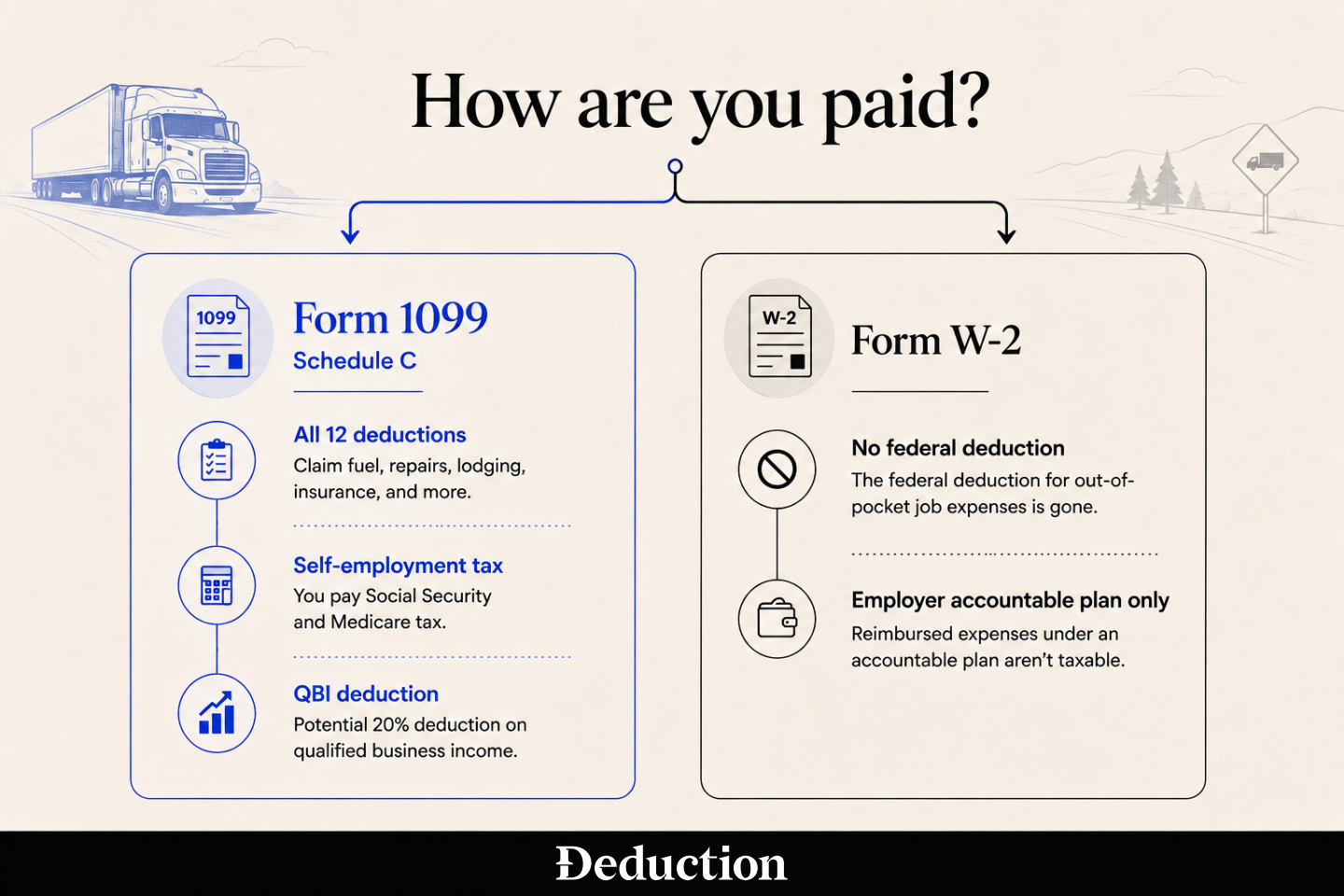
If you’re paid on a Form 1099-NEC, you’re treated as self-employed, whether you own your tractor, lease it, or run under someone else's authority. You report what you earned and what you spent on Schedule C, and you’re taxed on the profit rather than the gross.
You owe self-employment tax of 15.3% on your net earnings, covering both halves of Social Security and Medicare, with the Social Security portion stopping at $184,500 of earnings in 2026. Half of that tax comes back as a deduction on Schedule 1.
Every deduction in the list above cuts income tax and self-employment tax together, which is why they’re worth more to you than to an employee.
You also get the qualified business income deduction, which is now permanent instead of set to expire. It lets you deduct up to 20% of your qualified business income.
That number isn’t your Schedule C profit, which is where people go wrong. Start from the profit, take off the deductible half of your self-employment tax, your health insurance deduction, and anything you paid into a retirement plan, and the 20% comes off what’s left.
Trucking isn’t a “specified service” business, so your deduction never disappears just because you earned a lot, the way a consultant’s or an accountant’s can. Below $201,750 of taxable income, or $403,500 filing jointly, you skip the wage and property test.
One limit applies at every income level. The deduction can’t be more than 20% of your taxable income before the QBI deduction, minus any net capital gain, and for a lot of drivers that’s the figure that ends up controlling.
Above those thresholds, the wage and property test phases in, and it’s fully in at $276,750, or $553,500 filing jointly. It caps the deduction at the greater of 50% of the wages you pay or 25% of those wages plus 2.5% of what your equipment costs, so a one-truck operation with nobody on payroll still has the truck to work with.
Nobody withholds anything from a 1099, so you pay in four instalments instead. For 2026 income, the dates are April 15, June 15, and September 15, 2026, then January 15, 2027.
As an Employed Truck Driver With W-2
For a company driver, there’s nothing on the federal return. Out-of-pocket job expenses used to be an itemized deduction; the Tax Cuts and Jobs Act suspended them in 2018, and the One Big Beautiful Bill made that permanent. No per diem, no gloves, no phone, no truck supplies. The handful of jobs that kept the deduction doesn’t include driving.
What you have instead is your employer’s accountable plan. A carrier can reimburse your per diem and expenses tax-free if the plan requires a business connection, substantiation, and the return of anything left over, and those payments aren’t reported as wages on your W-2. Ask whether your carrier runs one, because it’s the only version of this deduction still open to you.
California, Pennsylvania, and New York never followed the federal rule and still allow employee business expenses on the state return, so check your own. California runs its version through a floor set at 2% of your federal AGI, and Pennsylvania won’t take federal per diem rates at all, so there you deduct what you spent with receipts behind it and no floor applies.
And if you’re paid on a 1099 but dispatched and supervised like an employee, told what to haul and when to run, the classification itself may be wrong. Form SS-8 asks the IRS to decide, and Form 8919 limits you to the employee half of Social Security and Medicare tax if it was.
How to Find Tax Deductions as a Truck Driver
Finding deductions is more of a sorting job than a tax job. Five steps take you from a year of receipts to numbers on a Schedule C.
- Track every truck expense as it happens: Fuel, repairs, tolls, scales, permits, parking and gear. Keep the receipt, note the unit number, and photograph anything printed on thermal paper before it fades to nothing.
- Compile everything and sort by quarter: Pull a full year from every card, bank account and fuel card, including the personal card you reached for at the parts counter, and group the receipts by date. Quarterly is the right grain, because that’s how you pay estimated tax.
- Map each cost to a Schedule C category: Use the table at the top of this article. A load board charge lands in office expense rather than sitting unclassified, and a mixed-use item gets its business percentage written down now, while you still remember the month.
- Check the current figures before you rely on them: Per diem rates, Section 179 limits and mileage rates all reset, and 2026 has two mileage rates rather than one.
- Keep the financial records: Three years from the date you filed is the general rule, longer in specific situations, and indefinitely if you never filed at all.
Hiring a Bookkeeper or Tax Professional
A bookkeeper and a tax professional do different jobs, and drivers often need both. A bookkeeper keeps the tax year’s financial records organized, categorizing settlements and expenses as they land. A CPA or an enrolled agent handles the return itself and the judgment calls inside it.
You’re paying for the judgment calls, and they’re the ones that move real money: whether the engine overhaul was a repair or an improvement, whether your tax home holds up, what share of the phone bill survives a question, and whether Section 179 or bonus depreciation suits your income this year.
Expect several hundred to a few thousand dollars for a return, and expect firms to be hardest to reach in the weeks you need an answer. You sign the return either way, so you still owe the tax if something on it is wrong.
Using a Tax Deduction Finder
A deduction finder works from the other direction. Instead of you deciding what each charge was, software reads your statements and receipts, categorizes the transactions, and surfaces the deductions you never flagged.
The deal breaker for this method is accuracy. Software is good at sorting and weak at judgment, and the questions that cost drivers real money are judgment calls. The tools worth paying for put a qualified human between the output and the IRS, so check what that review involves before you rely on it.
Let Deduction Find Your Truck Driver Tax Deductions
Getting your tax home wrong costs you $64 of deduction a day. Two hundred nights out is around $12,800 of deduction that either holds up or doesn’t, and the answer turns on whether you kept real duplicated living expenses at an address you come back to.
That isn’t a question you can look up, because it depends on facts only you have. Deduction is a tax deduction tracker built for exactly that kind of call, with a licensed CPA reviewing the answer before anything is filed.
- Upload your documents: Settlement statements, 1099s, fuel card exports and receipts go in as they are, in whatever format you have them.
- The AI finds your deductions: It categorizes every transaction, applies the current-year rules, and flags the mixed-use items that need a percentage.
- A real CPA reviews and files: A licensed professional checks the return, asks about anything that looks off, and files it.
This article is general information, not tax advice. Tax rules change and your situation has details this page can’t know, so confirm anything you plan to act on with a CPA or qualified tax professional before you file.
Frequently Asked Questions on Tax Deductions for Truck Drivers
What Tax Breaks Do Truckers Get?
Owner-operators deduct fuel, repairs, per diem meals, lodging, insurance, licenses, phone, software, loan interest, tools, and the truck itself through Section 179 or bonus depreciation. They also deduct up to 20% of profit as qualified business income and half of their self-employment tax. W-2 company drivers get none of these federally.
Is There a $7500 Tax Credit for Truck Drivers?
No. A bill proposing a $7,500 refundable credit for Class A CDL holders was introduced in March 2025 and is still sitting in the House Ways and Means Committee with no action since. Earlier 2022 and 2023 versions died there. Nothing is law yet, so no trucking tax credit exists today.
What Expenses Are 100% Deductible?
Fuel, repairs, tires, insurance, licenses and permits, tolls, load board and ELD subscriptions and tools are fully deductible for a self-employed driver. Meals are capped at 80% when you're away overnight under DOT hours of service, gifts at $25 a person a year, and entertainment at nothing. Day-run meals aren't deductible.
What's the Most I Can Claim on Tax Without Receipts?
There’s no such allowance. Under $75 you can skip the receipt, though lodging always needs one, and travel, meals and lodging are held to a stricter standard that rules out estimates. Per diem is the closest thing: it replaces meal receipts, but you still prove dates, places and business purpose.
What Law Did Trump Pass for Truck Drivers?
On taxes, the One Big Beautiful Bill Act of July 2025, which contains nothing trucking-specific. It raised Section 179 limits and made bonus depreciation and the qualified business income deduction permanent, and it permanently ended employee expense deductions. A separate 2025 executive order on English proficiency isn’t a tax measure.
What Kind of Truck Can Be Written Off on Taxes?
Any truck used in your business. A Class 8 tractor escapes the passenger-vehicle depreciation caps, so its full cost comes off in year one. A pickup over 6,000 pounds avoids them too, and a six-foot bed clears the $32,000 SUV limit, but it needs over 50% business use to qualify for Section 179 or bonus.
How Much Can a Trucker Deduct for Meals Per Day?
$64 for each day you’re away from home overnight. The per diem rate is $80 for the continental US through September 30, 2026, and drivers under Department of Transportation hours-of-service limits deduct 80% of it. Departure and return days are claimed at three-quarters of the rate. Only self-employed drivers can deduct it.
What Tax Deductions Can a 1099 Truck Driver Claim?
All twelve on this page, reported on Schedule C: fuel, repairs, per diem meals, lodging, licenses, insurance, phone and internet, home office, software, loan interest, depreciation, and tools. Plus the qualified business income deduction, half of self-employment tax, and self-employed health premiums on Schedule 1.