

Tax deductions for content creators are scattered across every part of social media life. The camera on your desk, the ring light in the spare bedroom, the flight to a brand shoot, the editing software billed monthly to the card you buy groceries with.
None of it arrives labeled. Platforms report the gross payment and take their cut quietly, brands send products with no paperwork, and one phone runs your business and your group chats. The cost of not sorting it is tax you paid on money you never kept.
This guide covers the 13 deductions creators claim most, the taxes you owe, and how to file for the 2026 tax year.
The 13 Deductions at a Glance
1. Production Gear
Production gear is the equipment you point at yourself: cameras, lenses, lighting, microphones, tripods, and green screens. Rentals count too, along with props and backgrounds you buy for a shoot.
How you deduct it depends on the price. Items costing $2,500 or less per invoice or item can be written off in full under the de minimis safe harbor, which needs a policy in place at the start of the year and an election statement on your return.
Bigger purchases are assets. Section 179 expenses up to $2,560,000 of them in 2026, capped at your income from businesses you actively run, while 100% bonus depreciation has no such cap. Both need business use above 50% on a camera that also shoots family holidays, which counts as "listed property."
2. Home Office
Your home office is the area where you film, stream, edit, package giveaways, and do admin. It has to pass three tests. Two of them are "exclusive use," meaning the space is used only for business, and "regular use," meaning consistently from a business standpoint instead of being used once in a while.
The third is what the space is: your principal place of business, somewhere you meet clients in person, or a separate structure like a garage studio. Storing merch inventory is a separate exception with its own conditions, and it only opens up if you sell retail or wholesale.
The simplified method gives you $5 per square foot up to 300 square feet, so $1,500 at most. The regular method uses Form 8829 for the business percentage of rent, utilities, and repairs. Either way it’s capped at your home-business income after other expenses, though only the regular method carries the excess forward. W-2 employees can’t claim it at all.
Your home studio may qualify as an office, but its size alone won’t tell you which method gives you more. Compare them with our home office deduction calculator.
3. Advertising and Marketing
This covers what you spend to get attention: paid social ads, search ads, boosted posts, campaigns behind a film, special, product launch, or partnership. Agency retainers, PR fees, press kits, and the cost of promoting your own channel all belong here.
It goes on line 8 of Schedule C, and it’s one of the cleaner deductions on this list, because promotional spending is rarely mistaken for something personal. Keep the invoice and the campaign it paid for, since "advertising" is a category auditors look at when the number is large relative to revenue.
4. Office Supplies and Furniture
Office supplies are the consumables that keep the admin side running: paper, ink, printer toner, folders, envelopes, pens, staplers, shipping materials, and labels. These are deducted in full the year you buy them.
Furniture is different in principle and often the same in practice. A desk, chair, shelving unit, or filing cabinet is technically an asset with a useful life, but the de minimis safe harbor and Section 179 both let you deduct the full cost in year one for the amounts creators typically spend.
Other equipment doesn’t belong here. Computers, cameras, and lighting go under production gear, and mixing them into office expense makes both categories harder to defend.
5. Software and Subscriptions
Editing suites, photo software, streaming tools, cloud storage, scheduling platforms, stock footage and music libraries, design tools, transcription services, and analytics dashboards are all deductible when you use them for the business.
Monthly and annual subscriptions are ordinary expenses you deduct in the year you pay them. Software you buy outright is treated as an asset, though off-the-shelf software qualifies for Section 179, so in practice you can usually still deduct the whole cost up front.
Split anything you also use personally. A music subscription you listen to in the car and use for background tracks is partly a personal expense, and the deductible share is the business share.
6. Phone and Internet
You can deduct the business portion of your phone plan and your home internet. For most creators, that’s a percentage rather than the whole bill, and the percentage needs a basis you could explain: a month of usage logs, a data split, or a consistent estimate you apply all year.
One rule people miss. The basic local service charge on the first landline into your home is a personal expense under the tax code, no matter how much business you do on it. A second dedicated business line is fully deductible, and cell phones aren’t affected by this rule.
7. Travel, Meals, and Insurance
Business travel is deductible when you’re away from your "tax home," the whole city or general area where you normally work, not the house you sleep in. The trip also has to be long enough that you need sleep or rest, so a long day trip to film nearby doesn’t count.
Inside the US, a trip that’s primarily for business gets the round-trip airfare in full even with personal days added, though hotels and meals only count for the business days. On a foreign trip, you prorate the airfare by business days, unless you’re away seven days or fewer or personal time stays under 25%.
When the trip is primarily a holiday, only the business expenses at the destination come off. Meals while traveling and meals with sponsors or collaborators are 50% deductible, and the standard meal allowance saves keeping receipts, though lodging has no shortcut. Line 15 insurance means business policies, since health premiums go on Schedule 1.
8. Vehicle and Mileage
If you drive to shoots, collaborations, events, or the post office to mail merch, those miles are deductible. There are two methods: the standard mileage rate, or the actual expense method, where you deduct the business share of gas, car insurance, repairs, and depreciation.
2026 has two mileage rates rather than one. The IRS set the business rate at 72.5 cents per mile from January 1 through June 30, then raised it to 76 cents from July 1 through December 31. If you drove all year, split your log at July 1 and multiply each half by its own rate.
Commuting is never deductible, though a qualifying home office turns trips to other work locations into business miles. Choose your method carefully in year one, because you have to use the standard rate the first year a car is available for business if you want the option to switch later.
9. Wardrobe, Costumes, and Beauty
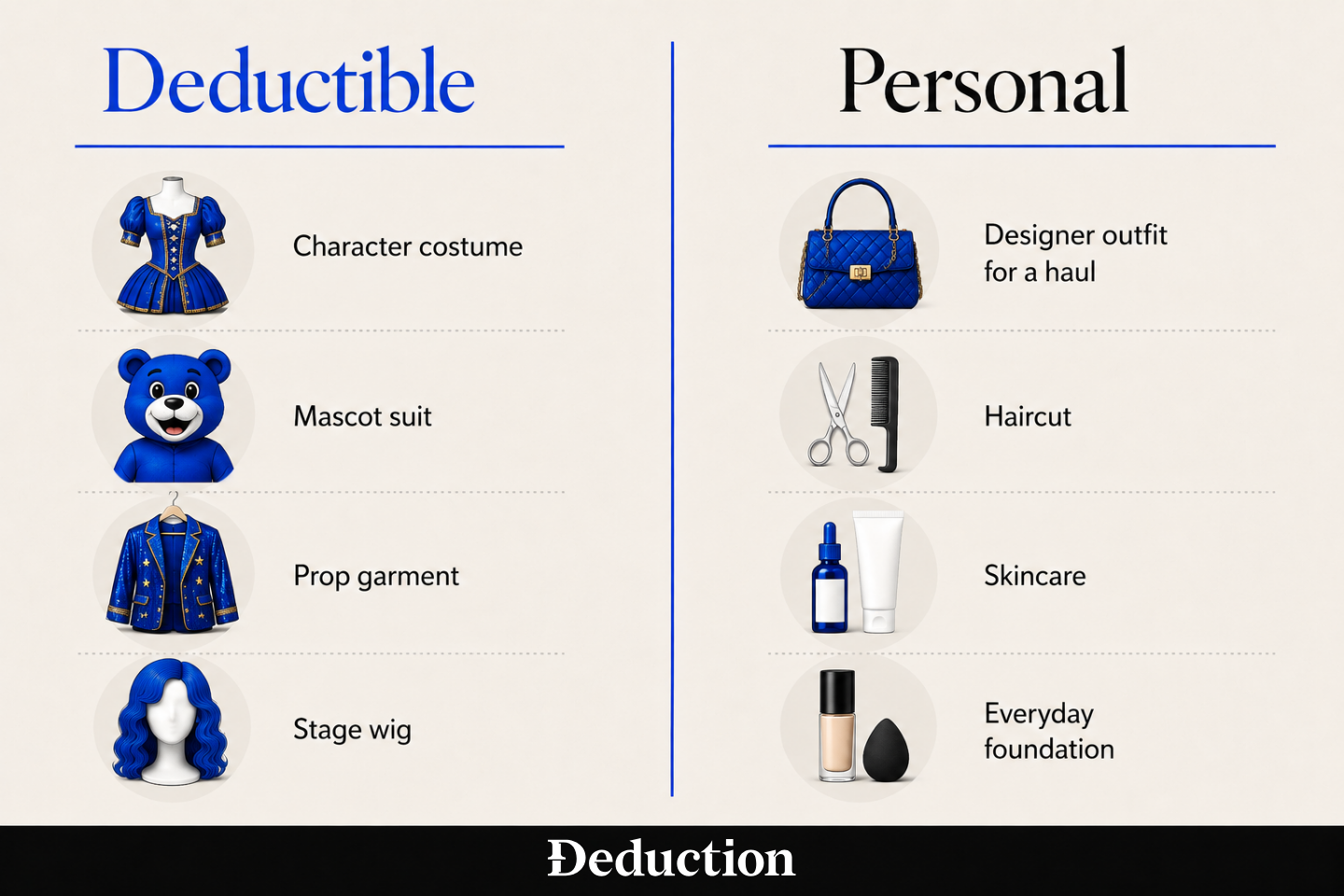
Short answer: usually no. Clothing has to clear three hurdles: your work requires it, it isn’t adaptable to ordinary wear, and you don’t wear it outside work. Courts judge that middle one objectively, by what counts as street wear generally rather than by your own habits.
The leading case is a Dallas boutique manager who bought Yves Saint Laurent clothing she wore only on the job. The Tax Court allowed the deduction, then the Fifth Circuit reversed in 1980, holding the clothes were adaptable to street wear whatever she did privately.
Costumes are clearly deductible, needed for the work and not wearable off it: a character outfit, a mascot suit, or a prop garment nobody would wear to dinner. Theatrical makeup and prosthetics are greyer, and the IRS audit guide treats makeup as personal beyond what the work adds. Haircuts, skincare, and everyday foundation are personal, even when your face is the product.
10. Website, Domain, and Hosting
If you run a site, whether it sells merch, hosts a portfolio, or collects newsletter signups, the running costs come off. Domain registration and renewal, hosting, SSL certificates, themes, plugins, email service, and platform fees are all ordinary business expenses.
Building the site is treated differently from running it. IRS Notice 2023-63 keeps hosting, domain registration, and content entry outside the software rules, so those stay ordinary running costs. A template site you set up yourself is a current expense too.
A substantial custom build falls under the software rules instead. Since 2025, Section 174A lets you deduct domestic software development costs in the year you pay them, or spread them over at least 60 months. Have your preparer pick a lane before you file.
11. Giveaways, Contests, and Prizes
Giveaways to your audience are promotion, not gifts. Merch, gear, gift cards, digital products, and cash prizes handed out to grow or reward a following are deducted as advertising on line 8, and the same treatment covers physical and digital items alike.
Gifts to specific individuals are capped hard. When you send something to one person to maintain a relationship rather than to promote the business publicly, the deduction is limited to $25 per recipient per year. Branded swag costing $4 or less escapes that cap when your name is permanently on it and you hand out many identical ones.
Winners may owe tax on what you send them. If prizes to one person reach $2,000 in 2026, up from $600, you report it in box 3 of Form 1099-MISC for a straight giveaway, or box 1 of Form 1099-NEC when the prize is really payment for work.
12. Platform and Payment Processing Fees
Every cut taken between the viewer and your bank account is deductible: the platform’s revenue share, marketplace commissions, payment processor fees, currency conversion charges, payout fees, and the percentage a fan-funding site keeps.
Here’s the part that costs creators money. A Form 1099-K reports the gross amount before fees, so if a platform paid out $40,000 after keeping $8,000, the form says $48,000. You report the gross figure as income and deduct the $8,000 separately, rather than reporting the net and hoping the numbers reconcile.
13. Business Formation
The cost of setting up the business behind the channel is deductible. State LLC filing fees, incorporation costs, legal fees for drafting your operating agreement, registered agent fees, and accountant fees for the setup all qualify.
Formation costs follow the start-up cost rules. You can deduct up to $5,000 of start-up costs in the year the business begins, with the rest written off over 180 months, and the $5,000 shrinks once total start-up costs pass $50,000.
Ongoing state fees are separate and simpler. Annual report fees, franchise taxes, and business licenses are deducted each year as taxes and licenses on line 23. Note that a single-member LLC is normally disregarded for federal tax, so you still file a Schedule C rather than a separate business return.
Do Influencers Pay Taxes?
Yes. Money earned from content is business income, and it’s taxable whether it arrives as a bank transfer, a gift card, a free product, or a comped hotel stay.
You owe self-employment tax once your net earnings reach $400 for the year, which is a far lower bar than most creators expect. And you have to report income even when no tax form shows up, so a brand that pays you $1,500 and issues nothing has not made that payment tax-free.
Methods of Earning Money by Influencers
Creator income arrives through several channels at once, and they’re all taxed the same way once they land on Schedule C.
- Platform monetization: Ad revenue shares from YouTube, TikTok, or Twitch pay you a cut of what advertisers spend against your content. It usually arrives monthly and is reported to you by the platform.
- Sponsorships: A brand pays you to feature or mention its product in a specific piece of content. Payment can be cash, product, or both, and both are income.
- Selling merch: Revenue from apparel, prints, digital downloads, and presets is business income, minus your cost of goods sold. Physical merch can also trigger sales tax obligations.
- Affiliates: You earn a commission when a viewer buys through your link or code. Payment usually comes from an affiliate network rather than the brand itself.
- Direct advertising: You sell placement on your own channel, newsletter, or podcast directly to an advertiser without a platform in the middle. The full amount is yours, and the full amount is income.
- Partnerships: Longer-term arrangements such as ambassador deals, revenue shares, and co-branded product lines. These often mix fixed retainers with performance payments.
- Exclusive content passes: Subscription tiers on Patreon, Substack, or a channel membership. Recurring subscriber income is taxed as ordinary business income like everything else here.
What Kind of Taxes Do Content Creators and Influencers Pay?
Creator income can attract several taxes at once, and only the first two are unique to being self-employed.
- Self-employment tax: 15.3% covers Social Security and Medicare, and you pay both halves because there’s no employer. It applies to 92.35% of your net earnings, and the Social Security portion stops at $184,500 of earnings in 2026.
- Additional Medicare tax: An extra 0.9% applies above $250,000 of earnings if you file jointly, $125,000 if you’re married filing separately, and $200,000 for everyone else. Those thresholds aren’t indexed for inflation.
- Federal income tax: This sits on top of self-employment tax at your normal bracket rate. You may also deduct 20% of your profit as qualified business income, though sponsorship and endorsement income is a "specified service business," so that deduction phases out between $201,750 and $276,750 of taxable income, or double those figures filing jointly.
- Quarterly estimated payments: Nobody withholds tax from your creator income, so you pay it in four instalments. For 2026 income, the dates are April 15, June 15, and September 15, 2026, then January 15, 2027.
- State and local taxes: Most states tax business income, some cities add their own, and a few states have no income tax at all. Where you live when you earn the money is what generally determines this.
- Franchise taxes: Several states charge an LLC an annual fee whether or not it made a profit. California’s $800 annual LLC tax is the one creators hit most often, and Texas still wants an annual Public Information Report even when no franchise tax is due.
- Sales taxes: Selling physical merch means collecting sales tax in your own state from the first sale, with no threshold at all, and in other states once you cross their economic nexus threshold. Selling through a marketplace usually shifts that job to the platform.
- Tax on gifted product and comped trips: A product or trip given in exchange for a post is taxable at its fair market value, the same as if the brand had wired you cash. An unsolicited box rarely counts as a gift either, because what matters is the brand’s motive, and hoping for coverage is a business motive.
- Foreign withholding: As a US person you file a Form W-9 with your platforms, not a W-8BEN, and no US tax is withheld from your payouts. If a foreign country taxes income you earn there, you can credit only the tax you were legally required to pay, so claim any treaty rate first.
How to Find Tax Deductions When You Are a Content Creator
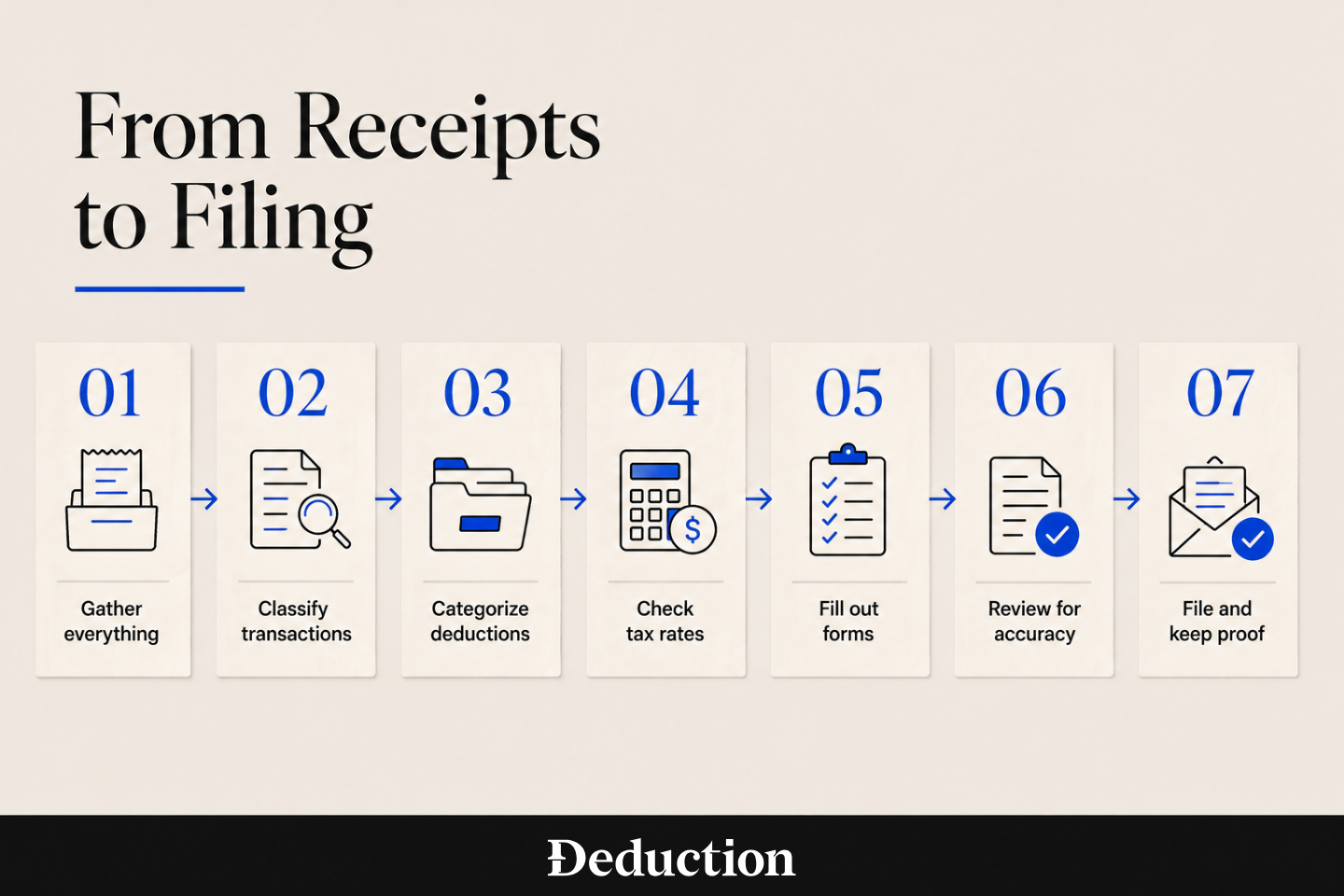
Finding deductions is mostly a sorting problem. Work through these seven steps in order, and the list above turns into numbers on a return.
- Check your spending and receipts. Pull a full year of statements from every card, bank account, and payment app you used for the business, including the personal card you reached for at the camera store.
- Compile everything and classify. Put every transaction in one place and mark each as business, personal, or mixed. Add a business percentage to mixed items now, while you still remember what you used them for.
- Categorize according to tax deduction lists. Map each business transaction onto a Schedule C category using the table at the top of this article. A Squarespace charge lands in office expense rather than sitting unclassified.
- Refer to the latest deduction rules. Check the current figures before you rely on them. Mileage rates, Section 179 limits, and reporting thresholds all changed for 2026.
- Fill out the schedules and forms. Income and expenses go on Schedule C, self-employment tax on Schedule SE, depreciation and Section 179 on Form 4562, and the regular-method home office on Form 8829.
- Have a CPA or tax professional review it. A review catches the judgment calls that spreadsheets don’t: what percentage of the phone bill holds up, whether the camera is listed property, whether a trip was primarily business.
- Submit your taxes. File the return and pay anything still owed. Then set the following year’s estimated payment dates in your calendar, because the first one lands before you’ve recovered from this one.
How to File Taxes for Influencers and Content Creators
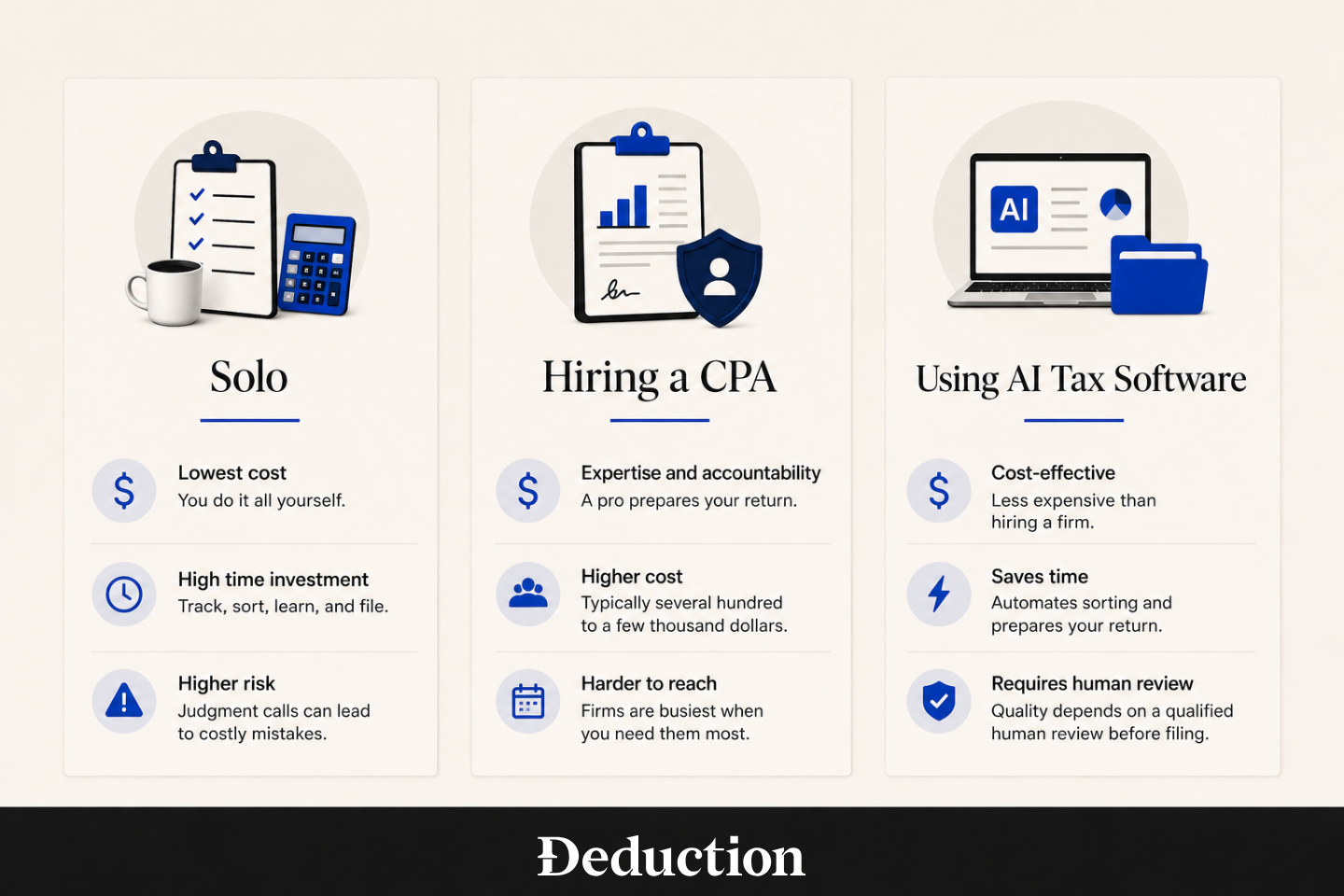
There are three realistic ways to file your return, and they trade money against time and risk in different proportions.
Solo
You do everything: track the income, sort the expenses, learn which schedule each number belongs on, and file. It’s the cheapest option, and it works when your situation is simple, though creator returns rarely stay simple for long, because mixed-use gear, home office percentages, and multi-state income all need judgment rather than data entry.
Hiring a CPA
You hand your records to a firm or an individual professional, and they prepare the return. You get expertise and a second set of eyes, though you sign the return and stay liable for the tax either way. Cost typically runs from several hundred to a few thousand dollars. The catch is timing, since most firms are hardest to reach in exactly the weeks you need answers.
Using AI Tax Software
You subscribe to AI tax software for influencers that reads your documents, categorizes your spending, and prepares the return. It removes most of the sorting work and costs less than a firm. The quality depends entirely on whether a qualified human reviews the output before it goes to the IRS, so check what the review involves.
Let Deduction Find Your Tax Deductions as an Influencer
You can have every receipt scanned, every transaction tagged, and a tidy spreadsheet of the year, and still not know what percentage of the phone bill will hold up, whether the camera counts as listed property, or which half of the year each mileage rate applies to.
Those are judgment calls, and they’re where creator returns are won or lost. Deduction is an AI tax deduction finder built to make them, with a licensed CPA reviewing the answer before anything is filed.
- Upload your documents. Statements, 1099s, receipts, and platform payout reports go in as they are, in whatever format you have them.
- The AI finds your deductions. It categorizes every transaction, applies the current-year rules, and flags the mixed-use items that need a percentage.
- A real CPA reviews and files. A licensed professional checks the return, asks about anything that looks off, and files it.
This article is general information, not tax advice. Tax rules change and your situation has details this page can’t know, so confirm anything you plan to act on with a CPA or qualified tax professional before you file.
Frequently Asked Questions About Tax Deductions for Content Creators
Here are some frequrntly asked questions about content creators and influencers tax deduction:
How Much Do Content Creators Get Taxed?
You pay 15.3% self-employment tax on 92.35% of your net profit, plus federal income tax at your normal bracket, plus any state tax. Many creators set aside 25% to 35% of profit, but treat that as a savings habit rather than a calculation and run the Form 1040-ES worksheet.
What Expenses Can Content Creators Write Off?
Any expense that’s ordinary in your line of work and helpful to the business. In practice, that means production gear, home office, software, the business share of phone and internet, advertising, travel, half of business meals, platform fees, giveaways, and business formation costs.
What Can I Claim on Tax as a Content Creator?
Claim what you can substantiate. Keep the receipt, the business reason, and the business-use percentage for anything mixed. An expense you can’t explain a year later is the one that gets disallowed, so the documentation matters as much as the category you put it in.
Can Influencers Write Off Clothes?
Rarely. Clothing has to be required for the work, unsuitable for ordinary street wear judged objectively, and not worn outside work. Costumes and character outfits qualify. Designer pieces bought for a haul do not, even if you never wear them off camera.
How Do I Do My Taxes as a Content Creator?
Report income and expenses on Schedule C, self-employment tax on Schedule SE, and carry the result to your Form 1040. Add Form 4562 for equipment and Form 8829 for a regular-method home office. Pay estimated tax quarterly, so you’re not settling it all in April.
Can Influencers Write Off Travel?
Yes, when the trip takes you away from your tax home overnight and is primarily for business. Adding personal days doesn’t disqualify the trip, and your round-trip airfare still comes off in full, but hotels, meals, and local transport only count for the business days.
Can Influencers Write Off Meals?
Half of them. Meals while traveling for business and meals with sponsors, clients, or collaborators are 50% deductible. Meals you eat alone at home while editing are personal. Keep a note of who you ate with and why, since that’s the part people forget.
What Business Expenses Are Not 100% Deductible?
Business meals are limited to 50%. Gifts to a specific person are capped at $25 a year. Mixed-use items like phones, internet, cars, and cameras are deductible only in proportion to business use. The home office deduction is limited to what other expenses leave behind.