
Are there a home renovation tax deductions for a new kitchen, roof, or finished basement? Usually not in the year you pay, because the tax rules treat work on your own home as a personal cost.
A few types of renovation projects can still lower your taxes now, and most real improvements can lower your taxable profit when you sell.
This guide shows which renovations count, when they count, and the records you'll need.
Key Takeaways
- Renovating your own home usually isn't deductible. The cost only adds to your "basis," your total investment in the home.
- A higher basis can lower your tax when you sell your home, but usually only on profit above $250,000 ($500,000 for most married couples filing jointly.
- Three costs can be deductible sooner: changes for a medical need, improvements to a home office for your own business, and interest on a home equity loan used for the renovation.
- The medical and loan-interest deductions only work if you itemize.
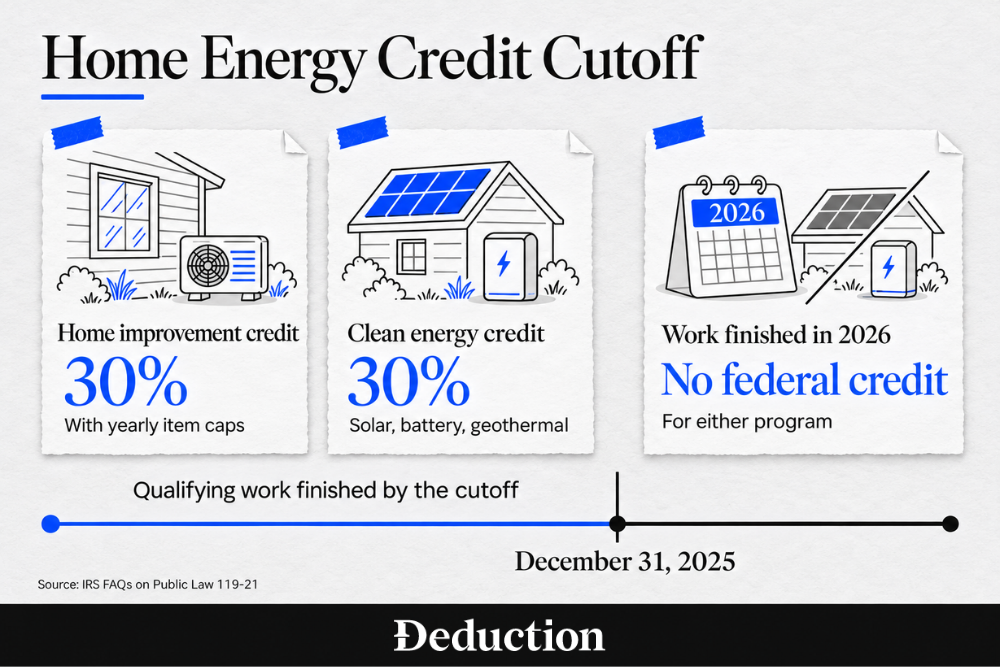
- The federal energy credits for windows, heat pumps, and solar panels ended for work finished after December 31, 2025.
Are Home Renovations Tax Deductible?
Generally no. Any work on the home you live in is considered a personal expense, and you cannot deduct it.
Instead, the cost of an improvement adds to your home's "basis." That's your total investment in the home. It's usually what you paid for the house plus what you've spent on improvements.
A higher basis means less taxable profit when you sell your home in the future.
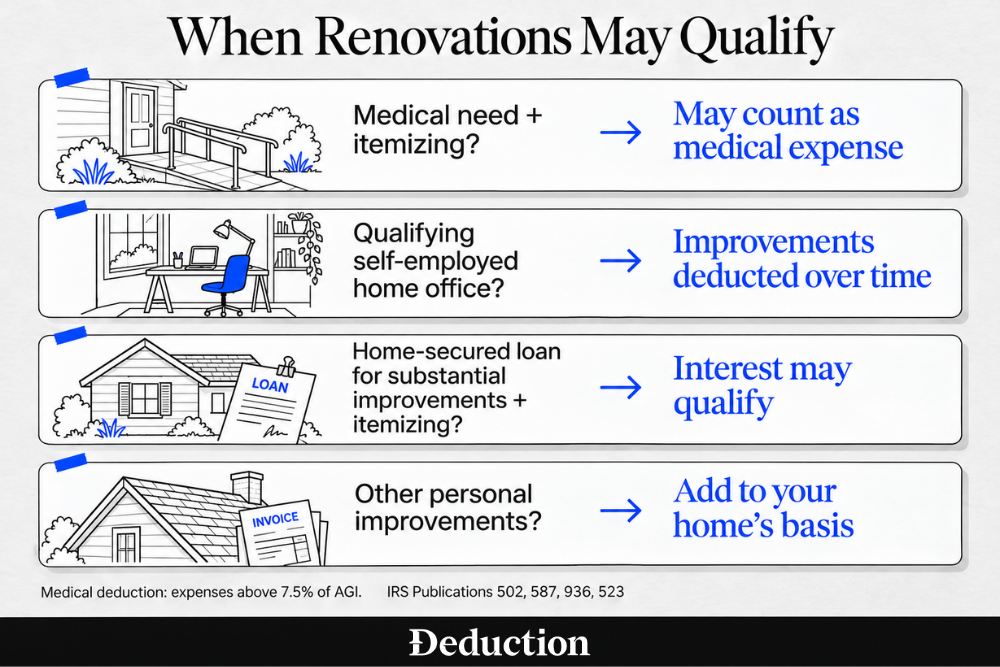
Some renovation costs can be deducted sooner (in selected cases), but only if you itemize, run your own business from home, or need the work for a medical reason.
Capital Improvements vs. Repairs
Patching a spot or fixing a leak is considered a repair, while replacing the whole roof is an improvement, and only the improvement adds to your basis.
An improvement adds value to your home, makes it last longer, or adapts it to a new use. A repair just keeps it in the same condition. IRS Publication 523 gives these examples:
- Improvements: A new room or deck, a new roof, new heating or central air, an updated kitchen, new flooring, and a new driveway or fence all add to your basis.
- Repairs: Repainting, fixing a leak, patching holes or cracks.
On a rental property, you can generally deduct repairs in the year you pay for them, while improvements are deducted a little at a time over many years since they're used in business. Our guide to tax deductions for landlords covers those rules.
Immediate Renovations that Can Lower Your Taxes
Here are some immediate home improvements that can lower your taxes in the same year:
Medical and Accessibility Improvements
If someone in your home can no longer manage the stairs or a standard bathroom, you may install a ramp, wider doorways, or grab bars. Changes like these can count as a medical expense when they're mainly for the medical care of you, your spouse, or a dependent (IRS Publication 502).
- Full coverage: Entrance ramps, wider doorways and hallways, railings and grab bars, lowered kitchen cabinets and equipment, and porch lifts usually add no value to the home, so their whole cost can count.
- What counts in part: A project that raises the home's value, such as an elevator, counts only for the cost above that added value.
- The limit: You have to itemize, and only your total medical costs above 7.5% of your adjusted gross income (AGI) are deductible. With an AGI of $80,000, the first $6,000 doesn't count.
Home Office Improvements
Home office improvements count only if you're self-employed. If you work from home as a W2, you can't deduct these types of improvements.
You have to use the space regularly and only for your business. It also has to be your main place of business, a place where you regularly meet clients, or a separate structure such as a detached studio (IRS Publication 587).
You deduct an office improvement a little each year over 39 years, not all at once. For work on the whole house, only the office's share of the space counts. A $20,000 roof on a home where the office is 10% of the space gives you $2,000 to deduct, or about $51 a year.
If you only paint or repair the office, you can deduct the full cost that year, up to a limit based on your business income. If you file Schedule C, you claim all of this on Form 8829, the form for business use of your home. The simplified method ($5 per square foot) has no deduction for improvements.
Interest on a Loan Used to Renovate
If you borrow against your house to pay for a remodel with a home equity loan or a home equity line of credit (HELOC), you may be able to deduct some of the interest as mortgage interest.
- Deductible: Interest on the money you use to buy, build, or substantially improve the home securing the loan counts.
- Not deductible: Interest on any part you spent on something else, such as a car or tuition, doesn't count. Neither does unsecured personal loan interest, even if the whole loan went into the remodel.
- The limit: You have to itemize, and the interest counts only on up to $750,000 of home loans in total ($375,000 if you're married filing separately), including your first mortgage (IRS Publication 936).
Repairs After a Declared Disaster
Repair bills due to damages after a storm, flood, or fire aren't deductible. The loss itself may be deductible as a "casualty loss" if it came from a federally declared disaster or, starting with the 2026 tax year, a state-declared disaster that the U.S. Treasury also recognizes.
Insurance reduces how much you can claim. Under the usual rules, the first $100 per event isn’t deductible. The remaining loss also has to exceed 10% of your adjusted gross income (AGI), and only the amount above that threshold is deductible. You need to itemize in order to claim it.
In the case of qualifying major disasters declared by the President that began before 2027, it becomes more generous. After insurance, just $500 per event is excluded from the deduction. There’s no income-based threshold, and you can claim it even if you take the standard deduction.
What Happened to the Energy Tax Credits for Home Improvements?
They're gone. Both federal credits for energy upgrades, including windows, insulation, heat pumps, and solar panels, ended on December 31, 2025. Work finished in 2026 doesn't qualify, even if a contractor's quote or an older article still promises a 30% credit.
If your project was finished in 2025, you can still claim the credit on your 2025 return with Form 5695, or generally amend that return within three years of filing it. A deposit paid in 2025 isn't enough, because the installation had to be finished by December 31, 2025.
Dishwashers, refrigerators, and other kitchen and laundry appliances are never eligible, so there was no federal tax credit for an energy-efficient dishwasher even before 2026. But your state or utility may still offer a rebate, so check before you buy.
Home Renovation Projects that are Tax Deductible
Here's how common projects are usually treated for the 2026 tax year at the home you live in.
How Renovations Can Reduce Your Taxes When You Sell
When you sell your home, you're taxed on your profit: the sale price minus your selling costs and your basis. Improvements aren't deducted when you sell. They raise your basis, which lowers the profit you're taxed on, so you can owe less tax. The money you get from the sale stays the same.
Many sellers owe no tax anyway, because of the home sale exclusion (IRS Topic 701). If you owned and lived in the home for at least two of the five years before the sale, you can leave up to $250,000 of profit untaxed.
If you’re married and filing jointly, you may qualify for up to $500,000 tax-free. Both of you need to have lived there for those two years, but only one of you needs to have owned it that long. You can’t use this break again within two years of claiming it on another home sale.
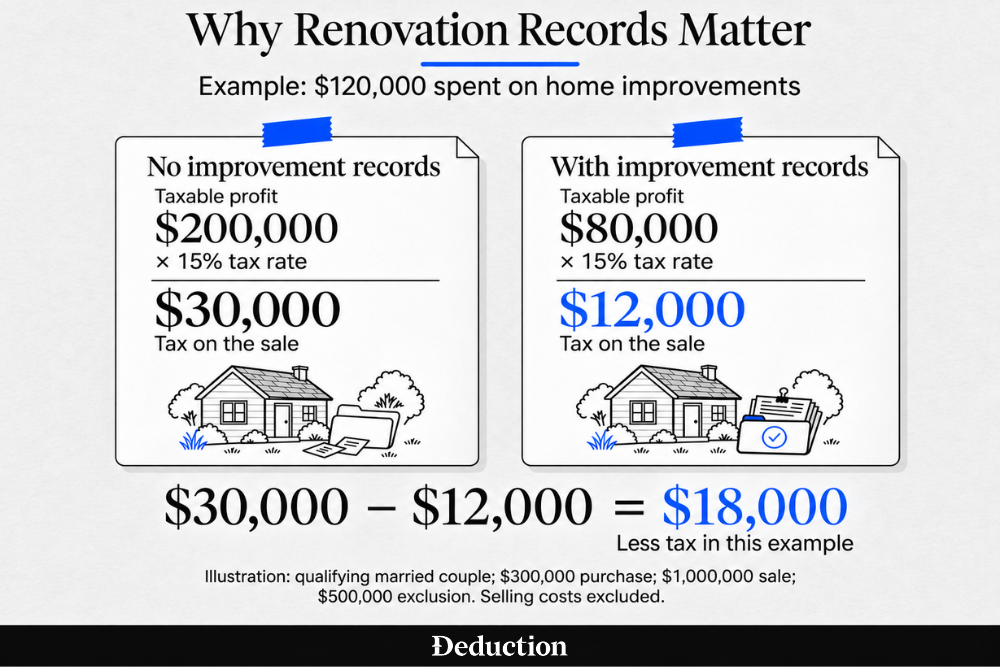
For example, a married couple who qualify for the full exclusion bought a home for $300,000, spent $120,000 on improvements, and sold it for $1,000,000. These are illustrative figures that leave out selling costs.
- Without records: Their profit is $700,000. After the $500,000 exclusion, $200,000 is taxed.
- With records: Their basis is $420,000, so their profit is $580,000. After the exclusion, $80,000 is taxed.
At a 15% federal capital gains rate, that's about $18,000 less in tax. It's a rough estimate, because the rate depends on their income and can be lower or higher.
Records matter most if you've owned the home a long time, if prices in your area have climbed, or if the home doesn't qualify for the exclusion, such as a vacation home. Our answer on how to report the sale of a second residence covers that last case.
Records to Keep for Home Improvements
You might sell decades after the work was done, so keep these for every improvement:
- Contracts and invoices: They show what was done and what it cost.
- Proof of payment: A canceled check or a bank or card statement shows the bill was paid.
- Permits and photos: A permit and before-and-after photos help show the work was an improvement and not a repair.
- Tax forms: Keep Form 5695 if you claimed an energy credit and Form 4684 if you deducted a disaster loss, because both lower your basis.
Keep Your Renovation Records Where You'll Find Them
When you sell, will you still have the invoice for a roof you replaced fifteen years earlier? And was the bathroom you redid an improvement that adds to your basis, or a repair that doesn't?
Deduction is a tax filing service built around AI, with CPAs and tax professionals ready to verify. Upload each contract and receipt to your Vault, or forward the email it came in, and the tax document organizer keeps it filed by tax year.
Before a project starts, you can ask Taylor, Deduction's AI tax agent, whether it's likely to count as an improvement. A CPA or licensed tax professional reviews your return before it's filed. Start by uploading the paperwork from your last project.
Frequently Asked Questions About Home Renovation Tax Deductions
Here are some frequently asked questions about Home renovation tax deductions:
What House Expenses Can Be Written Off?
If you itemize, you can generally write off mortgage interest, property taxes up to the state and local tax cap, and, from 2026, mortgage insurance premiums, which shrink above $100,000 of adjusted gross income and end at $109,000 (half those amounts if married filing separately). Repairs, utilities, and insurance on your own home aren't deductible.
Is Landscaping Considered a Capital Improvement?
Yes, when it's a lasting addition. New landscaping, a fence, a retaining wall, or a lawn sprinkler system adds to your home's basis, while mowing, trimming, and seasonal cleanup are upkeep that doesn't. On a rental or business property, some landscaping expenses are tax deductible in the year you pay.
What Are the Big Three Itemized Deductions?
The phrase usually means mortgage interest, state and local taxes, and charitable gifts. For most people, those three decide whether itemizing beats the standard deduction. If it doesn't, the medical and loan-interest breaks for a renovation won't lower your tax.
How Does the New $6,000 Tax Deduction Work?
It's an extra deduction for people 65 and older, not a renovation rule. For 2025 through 2028, you can deduct $6,000, or $12,000 if both spouses qualify, whether or not you itemize. Married couples must file jointly, and you need a Social Security number. It phases out above 75,000ofmodifiedAGI(150,000 joint).
This article is general information, not tax advice. How a renovation is treated depends on the work, how you use the home, and whether you itemize, so check your situation with a CPA or tax professional before you file.
Related Articles
- Above the Line Tax Deductions: How to Prepare Your Taxes
- 18 Tax Deductions for 1099 To Look Out for if You Are Self-Employed This Tax Season
- 9 Best Tax Software for Rental Property for Smooth Schedule E Filing