
You paid for mowing, new sod, or a new patio. Can any of those landscaping costs lower your tax bill? For many property owners, at least part of those landscaping expenses is tax deductible.
These costs can qualify for a deduction, but you won't always get the full tax break right away. Routine upkeep may come off this year's income, while certain improvements are deducted a little at a time over 15 years, unless you qualify to deduct them faster. Land costs can't be deducted that way.
One landscaping bill can include all three, and sorting them out is the most difficult part.
Landscaping generally qualifies for a deduction when the property earns income, such as a rental home or your business premises. But putting in new landscaping usually won't give you a full deduction right away. Those costs are generally "capitalized," meaning you get the tax benefit over time or when you sell the property.
Key Takeaways
- You generally can't deduct landscaping at the home you live in, but improvements such as a patio or fence add to your home's basis and can lower your tax when you sell if your profit is more than you can exclude.
- On a rental or business property, you can generally deduct routine lawn care and yard upkeep in the year you pay for it.
- New landscaping on income property is generally capitalized: fences, walkways, and driveways are depreciated over 15 years, while grading and general planting usually go into the land's basis.
- Those 15-year improvements can qualify for 100% bonus depreciation in the first year, but not for Section 179.
- The energy-efficient home improvement credit ended after 2025 and never covered trees, shrubs, or rain barrels.
When Landscaping Is Tax Deductible, Property by Property
Landscaping is generally tax-deductible only on property that earns income, and the type of work decides whether you deduct it now or over time. Here's how each type of property is treated:
Landscaping the Home You Live In
You generally can't deduct landscaping at the home you live in. Trimming hedges, planting shrubs, and adding a garden walkway are all personal expenses.
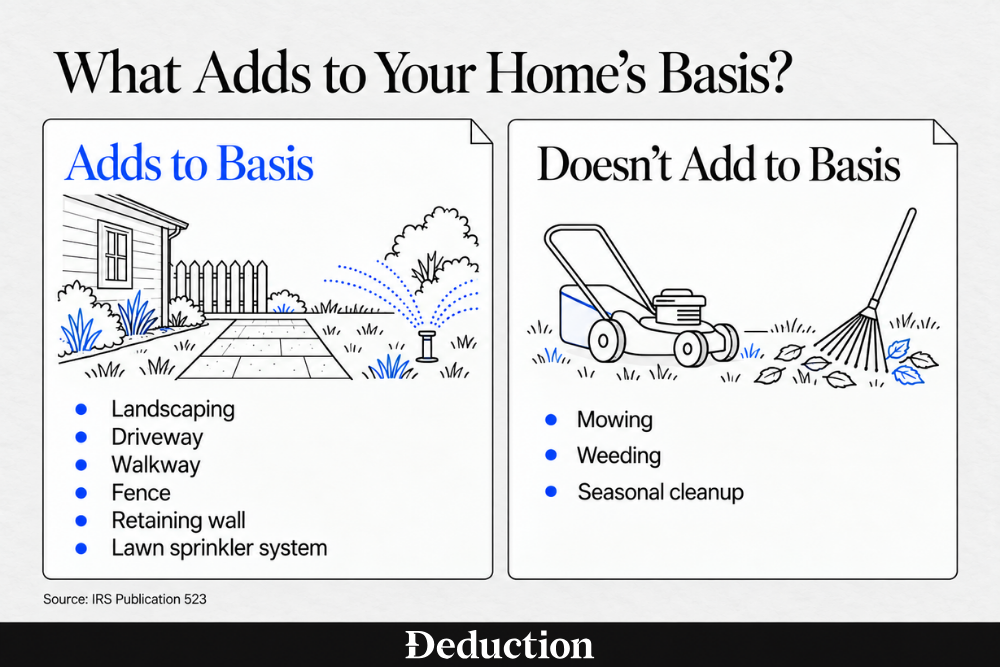
Improvements such as landscaping, a driveway, a walkway, a fence, a retaining wall, or a sprinkler system add to your home's "basis", which can lower the profit you're taxed on when you sell your home.
Think of basis as your total investment in the home: generally, the purchase price, certain closing costs, and the money you've spent on improvements, including landscaping.
A higher basis can reduce the profit you're taxed on when you sell your house. That can save you money if your profit exceeds the amount you're allowed to exclude from tax.
You can generally exclude up to $250,000 of profit, or $500,000 if you're married filing jointly. To qualify, you generally must have owned and lived in the home for at least two of the five years before the sale and haven't used the exclusion in the past two years.
If you qualify for the full exclusion and it covers all your profit, adding the patio's cost to your basis won't lower your tax bill. Routine upkeep, such as mowing, weeding, and seasonal cleanup, doesn't add to basis.
Keep your improvement invoices for as long as you own the home, and generally until three years after the tax return due date for the year you sell it.
Landscaping on Rental and Business Property
For a rental or business property, you can generally deduct routine yard upkeep in the year you pay for the work. New landscaping is usually deducted over time, so you'll need to check each bill and separate upkeep from improvements.
The same rules apply to a long-term rental, a short-term rental, and the building your business operates from. You report a rental on Schedule E, the form for rental income, and a sole proprietor's business property on Schedule C, the form for business profit or loss.
If you also use the property yourself, such as a vacation home you rent out part of the year, you split these costs between rental and personal use based on the number of days used for each. For everything else a rental lets you deduct, see our guide to tax deductions for landlords.
Lawn Care and Yard Upkeep
You can generally deduct routine yard maintenance in the year you pay for it. This is work that keeps the yard in its current condition: mowing, trimming, leaf removal, replacing dead seasonal flowers, and fixing a broken sprinkler line.
For a rental, you'd generally report lawn care on Schedule E, line 7 (cleaning and maintenance), and a repair such as the sprinkler line on line 14 (repairs). For business property, both go on Schedule C, line 21 (repairs and maintenance).
If one bill covers monthly mowing and a new flower bed, separate the two costs before claiming a deduction. Mowing is routine upkeep you can deduct this year. Installing the flower bed is an improvement, so it has a different deduction method. Ask your landscaper to list each charge separately.
New Landscaping Has to Be Capitalized
For your rental property, mowing and weeding generally count as upkeep. Installing a patio where there wasn't one adds a lasting feature, so it generally counts as an improvement.
You usually have to "capitalize" that cost, meaning you record it as an investment in the property and deduct it through depreciation rather than as routine upkeep.
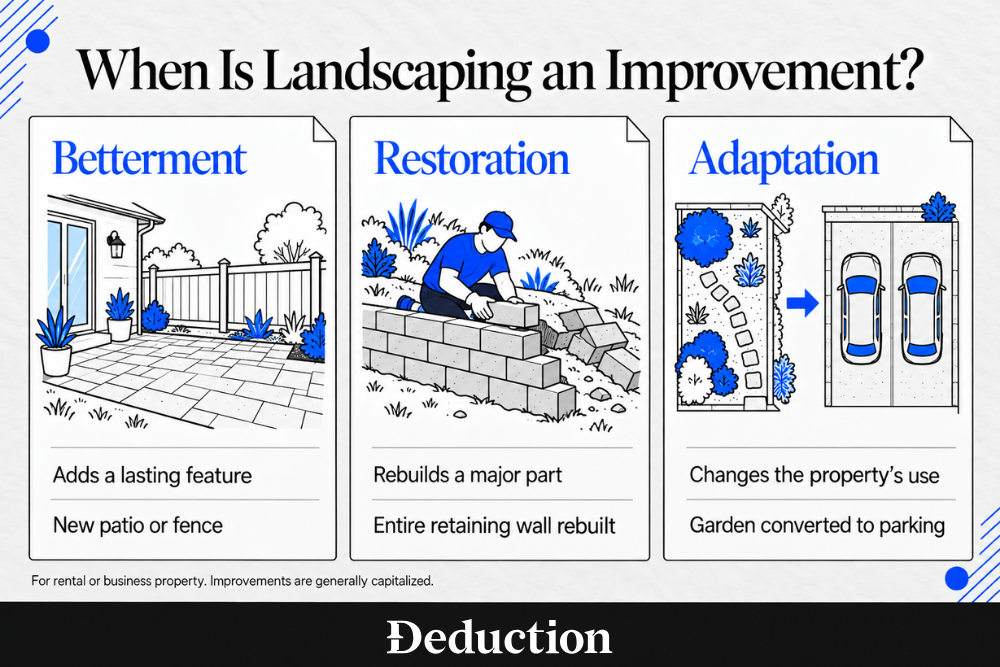
Under IRS rules, improvements fall into three groups:
- Betterment: The work adds a substantial feature or makes the property significantly better. Examples include installing a new paver patio, fence, or retaining wall.
- Restoration: The work replaces a major part of an existing feature or rebuilds it after it can no longer function. Rebuilding an entire collapsed retaining wall is an example.
- Adaptation: The work changes the property to a different use from when you began renting it, such as converting a garden into a parking area for a commercial tenant.
For smaller jobs, the de minimis safe harbor lets you deduct improvements that cost $2,500 or less per invoice or per item in the year you pay. You elect it each year by attaching a statement to your return. You also need a consistent policy, in place at the start of the year, of expensing those amounts in your own books.
The safe harbor doesn't cover amounts paid for land. Regrading and general planting generally count as land costs.
A full re-sod or a hardscape project isn't a repair just because it replaces something that was already there. Replacing an entire lawn, patio, or fence is generally an improvement.
How Long to Depreciate Landscaping and Hardscape
Once a cost counts as an improvement, the next question is when you can deduct it. Some improvements are deducted over several years. Other costs stay in the land's basis until you sell.
An attached patio may count as part of the building, so ask a tax professional which category fits yours.
Bonus depreciation can speed up the deduction. Qualifying 15-year improvements acquired and placed in service, meaning ready for use, after January 19, 2025, may qualify for 100% bonus depreciation. That lets you deduct the full cost in the first year. Land improvements generally don't qualify for Section 179, another way to deduct asset costs upfront.
You can choose to spread the deduction out instead, but opting out of bonus depreciation applies to the whole property class placed in service that year, such as all your 15-year property.
A large deduction can help when you have rental or business income to offset. If it creates a rental loss, the passive activity loss rules may delay some of the tax benefit. Losses you can't use generally carry forward.
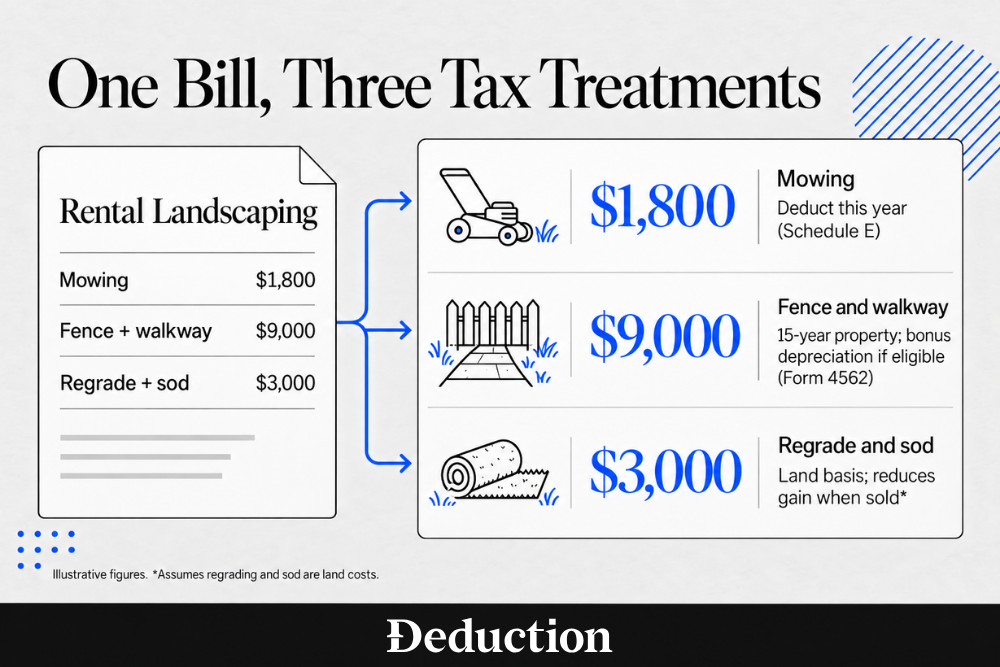
For example, suppose you spend these estimated amounts on a rental:
- $1,800 on mowing: Deduct this year on Schedule E, line 7.
- $9,000 on a fence and walkway: Deduct in full on Form 4562 if eligible for 100% bonus depreciation, or over 15 years if you opt out.
- $3,000 on regrading and sod: Assuming these are land costs, add them to the land's basis. They reduce your profit when you sell.
That's a potential $10,800 deduction this year, subject to loss limits, with $3,000 added to the land's basis.
Landscaping Tax Credits and Rebates in 2026
There's no federal tax credit for landscaping in 2026. Some homeowners have heard that the energy-efficient home improvement credit covers shade trees and rain barrels, but it never did. It also doesn't apply to property placed in service after December 31, 2025.
While it lasted, that credit covered energy upgrades to your home, such as insulation, exterior windows and doors, and heat pumps.
Some local water utilities offer rebates for replacing grass with drought-tolerant plants or for installing rain barrels. Federal law excludes some utility rebates from income, but only for energy-saving upgrades, not water conservation.
Check the rebate's paperwork, including whether the utility will send you a Form 1099, and ask a tax professional how to report it.
How to Claim Landscaping Expenses on Your Return
At tax time, these five steps get each landscaping bill to the right place:
- Sort invoices by property: Separate bills for your home, each rental, and any business property.
- Separate upkeep from improvements: Identify routine maintenance you can deduct now and improvements that generally must be capitalized.
- Elect the de minimis safe harbor if you qualify: For eligible improvements costing $2,500 or less per invoice or item that you expense in your books, attach the election statement to your return.
- Report the deductions: Report upkeep on Schedule E for a rental or Schedule C for a business. Use Form 4562 for depreciation, including bonus depreciation.
- Keep supporting records: Save invoices and before-and-after photos to support your deductions and track your property's basis for a future sale.
Sort Every Yard Invoice the Right Way With Deduction
Whether the shrubs along your rental's foundation can be depreciated or belong with the land depends on where they're planted and what they're tied to. The same question comes up for every line on a landscaper's invoice.
Deduction helps you sort it out, with a licensed CPA reviewing your return before it's filed:
- Upload your invoices as you pay them: Forward or upload each landscaper's receipt, and the tax deduction tracker logs it as it lands.
- Taylor separates deduct-now from depreciate: Deduction's AI tax agent flags which costs you can deduct this year and calculates depreciation on the rest.
- A CPA reviews and files: A licensed tax professional checks your Schedule E or Schedule C before anything goes to the IRS.
You can ask Taylor questions and upload documents for free, and you pay when you're ready to file or need a licensed tax professional to review a high-impact decision. The Personal plan is $499 a year and comes with a 100% accuracy guarantee.
Frequently Asked Questions About Deducting Landscaping
Can You Write Off Lawn Care for a Rental Property?
Yes. You can generally deduct rental lawn care, such as mowing and leaf removal, in the year you pay, usually on Schedule E, line 7. New landscaping, such as a patio or fence, is an improvement you capitalize instead. If you use the property yourself, split the cost by days of use.
Are Lawn Care Services Tax Deductible?
Not for the home you live in. Lawn care there is a personal expense, and it doesn't add to your home's basis. For a rental or business property, you can generally deduct lawn care services in the year you pay, on Schedule E for a rental or Schedule C for a sole proprietor's business.
Do You Capitalize Landscaping Costs?
You capitalize new landscaping on income property, such as patios, fences, retaining walls, and new plantings, while upkeep is deducted the year you pay. If you elect the de minimis safe harbor, you can deduct improvements of $2,500 or less per invoice or item. It doesn't cover amounts paid for land, such as regrading.
How Many Years Do You Depreciate Landscaping?
Land improvements such as fences, walkways, and driveways are depreciated over 15 years, as are shrubs planted right next to a building. Grading, clearing, and general planting usually go into the land's basis and aren't depreciated at all. Many 15-year improvements also qualify for 100% bonus depreciation in the first year.
Can I Write Off Landscaping as a Business Expense?
Yes, if the landscaping is at property your business uses. As a sole proprietor, you can deduct upkeep such as mowing on Schedule C, line 21, and capitalize new landscaping. Lawn care at the home you live in generally isn't deductible, even if you have a home office, because it doesn't benefit the business space.
What Home Improvements Can Be Written Off on Taxes?
Most improvements to your home can't be written off. Work done mainly for medical care is the exception. If you itemize, it counts as a medical expense to the extent it doesn't raise the home's value, and only medical costs above 7.5% of your adjusted gross income are deductible. Other improvements add to your basis.
Related Articles
- 18 Tax Deductions for Landlords to Claim on a Rental Property
- 9 Best Tax Software for Rental Property for Smooth Schedule E Filing
- Is Personal Loan Interest Tax Deductible? Usually Not, but These 15 Loans Can Be
This article is general information, not tax advice. The rules depend on the property and how you use it, so confirm your situation with a CPA before you file.