
Most of what it costs to own and run a rental property can reduce its taxable income: mortgage interest, insurance, repairs, property management fees, and depreciation as the building wears out.
The problem is that many of these expenses never make it onto the return. Receipts get split across bank accounts, repairs land on personal cards, and depreciation may be missed entirely, even though the IRS generally reduces your basis by the amount you were allowed to claim when you sell.
This guide explains 18 tax deductions for landlords, where each one goes on your return, and whether it lowers your tax bill now or over several years.
The 14 Core Landlord Deductions at a Glance
These 14 apply to almost any residential rental, long-term or short-term. The line numbers are from Schedule E, the form most landlords file.
1. Mortgage Interest
You can deduct the interest on your rental mortgage, but not the principal.
Your payment is really two payments in one. The interest is what the bank charges you to lend the money, and that is a business cost you can deduct. The principal is you buying more of the building, and that money is technically yours, so it is not deductible.
Say your payment is $1,800, made up of $1,300 interest and $500 principal. You deduct the $1,300. Your lender sends you Form 1098 in January with the year’s interest already added up.
It goes on Schedule E, line 12, if you borrowed from a bank, and on line 13b if you borrowed from a person, a seller, or a private lender. The 2026 form splits the old line 13 into 13a for vehicle loans and 13b for everything else.
You may have read somewhere about a $750,000 limit on mortgage interest. That limit is for the home you live in, and it does not apply to a rental, because a rental mortgage is a business expense.
The exception is a rental you also use personally. The IRS treats it as a second home if your personal use exceeds the greater of 14 days or 10 percent of the days you rent it at market rate.
The personal share of your interest then moves to Schedule A, where a cap applies: $750,000 for loans taken out after December 15, 2017, and $1 million for older ones. It only helps if you itemize, and you can only name one second home a year.
2. Depreciation
Depreciation lets you deduct the cost of the building over many years instead of all at once. You do not have to spend more money each year to claim it, which is why it is often the largest deduction a landlord has.
Residential rental property is written off over 27.5 years, so a $275,000 building gives you roughly $10,000 of deduction a year.
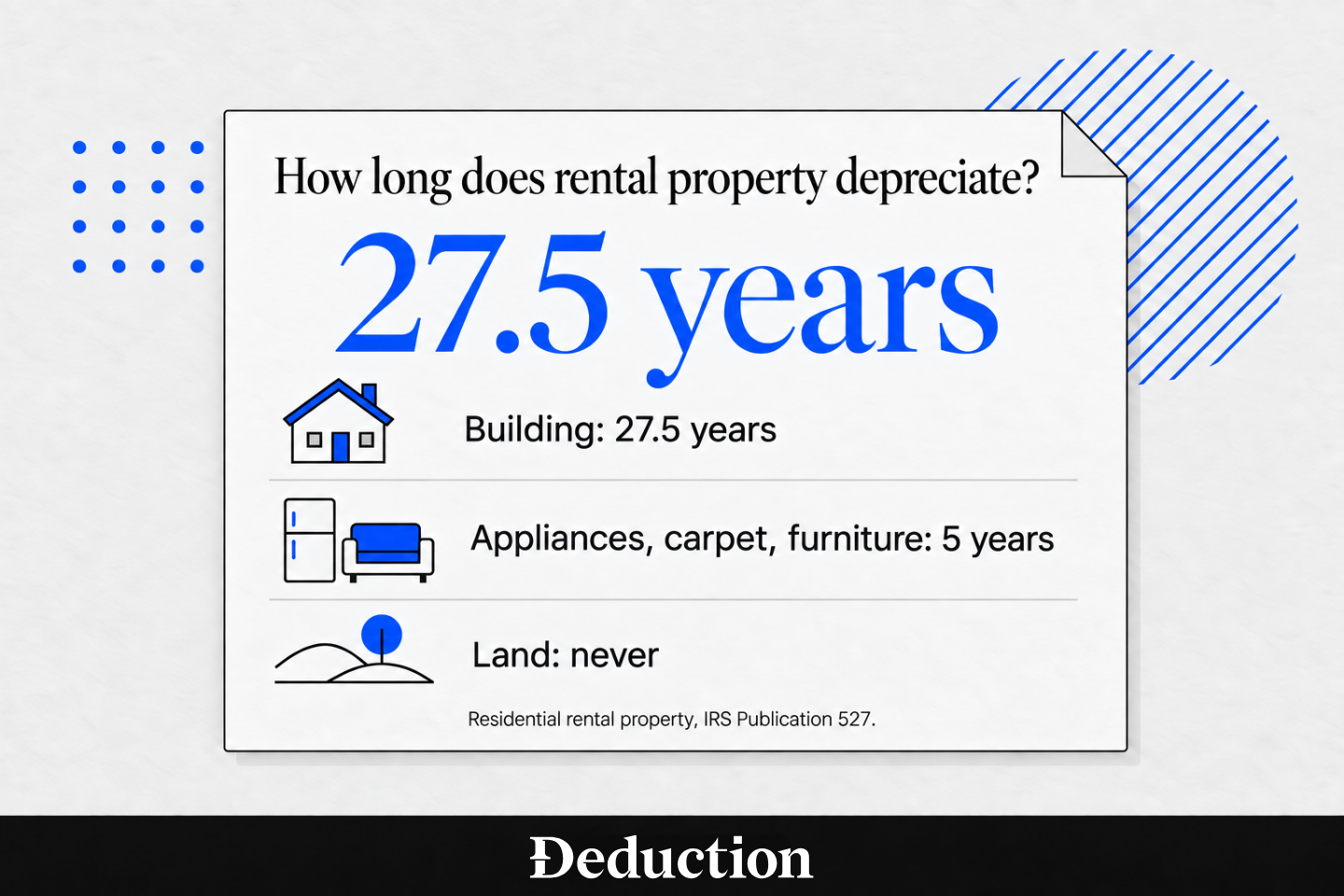
You cannot depreciate the land because the IRS considers it something that does not wear out. Instead, split the purchase price between the land and the building, then depreciate only the building. Most landlords use the values on their county property tax assessment to make that split.
Anything you add later starts its own schedule, so a new roof in year six is depreciated separately from the building you bought in year one.
Skipping depreciation does not save the deduction for later. When you sell, the IRS reduces your basis by the depreciation you were allowed or allowable to claim, even if you never claimed it. That can leave you paying tax on a deduction you never used.
If you have missed years already, Deduction’s answer covers whether you can still claim depreciation on a rental property.
3. Repairs and Maintenance
A repair keeps the property in the shape it was already in, and you deduct the full cost this year. Typical examples include fixing a leak, servicing the furnace, repainting between tenants, replacing a cracked windowpane, and unclogging a drain.
Hiring someone else to do the repair does not change the deduction. You can deduct the plumber’s invoice, the handyman’s hourly rate, the landscaper’s bill, or the cost of hiring a company to power-flush a blocked line in the year you pay them.
Repairs go on Schedule E, line 14, and recurring upkeep like lawn care and pest control goes on line 7. Improvements do not belong here, and the section further down draws that line.
4. Property Taxes
You can deduct county and city property taxes on a rental in full on Schedule E, line 16. You can also deduct local service assessments, such as trash collection, along with gross receipts or rental excise taxes charged by some states and cities.
State income tax on your rental profit works differently. It is an itemized deduction on Schedule A, not a rental expense on Schedule E, so it counts toward the SALT deduction cap.
The SALT deduction is capped at $40,400 in 2026, or half that if you file separately, and it shrinks once your income passes $505,000, down to a $10,000 floor.
If you never use the rental personally, all of its property tax stays on Schedule E and is not affected by the Schedule A cap. If you stay there for part of the year, divide the tax based on your rental and personal days. The rental share stays on Schedule E, while the personal share moves to Schedule A.
If you pay through escrow, your deduction lands in the year the servicer sends the money to the county, not the year you paid into the account. Deduction’s answer on whether you can deduct property tax paid from an escrow account covers the timing.
5. Landlord and Hazard Insurance
You can deduct insurance that protects the rental as a business asset on Schedule E, line 9. This includes landlord or dwelling policies, hazard and fire insurance, liability coverage, flood and earthquake policies, umbrella coverage for the rental, and loss-of-rental-income insurance.
Insurance that protects you rather than the rental does not belong on Schedule E. Life and disability premiums remain personal expenses, even if you pay them with rental income. Health insurance follows a separate set of deduction rules.
If you paid a two-year policy up front, you deduct only the part that covers this year and carry the rest forward.
6. Property Management Fees
If you pay someone else to manage the property, you can deduct their fees on Schedule E, line 11. That includes a property management company, an individual who handles tenant calls, or a short-term rental co-host who takes a percentage of each booking.
A leasing commission is different from a management fee. It is the one-time fee an agent charges to find a tenant, and it goes on Schedule E, line 8, with your other commissions. Track the two separately in your records.
Hiring people brings one filing job with it. Pay a manager or contractor $2,000 or more during 2026 and you owe them a Form 1099-NEC, as long as your rental counts as a trade or business. The threshold was $600 through 2025, so fewer payments cross the line now.
Most payments to incorporated businesses are exempt from Form 1099-NEC reporting, so an S corporation or C corporation usually does not receive one. Legal services are an exception. If you pay a lawyer for an eviction, you generally must file the form even if the firm is incorporated.
The form has to reach both the contractor and the IRS by January 31, and both copies carry their own late penalty. Ask for a W-9 before you pay anyone, so you already have the tax ID and entity type when January comes.
7. Utilities
Water, sewer, gas, electricity, trash collection, and internet are deductible on Schedule E, line 17, as long as you paid the bill. The name on the account does not matter.
If the tenant pays the utility provider directly, you cannot claim the deduction because you did not pay the expense.
If the tenant reimburses you instead, report the reimbursement as rental income and deduct the bill you paid. The amounts may offset each other, but both still belong on your return.
A vacancy does not stop the deductions. Keep the property listed for rent and you can still deduct the cost of managing, conserving, or maintaining it while it sits empty, including the utilities you leave on. The one thing you cannot deduct is the rent you did not collect.
8. HOA Fees and Condo Dues
HOA dues and condo fees are deductible when they apply to a rental property, but not when they apply to the home you live in. The payment may go to the same association, but its tax treatment depends on whether the property produces rental income or serves as your personal residence.
Put the regular dues on Schedule E, line 19, as an "other" expense, and label the line so you know what it is later.
Special assessments need closer attention. If the association charges you to repair something that already exists, such as patching the roof, you can deduct the assessment that year.
If the assessment pays for something new or better, such as a gym or a complete roof replacement, it counts as an improvement. Add the cost to the property and depreciate it over time instead of deducting it all at once. The same rule applies when an assessment is charged in place of an improvement.
9. Advertising and Tenant Screening
The money you spend finding a tenant is deductible on Schedule E, line 5. That means listing fees on rental sites, professional photos, a yard sign, printed flyers, and paid ads for the unit.
Background checks, credit checks, and tenant-verification reports go on the same line, because they are part of getting the unit occupied.
If you charge applicants a screening fee, report the full amount you collect as rental income. Then deduct the cost of the background or credit checks separately, rather than reporting only the difference.
10. Legal and Professional Fees
You can deduct professional fees related to the rental on Schedule E, line 10. This includes the cost of drafting or reviewing a lease, handling an eviction or tenant dispute, keeping the property’s books, and the portion of your tax preparation fee related to the rental.
Fees tied to buying or selling the property are treated differently. Legal fees, title work, and closing costs from the purchase are added to the property’s basis instead of deducted right away. Fees paid to sell are accounted for when calculating the gain rather than claimed as current rental expenses.
Costs of getting the loan follow a third path. Mortgage commissions, abstract fees and recording fees go into your basis, while points get spread over the loan, covered under other interest below.
11. Travel and Mileage to the Property
You can deduct the cost of driving to the rental on Schedule E, line 6, when the trip is for a rental activity such as collecting rent, showing the unit, meeting a contractor, or making repairs.
The catch is that a trip from your home to the property may count as commuting. If it does, the trip is not deductible.
Three things get you out of it:
- Your home is the principal place of business for the rental.
- The property is a temporary work location outside the metropolitan area where you live and normally work.
- The property is a temporary work location and you already have a regular workplace elsewhere.
The 2026 rate is 72.5 cents a mile for January through June, rising to 76 cents for July through December. If you drove in both halves of the year, you work out two totals.
You can use that per-mile rate, or track what the car really costs you and deduct the business share. For a car you own, you have to choose the per-mile rate in the first year the car is available for the rental, or you lose the option for good.
A leased car works the other way, because choosing the rate in year one locks you into it for the whole lease.
Some cars are ruled out entirely. You cannot use the per-mile rate on a car you already claimed Section 179 or bonus depreciation on. The same goes for one you depreciated on any method other than straight line, which includes the regular MACRS schedule.
You also lose the option if you run five or more cars at once, or if you already deducted actual expenses on a car you leased.
Either method means filling in Part V of Form 4562 and attaching it to your return.
A trip to improve the property does not count, because it gets added to the cost of that improvement and depreciated with it.
You can deduct overnight travel when managing or maintaining the rental is the main purpose of the trip. Keep a record of the date, destination, business purpose, and mileage in case the IRS asks you to substantiate the deduction.
12. Supplies, Tools, and Appliances Under the Safe Harbor
A replacement refrigerator, washer, lawnmower, set of blinds, or box of door handles would normally be depreciated over five years. The de minimis safe harbor lets you deduct the full cost in the year you buy the item instead.
For landlords without an applicable financial statement, the rule covers property costing $2,500 or less per item or invoice. That threshold covers most common rental purchases.
Three things have to be true to use it:
- You already do it in your books. Small purchases have to be expensed under a policy you had in place before the year started. It does not have to be written down, but it does have to predate the year, so you cannot decide at filing time and apply it backward.
- You attach the election statement. A short statement goes on your return every year you use the safe harbor, and your tax software or preparer writes it for you.
- It is all or nothing. Once you elect, it applies to everything that qualifies that year, so you cannot expense the cheap items and depreciate the ones you would rather hold back.
An item over $2,500 generally returns to the five-year depreciation rules, but that does not mean waiting five years to deduct it.
Property acquired after January 19, 2025, qualifies for permanent 100 percent bonus depreciation, so you can still deduct a $4,000 refrigerator in full in the year you buy it. You report the deduction on Form 4562.
Supplies and small items go on Schedule E, line 15.
13. Home Office for Managing the Rental
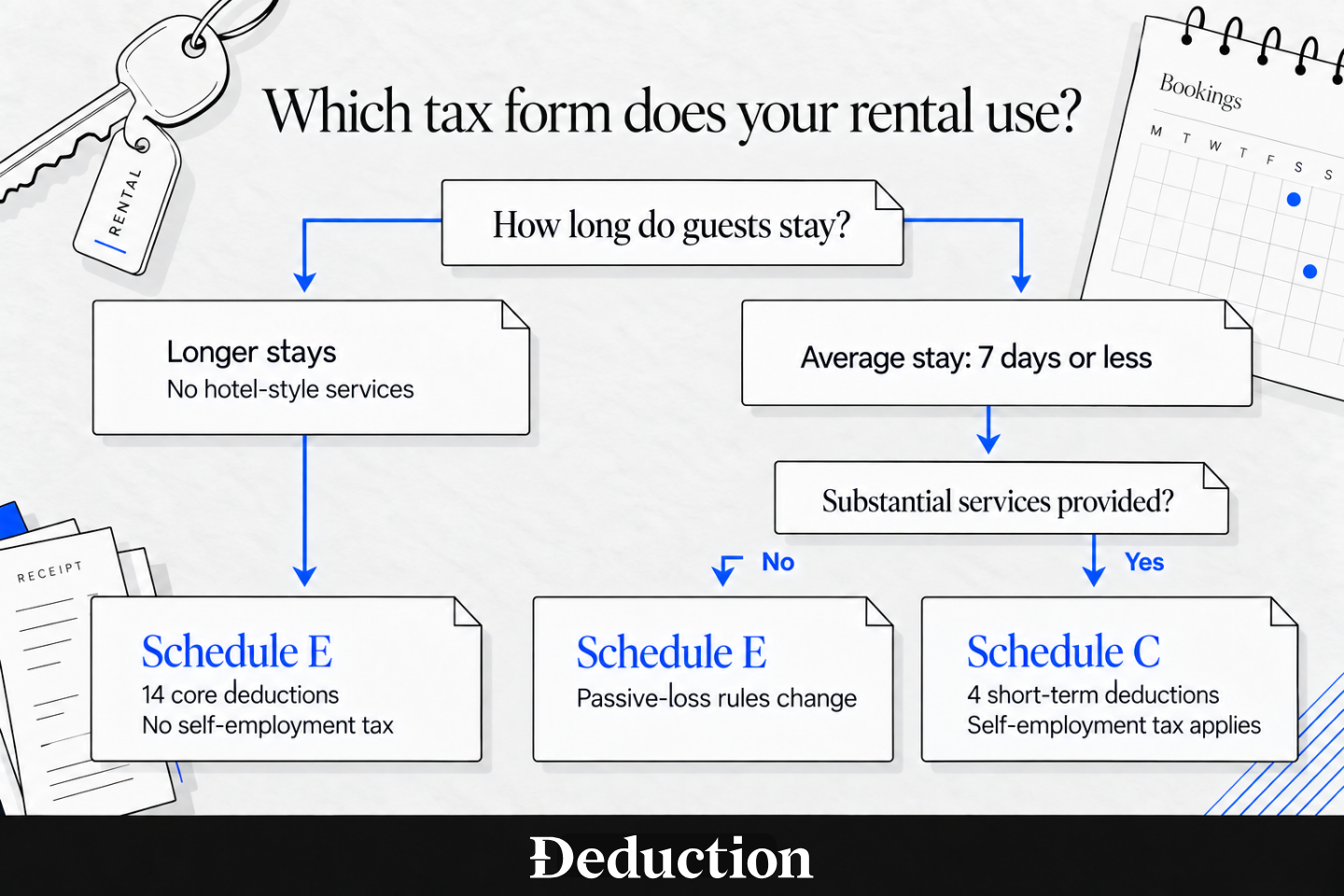
You may deduct part of your housing costs for a home office, but only if the rental counts as a trade or business rather than an investment. A landlord who personally handles leasing, repairs, and bookkeeping for several units is more likely to qualify than someone with one property managed by another person.
The space must be used only for the rental. A desk in a spare bedroom that also hosts guests does not qualify. It must also be your main place for managing the rental, with no other fixed location where you do that work. A separate structure, such as a detached garage, or a space where you regularly meet tenants can also qualify.
You can only choose one calculation method:
- Simplified method: Deduct $5 per square foot for up to 300 square feet, with a maximum deduction of $1,500.
- Actual-expense method: Deduct the rental’s share of your rent or mortgage interest, utilities, insurance, and repairs based on square footage.
The deduction cannot exceed your rental profit before the home office deduction. Unused actual expenses carry forward to the next year, but unused amounts under the simplified method are lost. Report the deduction on Schedule E, line 19.
14. Other Interests Beyond the Mortgage
Interest can be deductible when the borrowed money pays for the rental, even if the debt is not your first mortgage. This includes a HELOC used on the property, a personal loan for renovations, or a credit card used only for rental expenses. Report the interest on Schedule E, line 13b.
What matters is how you used the money, not what secures the loan. Interest on a HELOC used for a rental roof can qualify, while interest on the same HELOC used for a family vacation cannot.
Because a HELOC is secured by your home, you must elect to treat the debt as not secured by the home before reporting the interest on Schedule E. Once made, that election stays in effect.
Mortgage points are prepaid interest, so you deduct them over the life of the loan instead of all at once. Deduction’s answer on whether mortgage points are deducted or amortized explains how refinancing and early payoff affect them.
Other Deductions if Your Rental Property Is Short Term
The deductions above cover most long-term rentals. Short-term rentals often have additional deductible costs because guests turn over more frequently.
Personal use can change the rules. If the property qualifies as your residence and you rent it for fewer than 15 days, you report no rental income and claim no rental deductions.
Renting it longer may limit your deductions if personal use exceeds 14 days or 10 percent of the rental days, whichever is greater.
Platform and Booking Fees
You can deduct booking platform fees whether the platform takes them from your payout or bills you separately. Channel manager subscriptions, dynamic pricing tools, and payment processing fees also fall into this category.
Watch your Form 1099-K, because it usually shows gross bookings before fees, so the figure the IRS sees is bigger than what reached your bank. You report the gross and then deduct the fees, which Deduction’s answer on how to report Airbnb income on your tax return walks through.
Furnishings, Linens, and Guest Supplies
A short-term rental is furnished, and all of it is deductible: beds, sofas, a dining table, cookware, televisions, linens and towels, plus the coffee, toiletries, and paper goods you restock between guests.
You can deduct consumables as supplies in the year you buy them. Furniture and appliances are five-year property, but the $2,500 safe harbor above covers almost every individual item, so most hosts deduct the full cost in the year of purchase.
Cleaning and Turnover Costs
Cleaning between stays, laundry services, restocking, and maintenance that keeps the property guest-ready all go on Schedule E, line 7. A short-term rental may incur these costs 10 or 20 times a year instead of once per tenancy.
Cleaning fees you charge guests are income, and the cleaner’s invoice is the deduction. If you pay one cleaner $2,000 or more across 2026 they get a Form 1099-NEC, as long as your rental is a trade or business and the cleaner is not incorporated.
Occupancy and Lodging Taxes
City and county occupancy, lodging, and tourist taxes are deductible on Schedule E, line 16, alongside your property tax. Rates are set locally and vary widely, so check your city and county before you set a nightly price.
If the platform collects and remits the tax on your behalf, it generally does not appear in either your income or deductions. If you collect the tax yourself, report the amount received from guests as income and deduct the amount you remit to the city.
What’s the Difference Between a Repair and an Improvement for Rental Property Deductions?
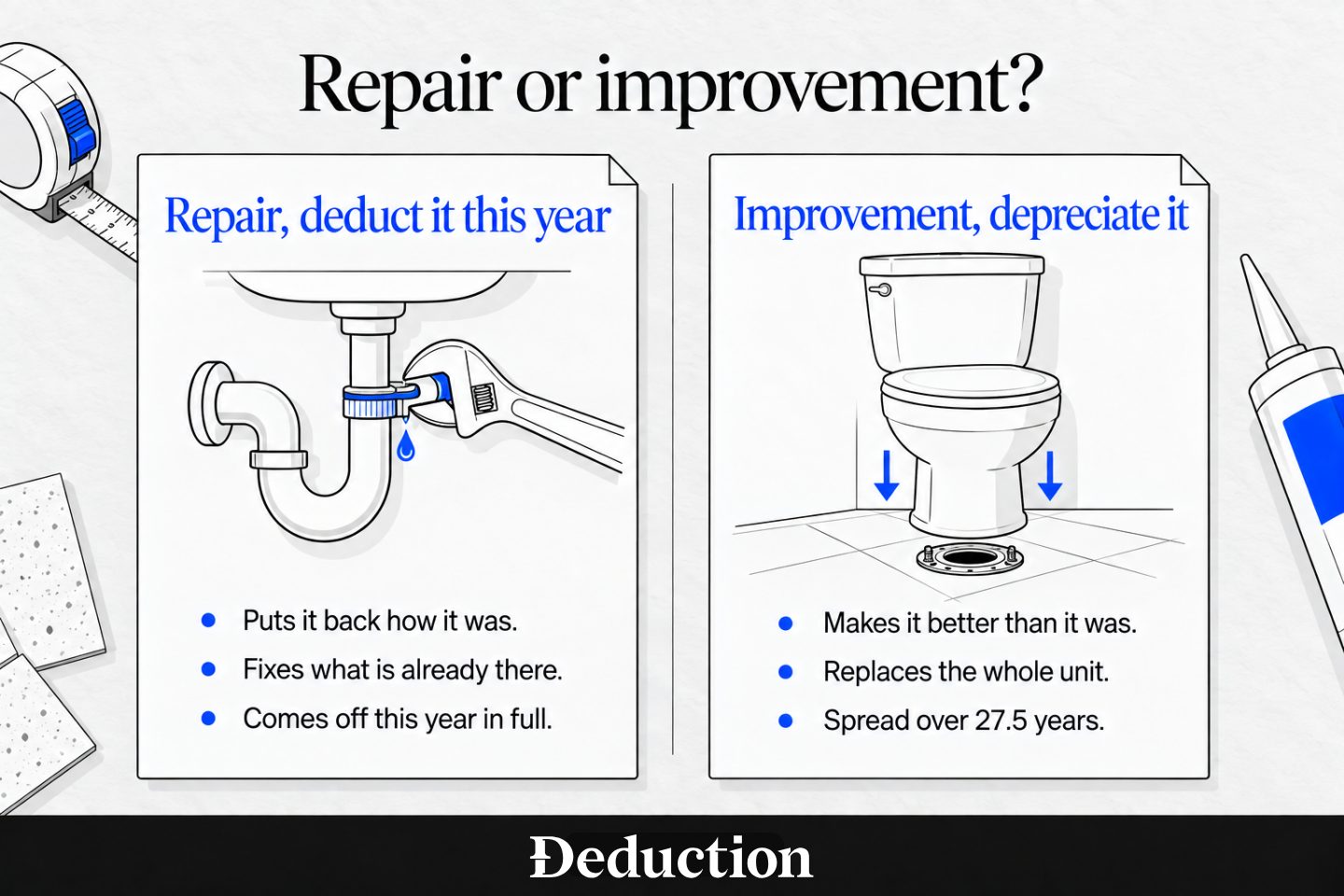
A repair keeps the property in its existing condition and is generally deducted in full that year. An improvement makes a significant change, so its cost is added to the property’s basis and depreciated.
Work generally becomes an improvement if any of these applies:
- Betterment: It fixes a material defect that existed before purchase, adds a major component or capacity, or materially increases efficiency, strength, quality, or output.
- Restoration: It replaces a major component or structural part, returns unusable property to working order, rebuilds it to like-new condition, or repairs damage already claimed as a casualty loss.
- Adaptation: It changes the property’s use from when it was first placed in service, such as converting a rental house into offices.
Patching a roof, servicing a furnace, and repainting are usually repairs. Replacing the entire roof or installing a new HVAC system are improvements.
Why Your Rental Loss Might Not Lower This Year’s Tax Bill
Depreciation can make a rental show a loss even when it generated cash. Rental activity is passive by default, so the loss generally offsets income from other passive activities, not W-2 wages or freelance income.
A special allowance may let qualifying landlords deduct up to $25,000 against other income. It requires active participation, such as approving tenants or repairs, and at least 10 percent ownership. The allowance phases out between $100,000 and $150,000 of modified adjusted gross income.
Married couples filing separately face lower limits. Those who lived apart all year may claim up to $12,500, with the phaseout running from $50,000 to $75,000. The allowance is unavailable if the spouses lived together at any point during the year.
Unused losses carry forward until they can offset passive income or the property is sold in a fully taxable sale to an unrelated buyer. Real estate professionals may treat losses as non-passive if one spouse meets the working-time and 750-hour tests and materially participates in the rentals
What Happens to These Deductions When You Sell the Property
When you sell, the deductions you took year to year are finished with. The one that follows you is depreciation, because every year you claimed it your basis went down, and a lower basis means a bigger gain when you sell.
The part of the gain that came from depreciation is taxed on its own, at a rate of up to 25 percent. Hold a property ten years and depreciate it by $100,000 and that is up to $25,000 of tax on the depreciation alone.
It is capped at whatever gain you made, so a sale with little or no gain produces little or no recapture.
The rest of the gain is a long-term capital gain if you owned the place more than a year, taxed at 0, 15 or 20 percent depending on your taxable income. A 3.8 percent net investment income tax can sit on top for higher earners.
Skipping depreciation does not get you out of this. The IRS lowers your basis by what you were allowed to claim, so you pay the same tax without ever having taken the deduction.
A 1031 exchange into another rental defers all of it, and the depreciation you took follows you into the new property. It only defers everything if you take nothing out, so cash in your pocket is taxed now, and so is a smaller mortgage on the new place. The deadlines are strict, so plan it before you list.
How to Find Your Landlord Tax Deductions
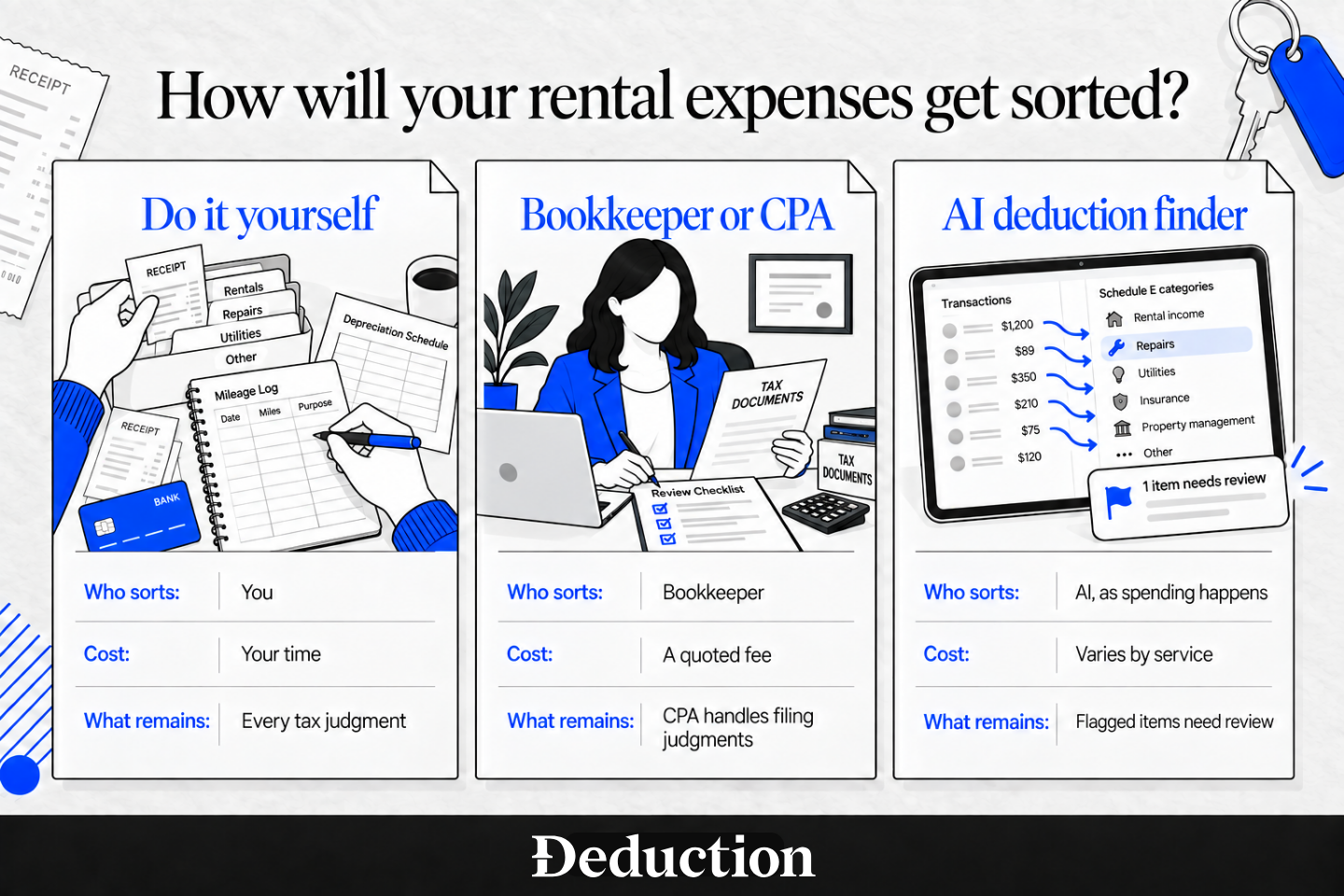
Three routes get you from a year of scattered spending to a finished Schedule E, and they differ mostly in how much of the sorting you do yourself.
Tracking It Yourself
A separate bank account and card for the rental make tracking much easier because the statements become a running expense list. Keep a mileage log, a receipt folder, and a depreciation schedule showing each asset, when it was placed in service, and how much depreciation has been claimed.
The depreciation schedule is the record landlords most often lose. It needs to stay with the property from purchase through sale, even if the software or tax preparer changes. Rebuilding it years later can be slow and expensive.
Hiring a Bookkeeper or CPA
A bookkeeper sorts the spending through the year. A CPA makes the judgment calls at filing: repair or improvement, which depreciation elections to take, and whether your activity is a trade or business.
Fees vary a lot by market and by how messy the books are, so get a quote for your own situation.
The economics work better once you have a few properties. For a single unit, the fee can eat a large share of what the deductions are worth, which is why many small landlords do it themselves and miss things.
Using an AI Tax Deduction Finder
An AI tax deduction finder connects to your accounts, sorts transactions into Schedule E categories as they happen, and flags the ones that need a decision. That removes the sorting, which is the part that makes people give up in March.
What matters is whether a licensed professional reviews the judgment calls before filing, because those are where rental returns go wrong. Deduction’s roundup of the best tax software for rental property compares the options on that point.
Let Deduction Find Your Rental Property Deductions and File Them
Guessing on a rental return is expensive. Call a new HVAC system a repair, and you have overstated this year’s deduction by thousands. Skip depreciation because it looked optional, and you still pay the recapture tax at up to 25 percent on a deduction you never took.
Deduction is an Ai tool for tax filing built for the calls in between. Taylor, its AI tax agent, works through your property records with you during the year, and a licensed tax professional reviews every return before it is filed. It works in three steps:
- Connect your property records: Upload closing documents, Form 1098, invoices and statements to your Vault, forward emails, or let Taylor pull them in.
- Taylor finds the deductions: It sorts expenses into Schedule E categories, keeps your depreciation schedule current, and talks through the repair-or-improvement and passive loss questions with you.
- A CPA reviews and files: A licensed tax professional checks every number and form before anything goes to the IRS.
You can ask Taylor questions and upload documents free all year, and you pay only when you are ready to file or when you need a licensed professional on a high-impact decision. The Personal plan is $499 a year, covering federal and state filing with a 100 percent accuracy guarantee.
Frequently Asked Questions About Tax Deductions for Landlords
Here are frequently asked questions about tax deductions for landlords:
Can I Deduct Mortgage Payments on a Rental Property?
Only the interest. Interest is deductible on Schedule E, and principal is not, because principal buys you equity. Form 1098 shows the year’s interest. Escrowed property tax comes off when the servicer pays the county, and escrowed insurance comes off over the period the policy covers.
How Much Can a Landlord Write Off?
Most running costs have no dollar cap, and ordinary and necessary operating expenses come off in full. Capital spending is the exception, because improvements are depreciated rather than deducted. The loss then gets limited, since by default it offsets passive income only.
Can I Deduct My Own Labor on a Rental?
No. If you repaint a unit yourself you deduct the paint and supplies, but nothing for your time, because you never had taxable income from it. Pay a contractor for the same work and the whole invoice is deductible.
Is a New HVAC a Repair or an Improvement?
An improvement. Replacing a whole HVAC system restores a major component of the building, so it gets depreciated over 27.5 years. Repairing the existing system is a repair you deduct in full this year, and so is replacing a blower motor or servicing it.
Can I Deduct Rental Expenses if the Property Sat Vacant?
Yes, as long as you were holding it out for rent. Advertising, utilities, insurance, property tax and depreciation all keep running during a vacancy. What you cannot deduct is the rent you did not collect, and if you take the property off the market for personal use the expenses stop.
Do I Need an LLC to Claim These Deductions?
No. Every deduction here is available to an individual who owns property in their own name. A single-member LLC changes nothing for income tax, because the IRS disregards it. You can elect corporate treatment on Form 8832, and an LLC with employees needs its own EIN.
What Records Do I Need to Keep, and for How Long?
Keep receipts, invoices, bank statements, leases and mileage logs for at least three years after filing. Property records last longer, so closing statements, improvement invoices and your depreciation schedule have to survive until three years after you file for the year you sell.
Can I Deduct a Loss on My Rental Against My W-2 Income?
Up to $25,000. You need to actively participate, and to hold at least 10 percent of the activity all year with your spouse. You get the full amount if your modified adjusted gross income is $100,000 or less, and above that it shrinks by $1 for every $2 and is gone at $150,000.