
When you run an in-home daycare, your groceries, electric bill, and living room furniture start to look like business costs. In-home daycare tax deductions let you subtract many of those costs from what you earn.
Because you share these costs with your family, you can deduct only the business portion of your daycare. For the house, you'll use a time-space percentage. For food, it’s what the daycare children eat, so it's best to have a separate receipt for your daycare consumables and a different one for household.
To deduct home costs for rooms that your family also uses, you need a state daycare license, certification, registration, or approval, a pending application, or an exemption. Here are the 18 deductions, grouped by who uses each cost:
Costs Only the Daycare Uses
When you buy something only for the children in your care, like their snacks, toys, or a crib, you can deduct it in full on Schedule C, the form for self-employment income and expenses, with no time-space calculation.
Food for the Children in Your Care
This is breakfast, lunch, and snacks for every child in your care.
You can deduct 100% of the food you serve the children in your care, unlike the 50% limit on most business meals. You can figure it one of two ways:
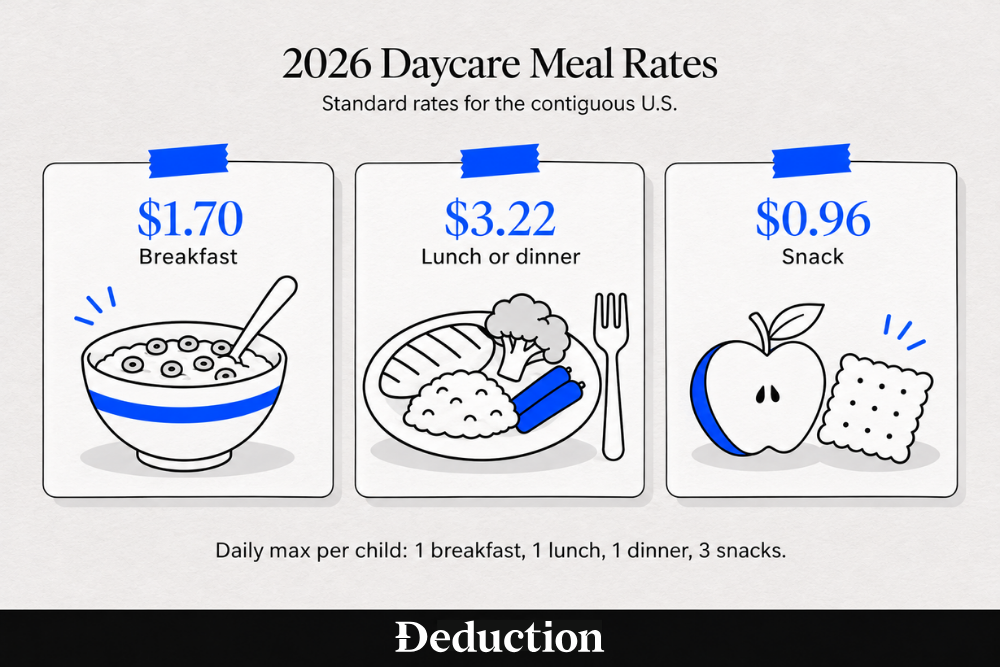
- Standard meal allowance: You deduct a flat rate per meal or snack, for up to one breakfast, one lunch, one dinner, and three snacks per child per day. For 2026, the rates in most of the US are $1.70 for breakfast, $3.22 for lunch or dinner, and $0.96 for a snack.
- Actual cost: You deduct what you spent on the children’s food, using receipts, and keep a separate record of your family’s groceries.
The standard rates are the Child and Adult Care Food Program (CACFP) Tier I rates in effect on December 31 of the year before, even if a food program pays you at Tier II. Alaska, Hawaii, Guam, Puerto Rico, and the US Virgin Islands have higher rates. If you choose the standard rates, you use them for all the children’s food that year.
The methods dont include your own child's meals. The standard rates also leave out children who live in your home and children you watch as a personal favor, or not a paying customer.
The standard rates still need a daily meal log with each child’s name, the dates and hours they attended, and the meals and snacks you served. Food program payments are covered after the list.
Toys, Books and Activity Supplies
You can deduct toys, books, art supplies, games, and learning materials you buy for the daycare. If only the daycare children use them, you deduct 100%. If your own children also use them after hours, you deduct only the daycare’s share, so note how you estimated it.
Cribs, Cots, High Chairs and Playground Equipment
You can deduct cribs, cots, high chairs, playground equipment, and other furniture and equipment you buy for the daycare. Most of it can be written off in full the year you buy it, either by electing the de minimis safe harbor for items up to $2,500 or with 100% bonus depreciation on Form 4562 for pricier ones.
Licensing, Training and Background Check Fees
Keeping your daycare licensed and safe means paying for things like state license renewals, CPR classes, and background checks.
You can deduct license and registration fees, first aid and CPR courses, training you take to keep your license or improve your skills, and fingerprinting and background checks for you and your assistants. Courses you need just to qualify for your first license aren’t deductible.
License and regulatory fees you pay each year go on line 23 of Schedule C, the line for taxes and licenses.
Field Trips and Activity Fees
You can deduct admission, transportation, and program fees for daycare outings, plus what you pay visiting programs such as a music class. Tickets for your own family on the same trip don’t count.
General Business Costs
These work the same way for a daycare as for any small business:
- Assistant wages: You can deduct what you pay helpers and substitutes. Assistants who work under your direction are usually employees, so you handle payroll taxes and give them a Form W-2, while a true independent contractor you pay $2,000 or more in 2026 gets a Form 1099-NEC.
- Liability insurance: You can deduct the full premium for daycare liability insurance, or for a business rider on your homeowners policy that covers the daycare.
- Mileage: You can deduct daycare driving at 72.5 cents a mile through June 30, 2026, and 76 cents from July 1, or at your actual car costs. For a car you own, the standard rate is available only if you choose it the first year you use the car for the daycare. On mixed errands, count only the miles to and from daycare stops, and log each trip.
- Advertising: You can deduct paid listings on childcare finder sites, a website and its hosting, flyers, business cards, and a sign.
- Software, phone, and office supplies: You can deduct childcare billing software, record-keeping supplies, and the business share of your cell phone bill. The basic charge for the first landline into your home isn’t deductible, but a second line used only for the daycare is.
If you run the daycare as a sole proprietor and hire your own child under 18, their pay isn’t subject to Social Security and Medicare taxes, though income tax withholding still applies.
Home Costs You Share With the Daycare
This is the house itself: the mortgage, the heat, and the roof over the playroom. You deduct the daycare’s share of the house costs on Form 8829, the form for business use of your home, using the time-space percentage explained after the list. Shared supplies and appliances go on Schedule C instead.
Most of these costs are subject to an income limit: they can’t be more than your daycare’s profit before home costs, with depreciation deducted last, and anything that doesn’t fit carries over to next year. If you itemize, the mortgage interest and property taxes you could deduct on Schedule A anyway aren’t limited.
Mortgage Interest, Property Taxes, Utilities and Insurance
You deduct the time-space share of each of these on Form 8829:
- Mortgage interest or rent: Only the interest counts, not the part of each payment that pays down the loan, though for 2026 mortgage insurance premiums count as interest too. If you itemize, the rest of your mortgage interest stays on Schedule A, the form for itemized deductions.
- Property taxes: The cap on state and local taxes doesn’t take the daycare’s share away. But any share that doesn’t fit under the SALT deduction cap after your personal taxes, or all of it if you take the standard deduction, moves to the part of Form 8829 that’s limited by your daycare’s income.
- Utilities and internet: Electric, gas, water, trash, and home internet bills all count.
- Homeowners or renters insurance: You deduct the daycare’s share of the premium. A separate daycare liability policy or rider is deducted in full instead.
Repairs and Maintenance
With children in your home all day, your kitchen, bathroom, and other shared spaces wear out faster, and sooner or later you may need to pay a plumber to fix a clogged sink or a leaky faucet.
You can generally deduct repairs that keep your home in working order in the year you pay for them. The share depends on where the work is:
- Repairs to the whole home: You deduct the time-space share of work such as a furnace repair.
- Repairs to a room the daycare shares with your family: You deduct your time percentage alone, because the work is only on that room.
- Repairs to a room used only for the daycare: You deduct 100%, such as for repainting a playroom your family never uses.
- Repairs to a room the daycare never uses: You can’t deduct these, such as fixing the tile in your own bathroom.
Home Improvements
Running a daycare often means upgrading your home to keep children safe, and sooner or later you may put a fence around the play yard or replace the playroom carpet with flooring that holds up to spills.
Improvements that add value, make your home last longer, or adapt it to a new use are deducted through depreciation as home costs on Form 8829.
A fence is depreciated over 15 years, and with bonus depreciation you can usually write off the daycare’s share of it the first year.
New flooring is depreciated over 39 years, separately from the house, starting the month it goes in, on your time-space share of its cost.
The guide to tax deductions for landlords walks through the full test for telling repairs and improvements apart.
Home Depreciation
This is the deduction for wear on the house itself, and it’s easy to overlook.
You can deduct the time-space share of your home’s basis, not counting the land, over 39 years. Your basis is generally what you paid plus improvements, or the home’s value when the daycare started if that’s lower. It goes in Part III of Form 8829, and you also attach Form 4562 the first year you use your home for the daycare and any year you add an improvement.
It’s usually worth claiming, because the IRS lowers your home’s basis by the depreciation you were allowed to take, whether you took it or not.
Shared Household Supplies and Appliances
With children in your home all day, you go through paper towels and laundry soap faster, and the washer your family uses may run nonstop with daycare bibs.
You can deduct the daycare’s share of cleaning supplies, paper goods, and other household supplies your family also uses on Schedule C. Shared furniture and appliances, such as a playroom couch or the washer, follow the daycare furniture rules, applied to that share.
The usual share is your time-space percentage. If your records show the daycare uses an item more than that, such as a washer that mostly runs daycare loads, you may be able to use that higher business-use share instead. Write down how you figured it.
If you owned an item before the daycare started using it, you depreciate the daycare’s share of its value then, or its cost if lower, usually over several years.
Who Qualifies for the Daycare Home Deduction
You can deduct the shared home costs above without using the space only for business, but only if you meet each of these conditions in IRS Publication 587:
- In the business of daycare: You provide daycare as a business for children, people 65 or older, or people who can’t care for themselves because of a physical or mental condition.
- Licensed or exempt: You’ve applied for, been granted, or are exempt from a state license, certification, registration, or approval as a daycare center or a family or group daycare home. If your application was rejected or your license was revoked, you don’t meet this test.
- Regular use: You use the space regularly for daycare. A room used only now and then doesn’t count, but a playroom open to the children throughout each business day does, even if your family uses it in the evening.
Other situations that work differently:
- No license, application, or exemption: You can still deduct the costs in the first group and shared supplies and appliances, and use the standard meal rates. For home costs, the regular home office rules apply instead, and they require space used only and regularly for the daycare.
- Nannies and sitters in the parents’ home: If you watch children in their family’s home instead of yours, you’re often the family’s household employee. This article doesn’t cover that setup.
How to Figure Your Time-Space Percentage
Since your home and your daycare share most of the same space, you need a way to split the costs between them, and the time-space percentage does that. It combines how much of the year and how much of the home the daycare uses:
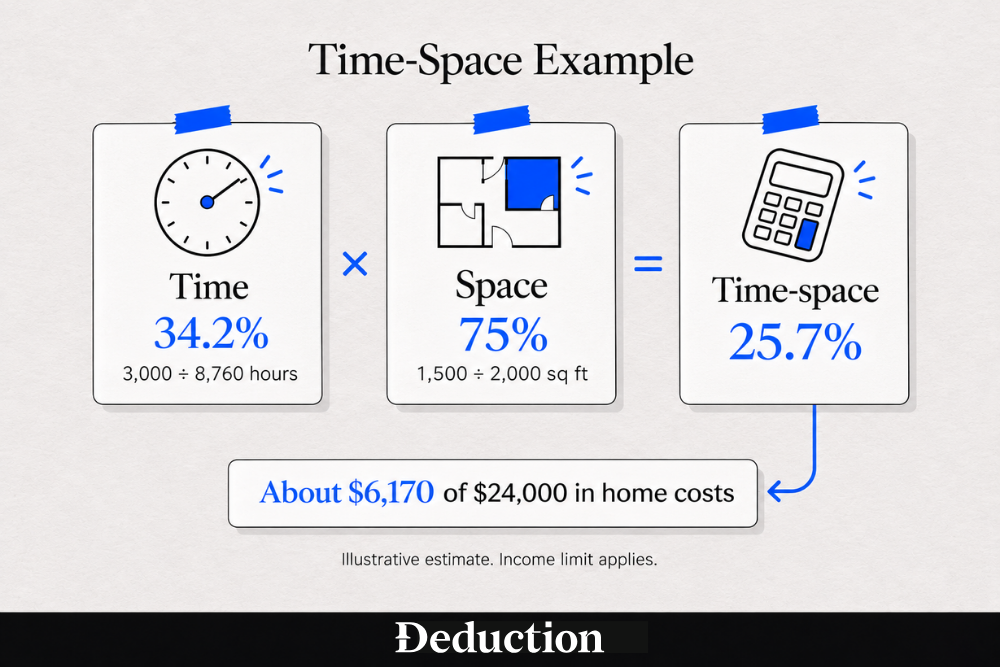
- Time percentage: Add up the daycare hours, which can include time spent cooking, cleaning, and preparing activities without the children. Divide by 8,760, the hours in 2026. If you started or stopped midyear, divide by 24 times the days your home was available for daycare.
- Space percentage: Divide the square feet you use regularly for daycare by your home’s total square feet.
- Time-space percentage: Multiply the time percentage by the space percentage.
- Rooms used only for daycare: Count these at 100% for time, so their costs aren’t reduced by your hours. If you have both kinds of space, figure the percentage for each separately, add them, and enter the total on line 7 of Form 8829 with a statement showing your math, as the Form 8829 instructions explain.
Take a provider with a 2,000-square-foot home who cares for children 11 hours a day:
That’s about $6,170 of home costs on Form 8829, subject to the income limit. Counting only the hours children were present would have dropped the time percentage to 31.4% and cut the deduction by about $500.
The simplified method skips Form 8829: you deduct $5 per square foot for up to 300 square feet, reduced by your time percentage if the space isn’t used only for daycare. Here, that’s about $513, and you can’t deduct depreciation that year. If the daycare uses most of your home, the regular method usually comes out well ahead.
How Food Program Reimbursements Are Taxed
The food deduction above has one more piece if you join the Child and Adult Care Food Program (CACFP). It’s a federally funded program that pays licensed or approved daycare homes a set rate for healthy meals and snacks, through a local sponsoring organization.
Because those payments cover food you may also deduct, only the part that’s more than you spent on the children’s food is taxable, even if your sponsor sends you a Form 1099-MISC:
- Payments are higher: Report the difference as income on Schedule C.
- Food costs are higher: Report the difference as an expense.
- You use the standard meal rates: Deduct only the part of each rate that’s more than the reimbursement for that meal or snack.
- Your own children: Leave their payments out of your income.
What Happens When You Sell Your Home
If you qualify for the home sale exclusion, you can leave up to $250,000 of profit ($500,000 for qualifying married couples filing jointly) out of your income. The depreciation you could have taken after May 6, 1997 can’t be excluded, or only what you claimed if your records show it was less.
That part is taxed at up to 25%, except bonus depreciation above the straight-line amount, such as on a fence, which is taxed at your regular rate.
If the daycare is inside your house, you don’t have to split the sale into business and personal parts. If it’s in a separate building, such as a detached garage, you generally do, and the exclusion usually won’t cover that part.
Let Deduction Track, File, and Give You Tax Advice for Your In-Home Daycare Business
Your time-space percentage depends on hours and square feet only you can count. A big fix to the play-yard fence can fall on either side of the line between a repair and an improvement. Your meal log decides if the standard rates beat your grocery receipts.
Deduction is a tax filing service built around AI with CPAs and tax professionals ready to verify. Upload receipts and food program checks to your Vault as they come in, and the AI tax deduction finder flags what qualifies. Taylor, its AI tax agent, answers questions like these all year, and a CPA or licensed tax professional reviews your return before it’s filed. Ask Taylor about your floor plan to get started.
Frequently Asked Questions About In-Home Daycare Tax Deductions
What Is the Standard Meal Allowance for Daycare Providers?
It’s a flat rate per meal or snack you can deduct instead of tracking food receipts. For 2026, it’s $1.70 per breakfast, $3.22 per lunch or dinner, and $0.96 per snack in most of the US. If a food program reimburses a meal, you deduct only the part of the rate above the reimbursement.
Are Daycare Meals 100% Deductible?
Yes, for the children in your care. You can deduct 100% of their food, at actual cost or with the standard meal rates, while most business meals are limited to 50%.
How Do Home Daycare Providers Pay Taxes?
You report daycare income and expenses on Schedule C with your Form 1040. If your net earnings are $400 or more, you also owe 15.3% self-employment tax, figured on Schedule SE. No one withholds tax from tuition, so if you expect to owe $1,000 or more, you generally need to make quarterly estimated payments.
How Much Daycare Can I Write Off on Taxes?
If you’re a parent paying for daycare, you can’t deduct it, but you may claim the childcare tax credit instead. Starting in 2026, the credit can be up to 50% of up to $3,000 in care costs for one child, or $6,000 for two or more, depending on your income.
Do I Need a License to Claim the Daycare Home Deduction?
For shared home costs, generally yes: you need a state license, certification, registration, or approval, a pending application, or an exemption, and a rejected application or revoked license doesn’t count. Without that, home costs need space used only and regularly for the daycare. Costs only the daycare uses don’t depend on a license.
Can I Deduct Food for My Own Children in My Home Daycare?
No. Food for you and your family isn’t deductible, even when your children eat with the daycare kids, and they don’t count toward the standard meal rates. If a food program reimburses you for their meals, leave those payments out of your income too.
Can I Deduct a Room Used Only for the Daycare in Full?
Yes, licensed or not, if you use it only and regularly for the daycare. It counts at 100% for time, so your hours don’t reduce its share of home costs, though Form 8829’s income limit applies. If you meet the licensing test and also use shared rooms, you add the two percentages on Form 8829.
This article is general information, not tax advice. Daycare licensing rules vary by state, and the home deduction depends on your own hours and floor plan, so check your situation with a CPA or licensed tax professional before you file.
Related Articles
- 18 Tax Deductions for 1099 To Look Out for if You Are Self-Employed This Tax Season
- Above the Line Tax Deductions: How to Prepare Your Taxes
- 12 Best Self-Employed Tax Software Options to Manage Your Taxes as a 1099