
Farm tax deductions let you remove most of what it costs to run a farm or ranch from your taxable income. Feed, seed, fertilizer, fuel, repairs, hired help, land rent, and equipment can all come off on Schedule F, the IRS form farmers use to report profit or loss.
A July 2025 tax law expanded several of these breaks. You can now deduct the full cost of most equipment bought after January 19, 2025, in the year you start using it. The law also made the 20% deduction on farm business income permanent.
The table below covers 13 deductions you can claim on Schedule F and five other tax breaks you claim elsewhere on your return. From there, we’ll cover rules for different types of farms, key state tax breaks, and a simple way to file.
13 Schedule F Deductions Farmers Can Claim
Schedule F is where you report your farm’s sales and costs, and it’s where most farm deductions come off. Each one below covers what qualifies and the limits to know.
1. Seeds, Plants, Fertilizer and Chemicals
You can deduct the cost of seeds, seedlings, fertilizer, lime, and farm chemicals like herbicides and insecticides, usually in the year you pay for them.
If a lime or fertilizer application keeps working for several planting seasons, you’d normally spread its cost over those years. If the land was already being farmed, you can deduct the full cost in the year you pay. Fruit and nut trees and vines have separate rules, covered in the farm type table below.
2. Feed
You can deduct feed you buy for your livestock. Most farms use the cash method, which means recording expenses when they’re paid. If you pay this year for feed your animals will eat next year, you can deduct it now only if all three conditions apply:
- You bought the feed outright, rather than paying a refundable deposit.
- You had a business reason to buy early, beyond saving on taxes.
- Claiming the deduction now doesn’t give a substantially misleading picture of your income for the year.
Prepaid feed, seed, fertilizer, and other supplies also can’t exceed half of your other farm expenses for the year. Anything over that comes off in the year you use the supplies.
That limit generally doesn’t apply if farming is your main business or your main home is on a farm, as long as your prepaid supplies over the previous 3 years added up to less than half of your other farm expenses.
3. Livestock Costs
You can deduct vet bills, breeding fees, and medicine for your animals.
You don’t deduct the cost of animals you buy to resell when you buy them. You subtract it from the sale price in the year you sell them. A feeder calf bought in October and sold next spring counts on next year’s return.
If you buy animals for breeding or milking, you deduct their cost through depreciation rather than as a regular farm expense. Item 6 explains how that works.
4. Labor and Benefits
You can deduct wages for hired help, contract labor, and pay by the piece, plus the cost of boarding hired workers. You can’t deduct the value of farm products they used. If you pay day laborers in cash, those wages count too.
You can also deduct health plans for your employees and what you put into their retirement plans.
Paying your own children for farm work can lower your payroll taxes. If you farm as a sole proprietor, wages you pay your child under 18 aren’t subject to Social Security and Medicare tax.
Your child’s pay must be reasonable for the work they do. If your farm is a partnership, this rule applies only if every partner is a parent of the child.
5. Repairs and Maintenance
You can deduct repairs that keep equipment, fences, and buildings working the way they already did. Replacing a hydraulic hose, patching part of a barn roof, and mending a fence are typical repairs.
Work that makes the property better than it was is considered an improvement, and you write it off through depreciation instead. Work generally counts as an improvement if it does any of these:
- Makes it better: It fixes a defect the property had when you bought it, makes it bigger, or makes it noticeably more productive.
- Restores it: It replaces a major part, or brings back property that had broken down and stopped working.
- Changes its use: It converts the property to a different use, such as turning a dairy barn into a machine shop.
6. Depreciation, Section 179 and Bonus Depreciation
Equipment, vehicles, farm buildings, breeding animals, and orchards last for years. You normally deduct their cost a little at a time through depreciation. But two rules let you deduct most or all of the cost in the first year:
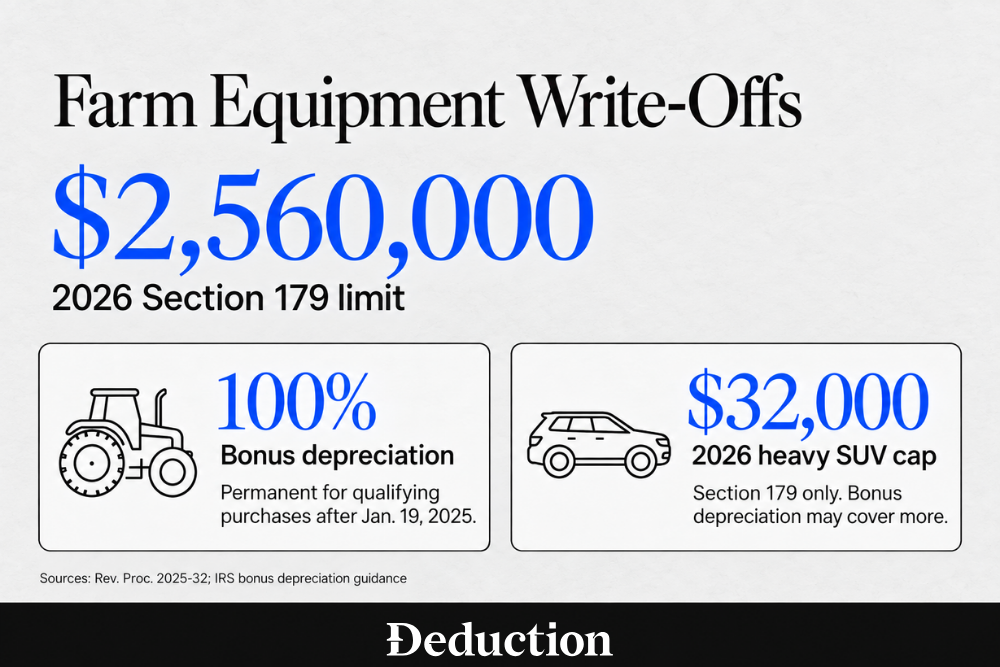
- Bonus depreciation: You can deduct 100% of the cost of qualifying property bought after January 19, 2025, with no dollar limit. The 2025 law made this permanent.
- Section 179: You can deduct up to $2,500,000 of qualifying property you start using in 2025, or $2,560,000 in 2026. The limit drops dollar for dollar once your purchases pass $4,000,000 in 2025 or $4,090,000 in 2026.
Your Section 179 deduction can’t exceed your total profit from businesses you actively run, plus any wages from a job. You can carry any unused deduction into later years. Bonus depreciation has no income limit, so it can leave your farm with a tax loss.
A big write-off saves the most tax in a year when your income is high. In a lower-income year, you may save more by spreading some of the cost over later years.
Used equipment qualifies for both, as long as you didn’t buy it from a related person, such as your spouse, parent, child, or a business you control. For bonus depreciation, you also can’t have used it before you bought it.
General farm buildings such as a new machine shed or barn are written off over 20 years. Bonus depreciation covers property written off over 20 years or less, so you can generally deduct a new farm building in full the year you start using it.
For smaller purchases, you can deduct items costing $2,500 or less per item or invoice right away. You choose this each year by attaching a short statement to your return, and these amounts go on line 32.
Pickups and SUVs have extra limits that depend on their weight, and you need more than half farm use to take Section 179 or bonus depreciation on them. Below that, you can still write off the farm share more slowly.
Tractors, combines, flatbeds and dump trucks don’t face those limits. Deduction’s guide to vehicles qualifying for the Section 179 deduction covers the weight rules, and the FAQ below covers trucks over 6,000 pounds.
7. Vehicles and Fuel
You can deduct the farm share of your car and pickup costs. You can either track your real costs, including gas, oil, repairs, insurance, and depreciation, or use the per-mile rate.
The per-mile rate was 70 cents for 2025. For 2026, it’s 72.5 cents for miles driven January through June and 76 cents from July 1. Keep your 2026 mileage log split at midyear. You can’t use the per-mile rate if you run five or more vehicles at the same time.
If you use a car or light truck during most of the normal workday directly in farming, you can claim 75% farm use without records that split farm and personal miles. You choose this the first year you use the vehicle and can’t switch later.
You can also deduct fuel for tractors and other farm machinery. On top of that, you can claim back most of the federal tax on gasoline and undyed diesel you use on the farm with Form 4136.
8. Rent and Leases
You can deduct cash lease for cropland or pasture and rent on vehicles, machinery and equipment. If you hire a machine along with someone to run it, that’s custom hire instead, covered in item 13.
If you pay rent with a share of your crop and also deduct what it cost to grow those crops, you can’t deduct the shares as rent too. You can’t deduct the rental value of the farmhouse you live in, and rent paid in advance generally comes off only in the year it covers.
9. Interest
You can deduct interest on farm loans, including a farm mortgage, operating loans, equipment notes, and seller-financed land. You can’t deduct the principal you pay back.
What matters is how you use the borrowed money, not the property backing the loan. If you use a home equity loan to buy a silo, the interest generally counts as farm interest. If you pay interest ahead of time, you can only deduct it in the year it covers.
10. Insurance
You can deduct insurance on the farm business, such as crop, fire, storm, theft, and liability coverage. If you prepay a policy that runs past this year, you generally deduct only the part that covers this year.
Health insurance for your employees goes under labor and benefits, and your own health insurance is covered in the next section.
11. Taxes
You can deduct property taxes on farmland, farm buildings and equipment, your share of Social Security and Medicare tax on workers’ wages, unemployment taxes, and the federal highway use tax on heavy trucks.
Federal income tax and your own self-employment tax aren’t deductible on this line. You can deduct half of your self-employment tax elsewhere on your return, as the next section explains.
Property tax on your own home goes on Schedule A if you itemize instead of taking the standard deduction. The SALT deduction cap, a limit on deducting state and local taxes, applies there. If one tax bill covers both the farmhouse and the farmland, split it between the two.
12. Conservation Expenses
You can deduct the cost of soil and water conservation work, such as leveling, terracing, building ponds, clearing brush, and planting windbreaks.
The work has to follow a conservation plan approved by the Natural Resources Conservation Service (NRCS), or by a similar state agency where there’s no NRCS plan. It also has to be on land you or your tenant farm now or have farmed before.
The deduction is capped at 25% of your gross income from farming for the year, and anything over that can be used in later years. Equipment such as pumps, pipe, and wells doesn’t count, and neither does draining or filling wetlands or preparing land for center-pivot irrigation.
13. Utilities, Supplies and Other Costs
The remaining lines cover the costs that don’t fit anywhere else:
- Custom hire: This covers machine work you hire along with an operator, such as custom combining, spraying, or baling.
- Freight and trucking: You can deduct the cost of hauling crops and supplies. Shipping costs on livestock you buy to resell are added to the animals’ cost instead.
- Storage: This covers grain elevator storage and other off-farm or 3rd party storage you pay for.
- Supplies: This covers small tools and farm supplies you use up during the year.
- Utilities: You can deduct electricity, water, and other utilities for farm buildings, plus the farm share of your phone. The base rate of the first landline into your home isn’t deductible.
- Other expenses: Tax preparation fees for the farm, other legal and professional fees, items under the $2,500 rule, and a home office deduction go here.
5 General Deductions and Farm Tax Breaks
Four of these go on other parts of your tax return, and the home office deduction goes on Schedule F. The first three lower the tax on a profitable year, and the last two help when farm income swings from year to year.
1. Qualified Business Income (QBI) Deduction
If you farm as a sole proprietor, in a partnership, or through an S corporation, the QBI deduction lets you deduct up to 20% of your farm’s qualified business income. The 2025 law made it permanent.
Qualified business income is roughly your farm profit minus a few items, such as half of your self-employment tax, your self-employed health insurance, and retirement contributions tied to the farm.
If your taxable income is below $197,300 for 2025 or $201,750 for 2026, extra limits based on wages and property don’t apply. On a joint return, those figures are $394,600 and $403,500. The deduction also can’t be more than 20% of your taxable income minus net capital gains.
If you sell crops or livestock to a cooperative, your deduction is figured differently, and you use Form 8995-A.
2. Self-Employed Health Insurance and Half of Self-Employment Tax
If your farm makes a profit, you can deduct health insurance premiums for yourself, your spouse, and your dependents. The self-employed health insurance deduction is figured on Form 7206 and can’t be more than you earned from the farm.
You can’t take it for any month you were eligible for a subsidized plan through an employer, including your spouse’s employer, even if you didn’t sign up.
Once your net farm earnings reach $400 for the year, you owe self-employment tax of 15.3% for Social Security and Medicare. The Social Security part stops at $176,100 of earnings for 2025 and $184,500 for 2026.
You can deduct half of that tax on Schedule 1. It lowers your income tax but not the self-employment tax itself.
3. Home Office Deduction
If you do the farm’s paperwork in a room at home, you may be able to deduct part of your housing costs. The room has to be used regularly and only for the farm, and you can’t have another fixed place where you do much of that paperwork.
You can figure the deduction either way:
- Simplified method: Deduct $5 per square foot for up to 300 square feet, or $1,500 at most.
- Regular method: Deduct the office’s share of your real housing costs, such as mortgage interest, utilities, and insurance.
Either way, it goes on line 32 of Schedule F. Either way, the deduction generally can’t be more than your farm profit.
4. Farm Income Averaging (Schedule J)
Income averaging lets you tax part or all of a big year’s farm income at the rates from your three previous years. On Schedule J, you choose how much farm income to average, and a third of it is taxed at each earlier year’s rates.
It helps most when a strong year follows lower-income years. It doesn’t reduce self-employment tax. Sole proprietors, partners, and S corporation shareholders in a farming business can all use it.
5. Two-Year Farm Loss Carryback
Most business losses can only be used on future years’ returns. If your farm loss is bigger than your other income for the year, you can instead carry the leftover loss back 2 years to get a refund of tax you already paid, or choose to skip that and use it in later years.
The carryback usually makes sense when the two earlier years were profitable and taxed at higher rates than you expect in the years ahead.
Who Counts as a Farmer for Tax Purposes
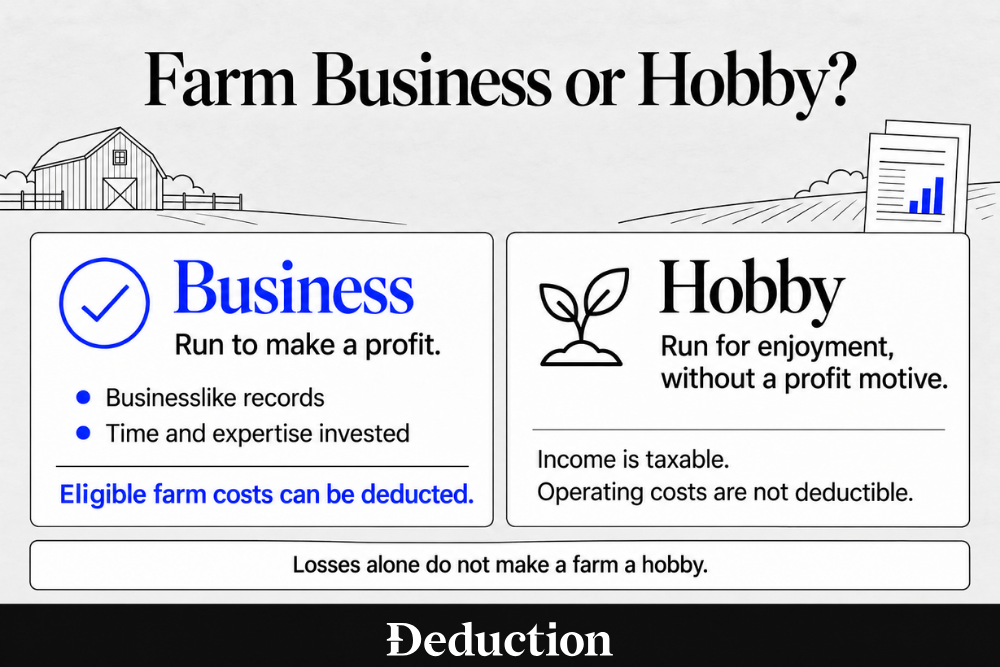
You’re in the business of farming if you run a farm to make a profit, whether you own the land or rent it. The IRS counts livestock, dairy, poultry, fish, fruit and vegetable farms as farms, along with ranches, orchards and groves. The tax code also includes nurseries and sod farms.
If you rent your land to someone else for cash, that income goes on Schedule E, where the tax deductions for landlords apply instead. If you’re paid a share of the crop but don’t materially participate in running the farm, as the IRS defines it, you report it on Form 4835.
The IRS presumes you’re farming to make money if the farm made a profit in 3 of the last 5 years, or 2 of the last 7 for an operation that breeds, trains, shows, or races horses.
Not meeting that test doesn’t automatically make your farm a hobby. The IRS looks at how you run it, including your records, the time and knowledge you put in, your past profits and losses, and how much you farm for personal enjoyment.
If your farm counts as a hobby, you still report what it earns, but you can’t deduct its operating costs. The 2025 law made that rule permanent.
Tax Rules by Farm Type
Some farms have an extra rule or two on top of the deductions above, mostly about which year income counts in and how animals and trees are written off. Find your type of farm in the table:
State Farm Tax Breaks
Every state gives farmland some kind of property tax break, and many don’t charge sales tax on farm purchases. The rules vary a lot, so check with your county assessor or state revenue department before you count on one.
State tax credits for beginning farmers, food donations and conservation work are covered in Deduction’s farm tax credits guide.
Property Tax on Farmland
Most states base property taxes on what qualifying farmland is worth for farming, rather than what a developer would pay for it. If you later take the land out of farming, you’ll usually have to repay some of those tax savings. Check the repayment rules before you sign up.
Sales Tax on Farm Purchases
Many states don’t charge sales tax on feed, seed, fertilizer and farm machinery, but you usually have to register first and show the seller a number, card, or certificate:
Fuel and Estate Tax Breaks
Some states give back the state fuel tax on fuel used off the road in farming, such as in tractors and other farm equipment. They include Ohio, Iowa and Texas. Each has its own form and filing deadline.
The federal estate tax exemption is $15 million per person for 2026, but a few states tax estates or inheritances at much lower levels. Several of them, including Maryland, Pennsylvania and Minnesota, give farm property a break, usually as long as it stays in farming, and in some states in the family, for a set number of years.
How to File Farm Taxes, Step by Step
If you farm on your own or through a single-member LLC, your farm goes on Schedule F with your Form 1040. A farm partnership or S corporation files its own return and sends you a Schedule K-1 with your share. Either way, most of the work happens before you file:
- Keep farm money separate: Use a separate bank account and card for the farm, and sort each transaction into its expense category once a month. Keep a list of equipment with what you paid and the date you started using it.
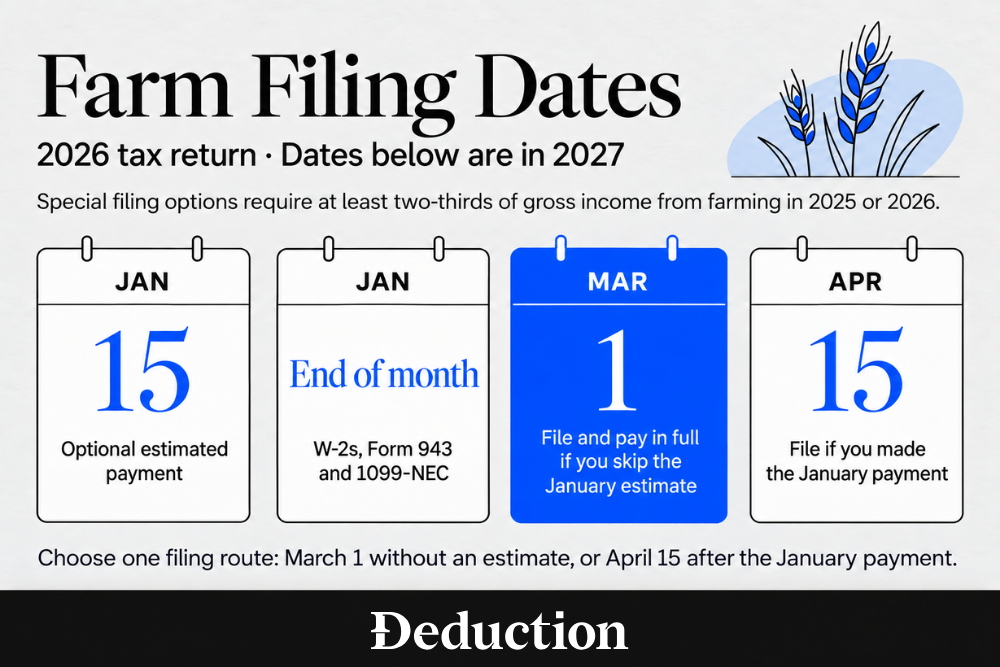
- Pick your deadline: If farming brings in at least two-thirds of your gross income in 2025 or 2026, you don’t make quarterly estimated payments for 2026. You either make one payment by January 15, 2027 and file by April 15, or skip it and file and pay in full by March 1, 2027.
The January payment only has to be two-thirds of this year’s tax or all of last year’s, whichever is less. If farming brings in less than two-thirds of your gross income in both years, the usual quarterly payments and estimated tax safe harbor rules apply.
- Collect the forms that arrive in January: USDA payments come on Form 1099-G or Form CCC-1099-G, crop insurance on Form 1099-MISC, co-op patronage dividends on Form 1099-PATR and land sales on Form 1099-S. The IRS gets a copy of each one, and your return needs to include all of them.
- Send forms to the people you pay: Once you pay a worker $150 or more in cash in a year, or your total farm payroll reaches $2,500, give each worker a W-2 and file one Form 943 by January 31 (February 10 if your deposits were on time). Contractors you pay $2,000 or more during 2026 get a Form 1099-NEC, up from $600 for 2025.
- Put each sale in the right place: Crops, products you raised for sale and livestock you bought to resell go on Schedule F. Breeding, dairy, work and sporting animals, along with machinery and land, go on Form 4797.
Gains on breeding and dairy animals aren’t subject to self-employment tax, so reporting them on Schedule F adds tax you don’t owe.
- Decide how much help you need: A cash-method farm with steady crops, no employees and few equipment purchases can be reasonable to file yourself. A preparer who knows farms is worth the fee when you’re weighing big equipment write-offs, selling livestock because of weather, averaging income, running payroll or selling land.
Whichever route you take, keep your records at least 3 years after you file and payroll records at least 4 years. Keep records for land, buildings and equipment until at least 3 years after you file the return for the year you sell them.
Let Deduction Find Your Farm Tax Deductions
Farm taxes come with choices that depend on your numbers over several years, such as how much equipment to write off now or whether to average a strong year’s income. Deduction is a tax deduction tracker that works through them with you, and a licensed CPA reviews the return before it’s filed:
- Upload your farm records: Bank and card statements, 1099 forms, co-op statements, sale receipts and equipment invoices go into your Vault as they are.
- Taylor finds the deductions: Deduction’s AI tax agent tracks your deductible expenses, applies this year’s rules and flags the decisions you need to make.
- A CPA reviews and files: A licensed tax professional checks every number and form before anything goes to the IRS.
You can ask Taylor questions and upload documents for free, and you pay when you’re ready to file or need a licensed professional to review a high-impact decision. The Personal plan is $499 a year and includes federal and state filing with a 100% accuracy guarantee. If your farm is an S corporation or a small partnership, the Simple Business plan is $999 a year.
Frequently Asked Questions About Farm Tax Deductions
What Is the Best Tax Deduction for Farmers?
For most working farms, it’s depreciation. With 100% bonus depreciation and a Section 179 limit of $2.56 million for 2026, you can generally deduct equipment, bought breeding stock and farm buildings in full the year you start using them. The 20% QBI deduction comes next, because it applies to farm profit itself.
What Are the Most Overlooked Farm Deductions?
Soil and water conservation costs, prepaid feed, the farm share of your phone and utilities, and wages paid to your own children. Two choices are easy to miss too: reporting a crop insurance payment on next year’s return, and delaying the gain on livestock sold because of drought.
Can a Hobby Farm Deduct Expenses?
Not its operating costs. If the IRS treats your farm as a hobby, you still report its income, and the 2025 law made the ban on hobby deductions permanent. A farm with a profit in 3 of the last 5 years, or 2 of 7 for horses, is presumed to be a business.
Can I Write Off a Truck Over 6,000 Pounds?
Usually, if you use it more than half the time for the farm. Pickups and SUVs over 6,000 pounds skip the yearly caps on passenger vehicles. An SUV’s Section 179 deduction is capped at $31,300 for 2025 and $32,000 for 2026, but bonus depreciation can cover the rest. Pickups with six-foot beds aren’t capped.
This article is general information, not tax advice. Farm tax rules depend on your accounting method, your state and the details of your operation, so confirm anything you plan to act on with a CPA or qualified tax professional before you file.