
If you run your own electrical business or take on a side gig alongside a W-2 job, tax deductions for electricians help account for the money you spend to do the work. Eligible expenses, such as tools, permits, business insurance, and qualifying business mileage, reduce the business income you pay tax on.
Unfortunately, some of those expenses can go unclaimed when you lose a receipt, forget a small purchase, or pay for a license renewal with your personal credit card. By the time you file, you’re left piecing together a year’s worth of expenses from whatever records you can find.
This guide walks you through 12 tax deductions for electricians, explaining which expenses qualify and where to report them on your return. A worked example shows how those deductions can affect your tax bill.
Start with the list below for a quick overview. All 12 are relevant to self-employed electricians who report business income on Schedule C, although some deductions are claimed elsewhere on the return. If you also earn W-2 wages, the section on employed electricians explains how that affects what you can claim.
Most Common Electrician Tax Deductions List
Hand Tools and Small Equipment
Your testers, meters, drills, drivers, fish tape, bits, blades, and toolbox can all qualify as business expenses, along with the supplies you use up on jobs.
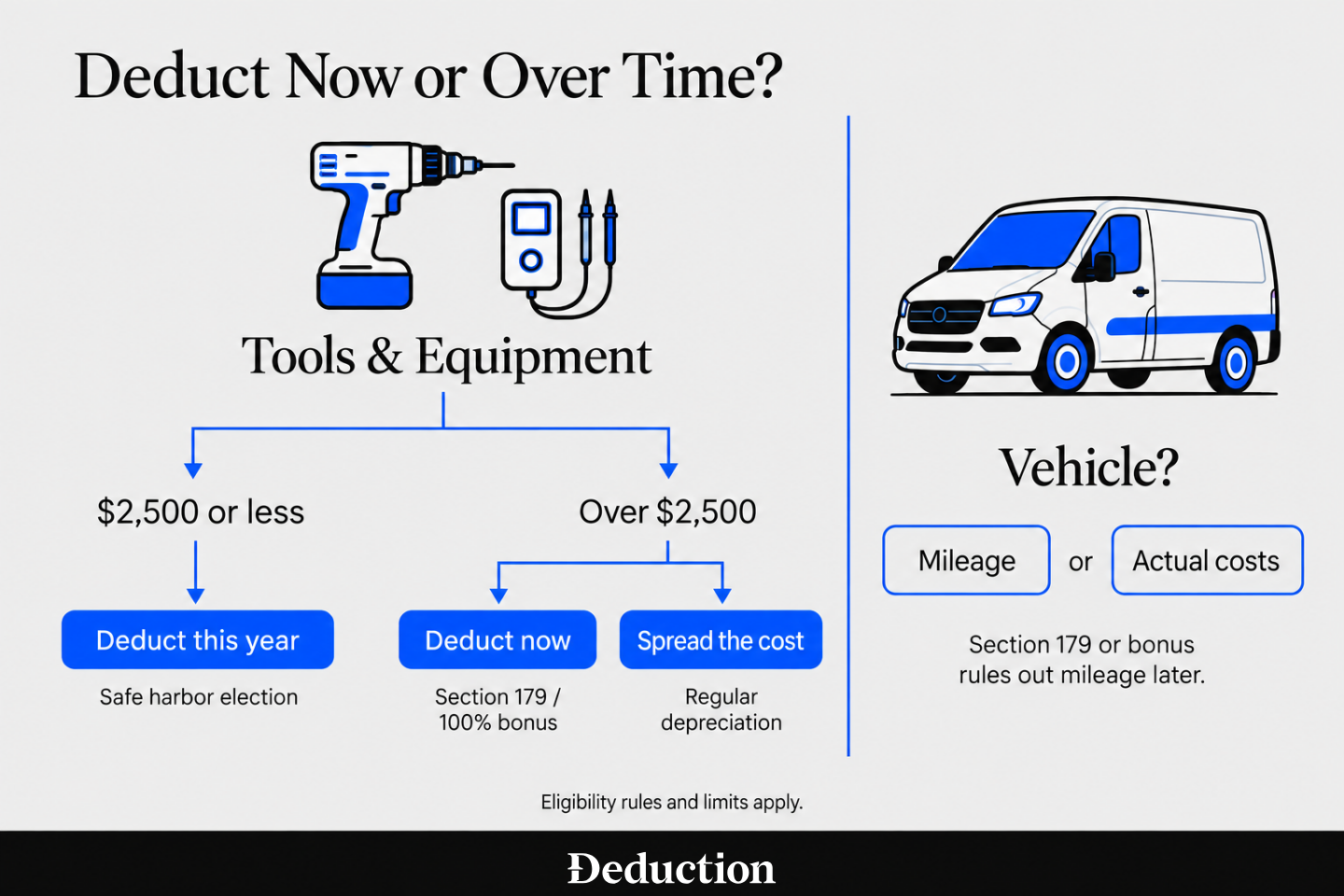
The rule that makes this simple is the "de minimis safe harbor." If you don't have audited financial statements (almost no one-person shop does), you can deduct any item costing $2,500 or less per item or per invoice in the year you buy it, instead of depreciating it over several years.
To use this rule, you must consistently record purchases below your chosen dollar limit as expenses in your business records, with that practice in place at the start of the tax year. You also need to attach a statement titled “Section 1.263(a)-1(f) de minimis safe harbor election” to your timely filed return each year you use it.
Ask your preparer to include the statement, or check that your tax software adds it. For larger purchases, such as a van or hydraulic bender, see the Section 179 discussion below.
Report these expenses on Schedule C, line 22 (supplies), or line 13 if you’re deducting their cost through depreciation. You can’t claim a business deduction for tools bought solely for projects around your own home or deduct the same costs your employer has reimbursed.
Licenses and Permit Fees
You can deduct the fees you pay for your state or city electrician license, renewals, contractor registration, and job permits. These go on Schedule C, line 23, “Taxes and licenses,” which includes licenses and regulatory fees paid annually to state or local governments for your business
If you charge a customer the exact cost of a job permit, you still record the permit fee as an expense and the customer’s reimbursement as income.
Trade association dues and premiums for a required license bond are also deductible, but you report them separately. Association dues go on line 27b, while bond premiums go on line 15 with your other business insurance.
If you paid for your first license before your business began operating, the fee may need to be treated as a start-up cost, which has separate deduction rules.
Deduction's answer on how to report and deduct professional licenses and regulatory fees covers what counts as a deductible license or fee.
Safety Gear and PPE
You can deduct protective equipment you need for electrical work, including voltage-rated gloves and their leather protectors, face shields, hard hats, safety glasses, and insulated tools.
For work clothing, including arc-rated shirts, coveralls, and steel- or composite-toe boots, the IRS applies two conditions: you must need it for your work, and it must be unsuitable for everyday wear. Wearing something like a plain shirt and jeans only on the job doesn’t, by itself, make it deductible.
A polo with your business name on it needs a bit of consideration. The logo alone doesn’t make it deductible; it still has to meet the work-clothing requirements above.
You can also deduct what you pay to clean and repair qualifying gear. Report these costs on Schedule C, line 22 (supplies) or line 27b (other expenses), as appropriate, and keep the receipts with a note explaining how you use each item for work.
Vehicle Expenses
Driving between jobs, picking up supplies, visiting the permit office, and going to a customer’s home to prepare a quote all count as business mileage. But the drive from home to your first job site, and home again after your last, is usually commuting and isn’t deductible.
There are exceptions. If you regularly work from a shop or yard, trips between home and a temporary job site in the same business can qualify. A temporary job is generally one expected to last, and that actually lasts, a year or less.
If your home office qualifies as your principal place of business, trips between home and other work locations in that business can qualify too. Simply scheduling jobs or keeping the books at home doesn’t automatically meet that requirement. IRS Publication 463
Once you’ve identified your business miles, you can calculate the deduction using the standard mileage rate or your vehicle’s actual expenses. For 2026, the business mileage rate is 72.5 cents per mile from January through June and 76 cents from July through December, following a midyear increase.
With the actual-expense method, you deduct the business share of costs such as fuel, repairs, tires, insurance, registration, and allowable depreciation. That share is based on your business miles divided by your total miles. If you’re self-employed, the business share of vehicle loan interest can also be deductible, even when you use the standard mileage rate. IRS Publication 463
The standard mileage rate may give you a larger deduction if your vehicle is inexpensive to run and you drive a lot for work.
Actual expenses may work out better for a costly van used mostly for business, particularly if it qualifies for a Section 179 deduction in the year you put it into service. Compare both methods before choosing.
For a vehicle you own, you must choose the standard mileage rate in its first year of business use to keep that option available. You can switch to actual expenses later, subject to depreciation rules. But if you claim Section 179, bonus depreciation, or regular MACRS depreciation on that vehicle, you can no longer use the standard mileage rate for it.
Either way, keep a mileage log with the date, destination, purpose, and miles, and put the total on Schedule C, line 9. Whether car insurance is tax deductible on its own depends on the method: it's built into the per-mile rate, and it's a separate cost only under real costs.
Business Insurance
You can generally deduct premiums for general liability insurance, tools-and-equipment coverage, workers’ compensation for employees, and surety bonds required by your license or contracts. Errors-and-omissions coverage for electrical design work also qualifies.
Most of these costs go on Schedule C, line 15, “Insurance (other than health).” Commercial auto insurance goes with your vehicle expenses when you use the actual-expense method; it isn’t a separate deduction under the mileage method. Employee health insurance goes on line 14. IRS Schedule C instructions
Your own qualifying health insurance premiums go on Schedule 1, alongside eligible retirement contributions. These are above-the-line tax deductions, claimed separately from your Schedule C business expenses.
Disability insurance that replaces your own lost earnings and personal life insurance benefiting you or your family are generally not deductible, even if the business pays the premiums.
Continuing Education and Training
Code update classes for license renewal, courses on the latest National Electrical Code (NEC), and manufacturer training on panels or lighting controls can all qualify. Certifications in EV charger installation or residential solar may qualify too. The IRS requires the education to maintain or improve skills used in your current work, or to meet requirements for keeping your license.
For example, you might run a residential maintenance business and take a solar installation course because more customers are asking about rooftop panels. The course may be deductible if it builds on your existing electrical skills without qualifying you for a new trade.
Training that meets the minimum requirements to enter the trade, such as qualifying apprenticeship courses or education for your first license, doesn’t qualify for this business deduction. Neither does a program that qualifies you for a different profession, such as an engineering degree.
Report deductible training on Schedule C, line 27b. Qualifying overnight travel goes on line 24a; deductible local driving belongs with your vehicle expenses.
Section 179 and Bonus Depreciation
Larger purchases, such as a work van, hydraulic bender, threader, cable puller, trencher, or scissor lift, can exceed the $2,500 limit for deductions discussed earlier. You can generally deduct their cost over several years through depreciation instead, typically five years for a van. If the purchase qualifies, Section 179 or bonus depreciation may let you deduct some or all of that cost in the year you put it into business use.
Section 179 lets you expense up to $2,560,000 of equipment placed in service in 2026, capped at your taxable income from all your businesses for the year (W-2 wages count toward that too); any excess isn't lost, because Section 179 limitations can be carried forward to later years.
Bonus depreciation is now a permanent 100 percent write-off for property acquired after January 19, 2025, with no income cap. Both cover used equipment. Section 179 requires more than 50 percent business use, while bonus depreciation applies that test only to vehicles and other listed property.
A small SUV rated at 6,000 pounds or less is capped at $20,300 of first-year depreciation in 2026 if you take bonus depreciation, and $12,300 if you don't.
Over 6,000 pounds, a heavier SUV, a short-bed crew-cab pickup, or a conventional cargo van with a hood is limited to $32,000 under Section 179, though bonus depreciation can cover the rest. Deduction's guide to vehicles qualifying for the Section 179 deduction walks through the classes.
Claiming Section 179 or bonus depreciation on a vehicle rules out using the standard mileage rate for that vehicle later. Compare the methods in the year you first use it for business, before claiming either deduction. Report Section 179 or bonus depreciation on Form 4562, with the deduction carried to Schedule C, line 13.
Travel, Lodging, and Meals
An installation two states over or a week-long commercial fit-out may qualify as deductible business travel if you need to stay overnight away from your tax home, generally the area where you mainly work.
The IRS looks at whether your duties keep you away substantially longer than an ordinary day’s work and require sleep or rest so you can continue working. Distance alone doesn’t qualify a trip, and a long workday followed by a late drive home generally doesn’t meet that test.
Once it does, your transportation, lodging, laundry, and tips are fully deductible, and meals are deductible at 50 percent. You can deduct your real meal costs or use the federal per diem rate for meals in that city, which spares you the receipts. There's no per diem for lodging, so keep those receipts.
If you bring a helper, their travel and meals are deductible under the same rules, as part of their wages or contract cost if you pay them directly. Costs for a spouse or family member who comes along aren't deductible, unless they're an employee doing real work on the trip.
Travel goes on Schedule C, line 24a, and meals on line 24b. The rules get more involved for assignments that run many months or trips that mix in personal days, so check Publication 463 or a CPA before a long one.
Advertising and Marketing
Online ads, van wraps, yard signs, business cards, lead-generation listings, and portfolio photos can all qualify as advertising expenses on Schedule C, line 8. Sponsoring a local team can qualify too when the sponsorship promotes your business.
Ongoing website hosting and routine maintenance are generally deductible business expenses. Higher costs, such as building a website, buying an existing domain, or purchasing software, may follow different rules and shouldn’t automatically be grouped with advertising.
The timing matters as well. Paying upfront for several years of billboard advertising doesn’t necessarily mean you can deduct the whole payment that year; prepaid-expense rules may require you to spread the deduction out.
Deduction’s page on whether websites, domain names, or other digital assets are deductible or depreciable is covered here.
Business Software
You can deduct subscriptions you use to run your electrical business, including scheduling and dispatch apps, invoicing and estimating software, bookkeeping tools, customer management software, and electrical design or load-calculation tools. Payment processing fees and the business share of your phone plan also qualify.
Subscriptions are generally deductible in the year you pay, though payments covering multiple years may need to be spread over the subscription period.
Software subscriptions go on Schedule C, line 18 (office expense) or line 27b (other expenses, totaled in Part V); either works as long as you're consistent. Payment processing fees belong on line 10.
Wages, Benefits, and Subcontractors
If you hire a helper for a big cable pull or bring on an apprentice, you can generally deduct their pay. Where you report it depends on whether they’re an employee or a subcontractor.
Report employee wages on Schedule C, line 26, and your share of their payroll taxes on line 23. Health insurance and other qualifying benefits go on line 14, while employer retirement contributions go on line 19.
Report payments to independent subcontractors on line 11 as contract labor. If they bring their own tools and control their hours, the IRS will likely think they are independent.
For 2026, reportable payments of $2,000 or more generally require Form 1099-NEC, up from $600 through 2025. File it with the IRS and give the subcontractor a copy by February 1, 2027, since January 31 falls on a Sunday. IRS filing rules
Get a W-9 before paying each subcontractor, so you have their tax ID and business classification ready for reporting.
Retirement Contributions
Because your business income is self-employment income, you can open a retirement plan for yourself and deduct what you put in. Two plans do most of the work for a one-person electrical shop:
- SEP-IRA: You can contribute up to 25 percent of your net self-employment earnings, to a maximum of $72,000 for 2026. You can open and fund it as late as your filing deadline, including extensions, which makes it the easiest way to cut last year's tax bill after the year is over.
- Solo 401(k): You contribute as an employee, up to $24,500 for 2026 (plus $8,000 if you're 50 or older), and again as the employer, up to 25 percent of net earnings, for a combined ceiling of $72,000 before catch-up contributions. It lets you put away more at a lower income than a SEP does, but it takes more paperwork.
Neither plan is deducted on Schedule C; both go on Schedule 1, so they lower your income tax but not your self-employment tax.
The "25 percent" is measured against net earnings after subtracting half your self-employment tax and the contribution itself, which works out to about 20 percent of your Schedule C profit. Deduction's page on the maximum allowable contributions to a solo 401(k) in 2026 has the full math.
Example of a Tax Deduction Scenario for Electricians
Here's what Section 179 looks like for a smaller, city-based operation. All figures are estimates for illustration.
Take a self-employed electrician in Queens who works alone servicing condo and co-op units: panel upgrades, EV charger installs, rewiring during renovations. Net profit before the purchases below is about $95,000, filing single, which puts the top of her taxable income just inside the 22 percent bracket for 2026.
In March 2026, she buys three things, all used 100 percent for the business:
- Used cargo van, $32,000: Over 6,000 pounds, so the passenger-car caps don't apply, and at $32,000 it fits inside the Section 179 SUV cap even though its hood is too long for the cargo-van exception.
- Hydraulic conduit bender and threader, $6,000: Too expensive for the $2,500 rule.
- Thermal imaging camera and circuit tracer kit, $3,000: Same.
Assuming the tools and van qualify for full deductions, either Section 179 or bonus depreciation lets her deduct the $9,000 spent on tools from her 2026 business income. For the van, she needs to compare Section 179 with the mileage method.
Claiming its full $32,000 cost under Section 179 would bring the combined deduction to $41,000, reducing her Schedule C profit from $95,000 to $54,000.
Bonus depreciation generally applies automatically to qualifying property unless she elects out. If she opts out for the van and doesn’t claim Section 179, she would spread its cost over the five-year recovery period.
Assuming standard MACRS depreciation and the half-year convention apply, her first-year van deduction would be 20%, or $6,400. After also deducting the $9,000 in tools, her Schedule C profit would be $79,600.
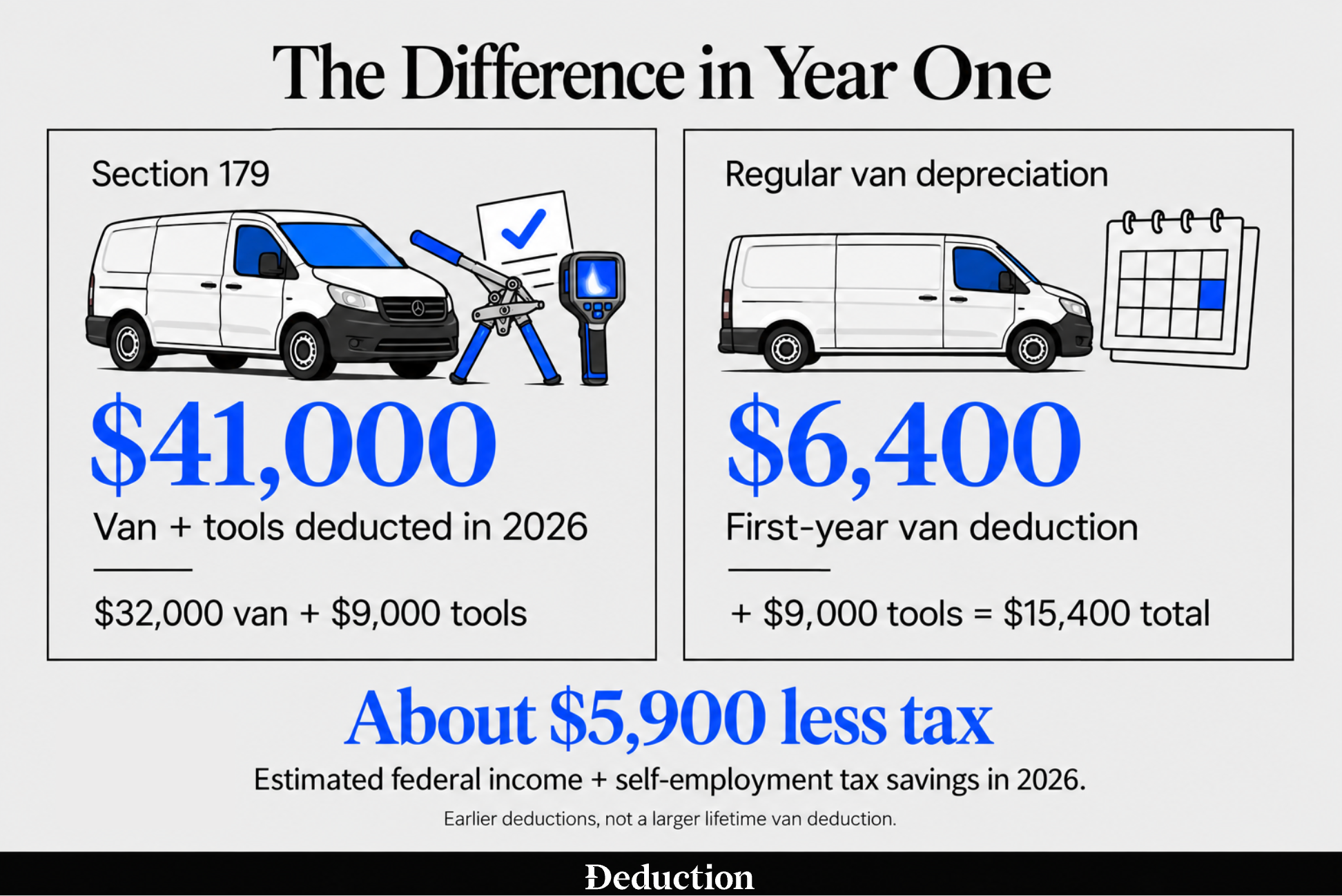
Taking the larger deduction gives her an extra $25,600 to deduct in 2026. In this example, that reduces her income tax by about $2,300 and her self-employment tax by about $3,600, for roughly $5,900 in savings this year.
Her income tax savings are less than 22% of the extra deduction because much of her taxable income falls in the 12% bracket. The larger expense deduction also reduces the business income used to calculate her qualified business income deduction.
Section 179 brings the deduction sooner rather than increasing the total she can deduct over the van’s life. It may offer less immediate benefit in a low-profit year because it’s limited by taxable income from active trades or businesses. Bonus depreciation has no equivalent business-income limit and can create a loss.
New York adds a wrinkle: the state doesn't follow federal bonus depreciation, so anyone who takes it has to add the federal deduction back and recompute on Form IT-398. New York does follow Section 179 (its only add-back is for heavy SUVs, and vans are exempt), which is one more reason she uses Section 179 here rather than bonus. Check how your own state treats both.
Why Electricians Should Get Tax Deductions
Deductions do three things for a small electrical business:
- Lower your taxable income: Deductible business expenses reduce your Schedule C profit, which helps determine your income tax and self-employment tax. This accounts for the money you spent doing the work before your taxes are calculated.
- Free up money to reinvest: A lower tax bill leaves you more money to buy a van, hire help, or contribute to a retirement plan, which may provide another deduction.
- Sharpen your business decisions: Knowing that a $6,000 bender costs someone in the 22 percent bracket closer to $4,200 after tax, or that equipment placed in service in December gets the same Section 179 deduction as equipment placed in service in January, changes when and what you buy.
How Missing Deductions Can Raise Your Tax Bill
Missing $5,000 in deductible expenses could leave you paying roughly $1,200 more in federal taxes in the example above. Small purchases, software subscriptions, insurance premiums, and license renewals can add up to a meaningful deduction over the year.
For a Schedule C filer, each $1,000 in missed deductions could mean about $300 in extra income and self-employment tax in the 22% bracket, or around $230 in the 12% bracket. Your actual cost depends on your tax situation.
If you discover missed expenses after filing, you can generally amend your return to claim a refund within three years of filing or two years of paying the tax, whichever is later.
How To Find These Tax Deductions for Electricians
The manual route works if your records are decent. The steps:
- Check your assets: List everything you bought for the business that cost more than $2,500 and is still in use: the van, large tools, equipment. These are your Section 179 and depreciation candidates.
- Check your expenses: Go through bank and card statements month by month and tag every business cost, including the ones paid from a personal card.
- Assess your income and tax bracket: Your net profit sets your bracket, which sets what each deduction is worth and whether Section 179 (capped at business income) or bonus depreciation makes more sense this year.
- Run the list above as a checklist: Go through the 12 categories one at a time and ask what you spent in each.
- Add them to your Schedule C: Each category has a line, and the table at the top of this article gives you the number.
- Have a tax professional check it, or check it yourself: A second look before filing catches the missed ones and the ones that don't qualify.
<IMAGE 4 of 4, PROCESS INFOGRAPHIC, 1200x800: Five paper-note steps in a row with electric-blue numerals: "Track" (receipts, mileage, statements), "Upload" (invoices, forms), "Prepare forms" (Schedule C, Form 4562, Schedule SE), "CPA review", "File". Minimal text, EDEDED paper. Deduction wordmark footer bar.>
The easier version replaces most of that with software:
- Use a tax deduction tracker: An app or AI that connects to your bank and categorizes as you go, or an AI tax deduction finder that does the tagging for you.
- Feed it everything: Invoices, receipts, statements, the mileage log, and the license and insurance documents.
- Prepare your forms: Let the tool build Schedule C, Form 4562, and Schedule SE from what it found.
- Let a professional check: Have a CPA review the return before it goes, especially the depreciation choices and anything you're unsure of.
- File it: E-file, and keep your records for at least three years after filing, longer for anything you depreciate (until three years after you file for the year you sell or scrap it) and at least four years for payroll records.
What Is the Best Software for Electricians Filing Taxes?
Five tools come up most often for tradespeople. Prices are from each vendor's site as of September 2026 and change through the season, so confirm before you buy. Deduction's roundup of the best self-employed tax software compares more options in depth.
- Deduction: An AI tax assistant (Taylor) finds deductions during the year, prepares the return, and a licensed tax professional reviews it before filing. Questions and uploads are free all year; the $499 annual fee is due only when you're ready to file or need a pro to review a high-impact decision. Best if you want the deductions found for you, with CPA review.
- Everlance: A mileage and expense tracker. The free tier logs 30 trips a month automatically, and the Professional plan at $99.99 a year bundles federal and state 1099 filing through a third-party provider, with no CPA review.
- H&R Block: Do-it-yourself online filing with a Self-Employed tier at $130 for federal plus $49 per state, and a paid Tax Pro Review add-on. Ideal if you already keep clean books and want an expert look as an option.
- TurboTax: Its Premium tier handles Schedule C. The vendor shows federal pricing that shifts through the season, with state filing charged separately, so check the page for the current figure. Great if you've used it before and your return is simple.
- TaxAct: The Self-Employed tier is $109.99 for federal plus $64.99 per state, one of the lower DIY prices here for a Schedule C return. Nice for a cost-conscious filer comfortable doing it alone.
Can I Deduct My Self-Employment Deductions While Being Employed as an Electrician?
Yes. If you work as a W-2 electrician and take on jobs through your own business, you can deduct qualifying expenses for those side jobs. Report the business income and expenses on Schedule C.
You generally can’t deduct unreimbursed expenses for your W-2 job on your federal return. Keep those costs separate: if you use a drill for both your employer’s projects and your own jobs, only the share used for your side business qualifies.
Let Deduction File Your Taxes as an Electrician and Find Your Deductions
You can have every receipt photographed, the mileage log complete, and the van's paperwork in a folder, and still be stuck on the questions that decide the bill: whether the van belongs on Section 179 or the per-mile rate, whether the solar course counts as improving your trade or entering a new one, whether the helper you paid by the hour was really a contractor.
Deduction as a tax filing software built for that gap: Taylor, its AI tax agent, works through your records with you during the year, and a licensed tax professional reviews every return before it's filed. It works in three steps:
- Upload your documents: Upload receipts, statements, and forms to your Vault, forward emails, or let Taylor pull them in.
- Taylor finds the deductions: It sorts your expenses into the right categories, talks through the depreciation and vehicle choices with you, and prepares your Schedule C and the rest of the return.
- A CPA reviews and files: A licensed tax professional checks every number and form before anything goes to the IRS.
You can ask Taylor questions and upload documents at no cost all year, and you pay only when you're ready to file or need a licensed professional to weigh in on a high-impact decision. The Personal plan is $499 a year and covers federal and state filing with a 100 percent accuracy guarantee.
Frequently Asked Questions About Tax Deductions for Electricians
Here are some frequently asked questions about tax deductions for electricians:
How does the new $6,000 tax deduction work?
It's an extra deduction for taxpayers age 65 or older, available for 2025 through 2028 whether or not you itemize. Each qualifying spouse gets $6,000, so a couple can deduct $12,000. It phases out once modified adjusted gross income passes $75,000 ($150,000 for joint filers). It has nothing to do with your business expenses.
What is the $2,500 expense rule?
The de minimis safe harbor lets you deduct any tool or piece of equipment costing $2,500 or less per item or invoice in the year you buy it, rather than depreciating it. You attach a one-line election statement to your return each year. Anything above $2,500 goes through Section 179, bonus depreciation, or regular depreciation.
What is the most overlooked tax break for electricians?
Often the QBI deduction, which takes up to 20 percent off your Schedule C profit before income tax with no receipts required. Electricians aren't a "specified service" business, so it isn't phased out like a consultant's, though wage and property limits can apply above $201,750 of taxable income. Health insurance and retirement plans are next.
What expenses are 100 percent tax-deductible?
Tools and supplies, license and permit fees, safety gear, business insurance, advertising, software, subcontractor payments, and employee wages are all fully deductible on Schedule C. Business meals are only 50 percent deductible. Vehicle costs and a phone or laptop you also use personally are deductible only for the business share.
What are the new tax breaks in 2026?
For electricians, the big ones are permanent 100 percent bonus depreciation on equipment acquired after January 19, 2025, a Section 179 limit of $2,560,000, a higher 76-cent mileage rate from July 1, a $2,000 threshold before you owe a sub a 1099-NEC, and the overtime deduction of up to $12,500 for W-2 electricians.
What can I claim on tax without receipts in 2026?
Any single expense under $75, except lodging, needs only a record of the date, amount, and business purpose, not a receipt. Mileage needs a log rather than fuel receipts if you use the per-mile rate. Meals on overnight trips can use the federal per diem rate instead of receipts. Everything else needs documentation.