
Are investment fees tax-deductible? For most people filing a federal return, no. Advisory fees, account fees, and other costs of investing stopped being deductible in 2018. Some older guides still describe the old write-off, so it's easy to plan around a deduction you can't take.
Some costs from investment activity can still lower your taxes, though as an alternative, if you want to reduce some overall spend. Here's how 11 common investment fees are treated for 2026:
Investment Fees You Can't Deduct on Your Federal Return
Under section 67 of the tax code, you can't deduct any of these investment fees on your federal return,
Financial Advisor and Investment Management Fees
What you pay a financial advisor to manage your investments isn't deductible on your federal return, whether it's a percentage of your account or a flat amount.
The rule covers investment management, wealth management, and financial planning fees, whatever your advisor or managing firm calls them.
The fee isn't part of what you paid for any investment either, so it doesn't reduce your gain when you decide to sell your investment.
But a few states, including California and New York, still allow a deduction on the state return.
Custodial and Account Maintenance Fees
Fees such as account maintenance or inactivity fees on your brokerage account aren't deductible. The same goes for a fee to switch brokerages. It isn't part of selling an investment, so it won't lower your taxable gain.
Tax Preparation, Legal and Accounting Fees for Your Investments
Your payment for a professional, such as a CPA or a lawyer, for work on your investments isn't deductible.
If you have a rental property, it can be different. Using professional services in relation to your property (from a business perspective), the part of a professional's fee for your rental, such as preparing its tax forms, is deductible on Schedule E, the form for rental income and expenses.
Investment Newsletters, Research and Software Subscriptions
Investment newsletters subscriptions, stock research services, charting tools and portfolio software aren't deductible for an investor. You are exempt if you are a trader with trader tax status, who reports business expenses on Schedule C.
Safe Deposit Box Fees
This one is a unique case. The cost of a bank box that holds stock certificates or bonds isn't deductible on your federal return, but Alabama still allows it on its state return if you itemize there.
Investment Fees That Lower Your Taxes Another Way
There are investment fees that aren't tax-deductible, but they can lower your tax in another way, depending on how the fee is charged and which account pays it. Here are some key examples:
Brokerage Commissions and Trading Fees
Brokerage commissions don't get deducted on their own. A lower cost is reflected on your Form 1099-B: what you paid to buy is added to your cost basis, and what you paid to sell is subtracted from your sale price.
Mutual Fund and ETF Expense Ratios
You can't deduct a fund's yearly fee, but there's still a way to pay less in another sector.
Say your fund earns $1,000 for you this year and charges a $100 fee. The fund keeps the $100 and reports only $900 of income to you, so you pay tax on $900, not $1,000. You get the same result as a deduction without doing anything.
If you paid a sales charge to buy into a fund, it usually counts as part of what the shares cost you. That makes your profit, and the tax on it, smaller when you sell.
IRA and 401(k) Account Fees
You can’t deduct IRA or 401(k) fees. If your traditional IRA holds pre-tax money, paying its own fees from the account can cost less than paying from your bank account. In private rulings, the IRS has allowed this without triggering a taxable withdrawal.
Use IRA money only for that IRA’s own fees. If you use it to pay fees on a regular brokerage account, the payment counts as a withdrawal. You’ll owe income tax on the taxable portion and may owe an extra 10% if you’re under 59½.
A Roth IRA can also pay its own fees. Every dollar you use for fees is a dollar less that can grow tax-free.
Investment Fees You Can Still Deduct
Three investment costs still come off your taxable income, each under a rule other than the old 2% one:
- Margin interest and other investment interest: Interest on money you borrow to buy taxable investments, such as a margin loan, is deductible if you itemize, up to your net investment income, which generally leaves out qualified dividends and long-term gains.
- Rental property management fees: If you own rental property, management fees come off your rental income on Schedule E, the form for rental income and expenses. Again, this is seen as a business expense for your rental property.
- Fees paid by a trust or estate: An estate or a trust that files its own Form 1041 (not a revocable living trust) can deduct costs it wouldn't have had if the property weren't held in a trust, such as probate fees, fiduciary bond premiums, and preparing its Form 1041, under section 67(e)
Why Most Investment Fees Stopped Being Deductible
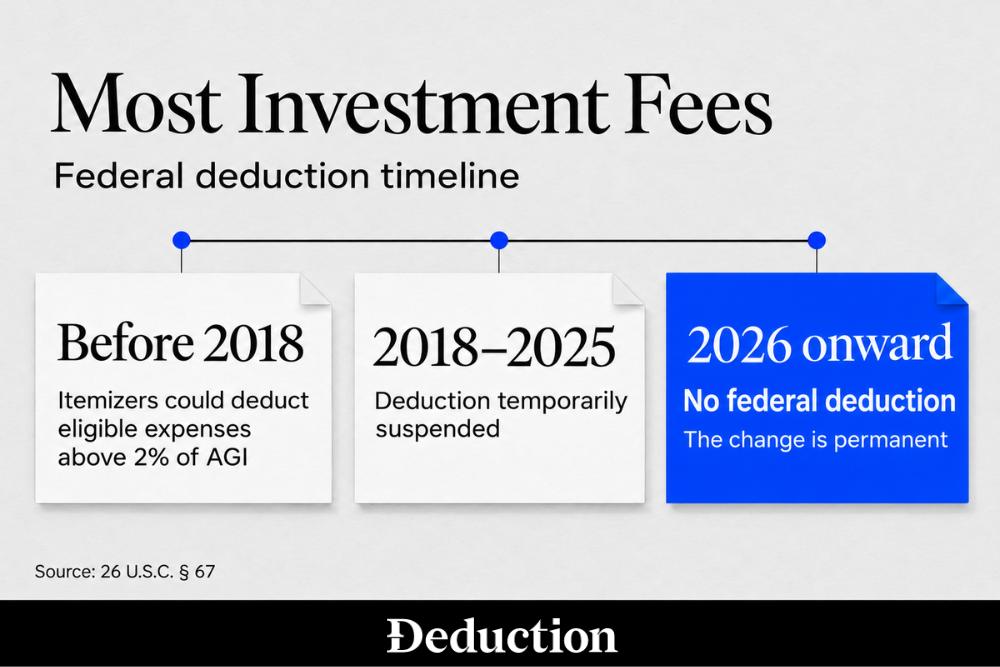
Most investment fees were miscellaneous itemized deductions, and individuals can no longer claim them on a federal return. Here's how the rule changed:
What a 1% Investment Fee Costs You Over 20 Years
A 1% yearly fee on a $100,000 portfolio can cost about $85,000 over 20 years, and you pay all of it with after-tax money. Here's the difference a fee makes:
The gap gets bigger over time because the money you spend on fees could have stayed invested and kept growing.
You can’t deduct these fees on your federal tax return. If you pay a traditional IRA’s own fee directly from the account with pre-tax money, you avoid paying income tax on the amount used for the fee.
State Returns That Still Allow a Deduction for Investment Fees
A handful of states did not adopt the federal changes to stop deductions, so you may be able to deduct investment fees on your state return. Most states with an income tax follow the federal result. As of the 2025 state forms, these states still allow it:
- California: Investment expenses, such as advisory and management fees, are deductible along with other miscellaneous itemized deductions, for the part that's more than 2% of your federal AGI.
- New York: Investment expenses are still deductible, along with job expenses and certain miscellaneous deductions.
- Alabama: Investment expenses, tax preparation fees and safe deposit box rent are deductible for the part that's more than 2% of your Alabama AGI.
- Arkansas: Brokerage and investment fees are deductible for the part that's more than 2% of your AGI.
- Hawaii: Hawaii didn't adopt the federal suspension for 2025, so investment fees and other miscellaneous deductions still count there. Check the 2026 instructions before you count on it for 2026.
Where Investment Fees Show Up on Your Tax Forms
Your broker's year-end tax package shows where most of these fees went:
- Form 1099-B: This form reports your sales, and its cost basis and proceeds usually already include commissions. Check it before you adjust anything.
- Form 1099-DIV, box 6: Box 6 shows your share of the expenses of a nonpublicly offered mutual fund. That amount is already included in your dividends in box 1a, and you can't deduct it on your federal return.
- Your brokerage statement: Margin interest you paid usually appears on your year-end statement rather than on a 1099. You'll need the total for Schedule A, and usually for Form 4952.
- Schedule K-1 from an investment partnership: Most investment expenses a partnership passes through to you are the old miscellaneous itemized deductions, and they don't come off your federal return. Investment interest and some other portfolio deductions on the K-1 still can if you itemize, so follow the code next to each amount.
- Your advisor's fee statement: Keep it if you live in a state that still allows the deduction.
Get a Straight Answer on Your Own Investment Costs
Should you pay your advisor’s fee from your IRA or your bank account? Could margin interest make it worth itemizing? Can you still deduct investment fees on your state tax return? The answers depend on what’s in your accounts, what else you can deduct, and where you live.
Deduction helps you prepare and file your taxes with AI. CPAs and other tax professionals can help you work through questions like these and review your return before it’s filed. Here’s how it works
- Upload your documents: Add your 1099s and brokerage statements to your Vault, or forward the emails they came in.
- Taylor answers your questions: Taylor, Deduction's AI tax agent, finds your deductions and asks about anything unclear, such as which account paid a fee.
- A CPA or licensed tax professional reviews your return: Your return is checked before it's filed.
Frequently Asked Questions About Investment Fee Deductions
Can I Deduct My Financial Advisor's Fees?
Not on your federal return. Fees you pay for investment advice, investment management or tax advice are miscellaneous itemized deductions, which individuals can't claim for 2018 and later. The 2025 tax law made that permanent. A few states, including California and New York, still allow them on the state return if you itemize there.
Can I Claim Brokerage Fees on My Taxes?
Not as a separate deduction. Commissions and trading fees you pay to buy an investment are added to its cost basis, and fees you pay to sell it reduce your sale proceeds. Both lower your taxable gain. Your Form 1099-B usually already includes them, so don't count them twice.
Were Investment Fees Tax Deductible in 2025?
No. Miscellaneous itemized deductions, which include investment fees, were suspended for 2018 through 2025, and the 2025 tax law made the suspension permanent starting in 2026. Investment interest falls under a different rule, so it stays deductible for people who itemize.
Are Investment Fees Tax Deductible for a Business?
It depends on the business. The rule that ended the deduction applies to individuals, estates, and trusts, so a C corporation can generally deduct its investment management fees. A partnership, LLC, or S corporation passes those expenses through to its owners, who can't deduct them. Fees on your personal investments aren't business expenses.
Can Day Traders Deduct Investment Expenses?
Only with trader tax status, which requires substantial, regular and continuous trading aimed at profiting from daily price movements. A trader reports business expenses, such as data and software subscriptions, on Schedule C. Most active investors don't meet that test and can't deduct those costs.
Is Margin Interest Tax Deductible?
Yes, if you itemize. Interest on a margin loan used to buy taxable investments is deductible up to your net investment income for the year, and any excess carries forward. You figure it on Form 4952. Interest on money used to buy tax-exempt bonds doesn't count.
General information only, not tax advice. How an investment fee is treated depends on the account, your state and whether you itemize, so check your situation with a CPA or licensed tax professional.
Related Articles
- Tax Deductions: The Best Ones That Are Easily Overlooked for Tax Year 2025
- SALT Deduction: Will You Benefit or Lose From Itemizing?
- 18 Tax Deductions for Landlords to Claim on a Rental Property in 2026