
Most lists of travel nurse tax deductions run long: mileage, scrubs, license fees, meals, your phone bill. When you move every few months and receive housing and meal stipends as part of your pay, it’s easy to assume you can claim most of those costs.
For most travel nurses, much of that list doesn’t apply. If your agency pays you on a W-2, you can’t deduct mileage, scrubs, or license fees on your federal return. If you don’t keep a tax home, your stipends become taxable wages too.
What you can claim depends on whether you’re paid on a W-2 or a 1099, and on whether you have an existing tax home. Both get full sections after the list. Here are the 12 tax breaks, grouped by how you’re paid:
Tax Breaks W-2 Travel Nurses Can Still Claim
If your agency pays you as a W-2 employee, these three tax breaks may apply to you. The remaining travel nurse tax deductions are for self-employed nurses, as explained in the W-2 or 1099 section below.
Tax-Free Housing and Meal Stipends
Stipends are the weekly housing and meal money your agency pays on top of your hourly rate. A common mistake is to call stipends a write-off and then try to deduct the rent or meals they paid for.
Stipends are often the biggest tax benefit a travel nurse gets, yet they aren’t a deduction. They’re pay that’s excluded from your taxable wages, so there’s nothing to claim on your return, and they don’t add to the income you pay tax on.
Your agency can leave these stipends out of your taxable wages if it pays them through an “accountable plan,” a reimbursement arrangement that meets IRS rules. The tax-free limit is generally the federal per diem rate, which sets a daily allowance for lodging and meals based on where you’re assigned.
This only works if you have a tax home and travel away from it for the assignment. Without a tax home, the IRS treats the stipends as taxable wages. A contracted area close enough to commute from home usually doesn’t qualify either, because you aren’t away from home. The tax home section below explains the test.
Stipends within the federal rate don’t appear in box 1 of your W-2. If your agency pays more than the federal rate, the extra is added to your box 1 wages, and the amount up to the rate is shown in box 12 with code L.
Overtime Deduction
You’ll see this when you pick up extra shifts, and your agency pays time and a half for the hours over 40.
From 2025 through 2028, you can deduct the extra half of time-and-a-half pay that federal law requires, up to $12,500 a year ($25,000 on a joint return). You can take it whether you itemize or take the standard deduction.
It applies to employees who are owed overtime under the Fair Labor Standards Act, the federal wage law. Registered nurses paid by the hour are owed overtime, so this covers W-2 travel nurses paid by the hour. Independent contractors generally don’t qualify.
Only the premium half counts, not the whole overtime paycheck. Time and a half means each overtime hour pays your regular rate plus an extra half of it. The deduction covers only that extra half, called the premium. The rest is ordinary pay, taxed like any other hour you work.
Here’s how that works for a nurse with a $40 taxable hourly rate who works 10 overtime hours a week on an 8-week contract, using estimates for illustration:
- $60 an hour is the overtime rate: $40 plus half of $40.
- $600 a week is the overtime pay, and $400 of it is ordinary pay at the $40 rate.
- $200 a week is the premium, the part you can deduct.
- $1,600 is the deductible premium over all 8 weeks.
At a 22% federal tax rate, deducting $1,600 saves about $352. If the same nurse took an offer with a $25 taxable rate and a bigger stipend, the premium would drop to $12.50 an hour, or $1,000 over the contract.
If your contract pays double time, or a state law requires overtime that federal law doesn’t, only the extra half that federal law requires counts toward the deduction.
The deduction shrinks by $100 for every $1,000 of modified adjusted gross income above $150,000 ($300,000 on a joint return). Married couples have to file jointly to claim it.
For 2026, your agency reports the qualifying amount in box 12 of your W-2 with code TT, and you can’t deduct more than what’s shown there. If it’s missing or looks too low, ask the agency for a corrected W-2. You claim the deduction on Schedule 1-A, a new form you attach to your Form 1040.
State Deductions for Unreimbursed Job Expenses
Your state may still let you deduct the license fees and scrubs that the federal return won’t.
A few states don’t follow the federal rule and still let W-2 workers deduct unreimbursed job expenses on the state return:
- California: You can deduct unreimbursed job expenses as an itemized deduction on your California return, even if you take the standard deduction federally. Only the amount above 2% of your federal adjusted gross income counts.
- New York: You can itemize job expenses on Form IT-196 whether or not you itemize federally. The same 2% floor applies.
- Pennsylvania: You can subtract allowable job expenses on PA Schedule UE without itemizing. Pennsylvania doesn’t accept federal per diem rates, and you generally can’t deduct costs your agency already covers with a tax-free stipend.
State rules change, and Hawaii stopped allowing this deduction starting in 2026, so check your own state’s revenue department before you claim anything.
Working in more than one state can also mean filing more than one state return. Filing tax returns in every state where you work as a travel nurse covers when that applies.
Deductions for 1099 Travel Nurses
If you work as a 1099 independent contractor, you’re self-employed and can deduct most of these costs on Schedule C, where you report your business income and expenses. To claim the travel deductions, you’ll need a tax home, which the next section explains.
Travel Between Your Tax Home and Each Assignment
It covers the flight or the drive from home to a new contract, and back again when it ends.
You can deduct the cost of getting from your tax home to each assignment and back, including airfare, baggage fees, rental cars, tolls, and parking. If you drive your own car, you can deduct either the standard mileage rate or your actual car costs.
The IRS raised the mileage rate partway through 2026. It’s 72.5 cents a mile for January 1 to June 30 and 76 cents a mile from July 1, so split your mileage log at July 1.
Driving between your temporary housing and the hospital also counts while you’re away from your tax home on the assignment. Driving from your tax home to a local job is usually commuting, which isn’t deductible, but a temporary job outside the metro area where you live and normally work can be an exception. All of these costs go on Schedule C.
Lodging at Your Assignment
Lodging means the flat or extended-stay room you rent near the hospital for a contract, often 13 weeks long.
You can deduct rent and utilities for temporary housing at the assignment. There’s no standard IRS rate for lodging, so you deduct what you paid and keep the lease and receipts.
You can deduct it only while you’re temporarily away from a tax home you keep paying for. The costs of the tax home itself, such as its rent or mortgage, aren’t deductible, even though paying them helps prove you have a tax home.
Meals and Incidentals
Meals and incidentals are what you spend on food and small costs on the days you’re away from home for work.
You can deduct 50% of your actual meal costs. Instead of keeping meal receipts, you can use the federal per diem rate for meals and incidental expenses (small costs such as tips) in the assignment area, and the 50% limit applies to that rate too.
As a self-employed nurse, you can use the per diem rate for meals only, not for lodging. Either way, you still need records of the dates, places, and business purpose of your travel. Meals go on Schedule C.
Nursing Licenses and Compact License Fees
License fees come up when a new contract needs a license in another state.
You can deduct state license fees, multistate license fees under the Nurse Licensure Compact, and renewals on Schedule C. W-2 nurses can’t deduct these on the federal return, though some of the states listed above allow it on the state return.
Certifications and Continuing Education
This is when you renew BLS or ACLS, or take the CEUs your license requires.
You can deduct certification courses and continuing education that maintain or improve your current nursing skills, including course fees and materials.
Courses that are part of a program qualifying you for a new profession aren’t a business expense, even if they also improve your nursing skills.
Malpractice and Liability Insurance
As a contractor, you may need your own policy because the agency’s coverage doesn’t extend to you.
You can deduct professional liability premiums you pay for your nursing work on Schedule C. If a hospital or agency policy already covers you and you pay nothing, there’s nothing to deduct.
Scrubs, Shoes and Medical Equipment
Work gear covers the scrubs, stethoscope, and penlight you bring to every new unit.
You can deduct work clothing only if your work requires it and it isn’t suitable for everyday wear. Scrubs can generally meet that test when your work requires them. Regular sneakers usually don’t, and nursing shoes and compression socks are harder to claim because you can generally wear them outside work.
Small equipment such as a stethoscope, penlight, and bandage scissors counts as a business supply on Schedule C.
Phone, Internet and Job Apps
It includes your phone bill, home internet, and the job-board apps you use to find the next contract.
You can deduct the business share of your phone and internet, plus paid job-search or credentialing apps. If about 30% of your phone use is for work, such as calls with recruiters and facilities, you deduct about 30% of the bill. Keep a note of how you worked out the share.
Self-Employed Health Insurance
Self-employed health insurance is the plan you pay for yourself because a 1099 contract comes without benefits.
You can deduct premiums for medical, dental, and vision coverage, plus qualified long-term care insurance up to age-based limits. It’s an “above-the-line” deduction, meaning it lowers your adjusted gross income whether or not you itemize.
You can’t take it for any month you were eligible for an employer-subsidized plan, including your spouse’s, even if you didn’t enroll. That includes months on a W-2 contract with an agency that offered one.
The deduction also can’t be more than your Schedule C profit from nursing, minus the deductible half of your self-employment tax and any retirement plan contributions you deduct for that business.
You figure it on Form 7206 and enter it on Schedule 1, not on Schedule C.
How a Tax Home Works for Travel Nurses
Your tax home decides whether your stipends stay tax-free and whether any travel cost counts.
Your “tax home” is your regular place of business. If you don’t have one, which can happen for travel nurses, your tax home can be the home you keep up and return to.
This three-part test decides whether it is, and the one-year rule decides whether each assignment counts as temporary.
The Three-Part Test for a Tax Home
This is when you keep an apartment back home, pay its rent while you’re away, and work there between contracts.
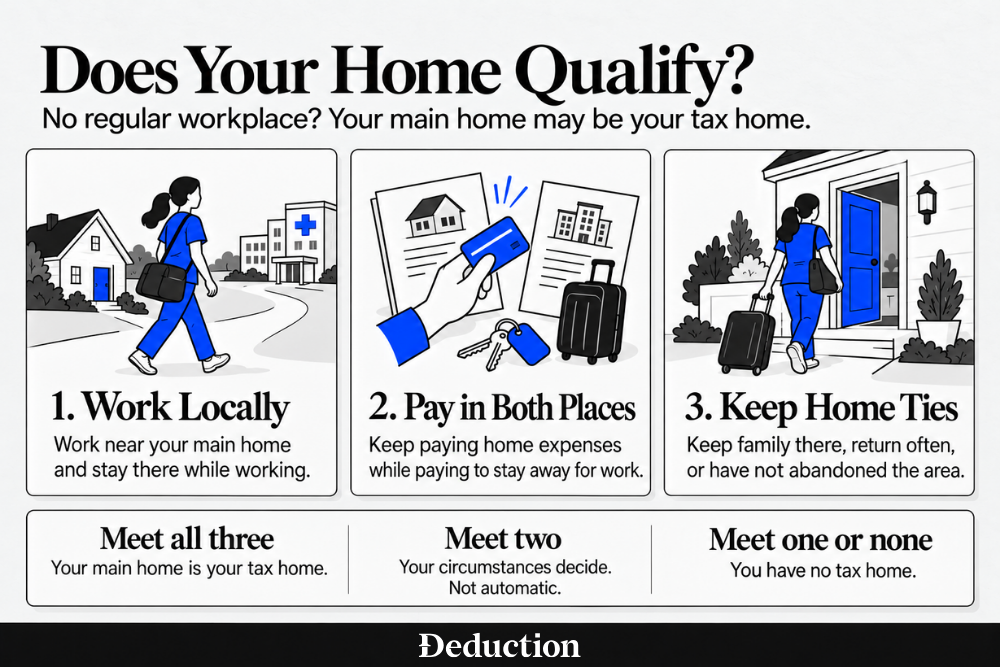
When you don’t have a regular place of work, the IRS looks at three factors:
- You work in the area of your main home and live in that home while you do.
- You keep paying for that home while you travel, so your living costs are doubled.
- You haven’t left the area for good, a family member lives in the home, or you often stay there.
If you meet all three, your tax home is the home where you regularly live. If you meet two, it depends on the facts, so two isn’t a guaranteed pass. If you meet one or none, you’re an “itinerant,” meaning you have no tax home for tax purposes.
Nurses who keep a lease or mortgage at home, pick up work there between contracts, and go back regularly are in the strongest position.
If you live with your parents between contracts, the second factor needs the most attention, because you need living costs there that you pay. For more on that setup, see whether your parents’ address can be your tax home.
The One-Year Rule for Travel Nurse Assignments
It comes up when a hospital offers to extend your contract, and you’re about to pass a year in the same city.
How long an assignment is expected to last when you start decides which group it falls in:
- A year or less: The assignment is temporary, as long as it does end within a year. Your stipends stay tax-free, and travel costs can count.
- More than a year: The assignment is indefinite from day one, and that city becomes your tax home. Stipends there are taxable, and travel costs don’t count as deductible.
An extension can change this partway through. If you now expect to stay past a year, the assignment becomes indefinite on the day that expectation changes. Costs before that day still count. After it, travel costs don’t count, and stipends are taxable.
The “12-month rule” you may hear about is this one-year rule. Habits such as going home every 12 or 13 months, or spending 30 days at home each year, are rules of thumb, not IRS rules. Neither one on its own keeps an assignment temporary.
The IRS hasn’t published a rule on breaks between contracts in the same area. In non-binding internal advice on the same one-year test for daily driving, the IRS has treated a break of three weeks or less as too short to restart the one-year clock and a break of at least seven months as long enough.
What Happens Without a Tax Home
If you give up your apartment and move from contract to contract with no home base, you no longer have a tax home.
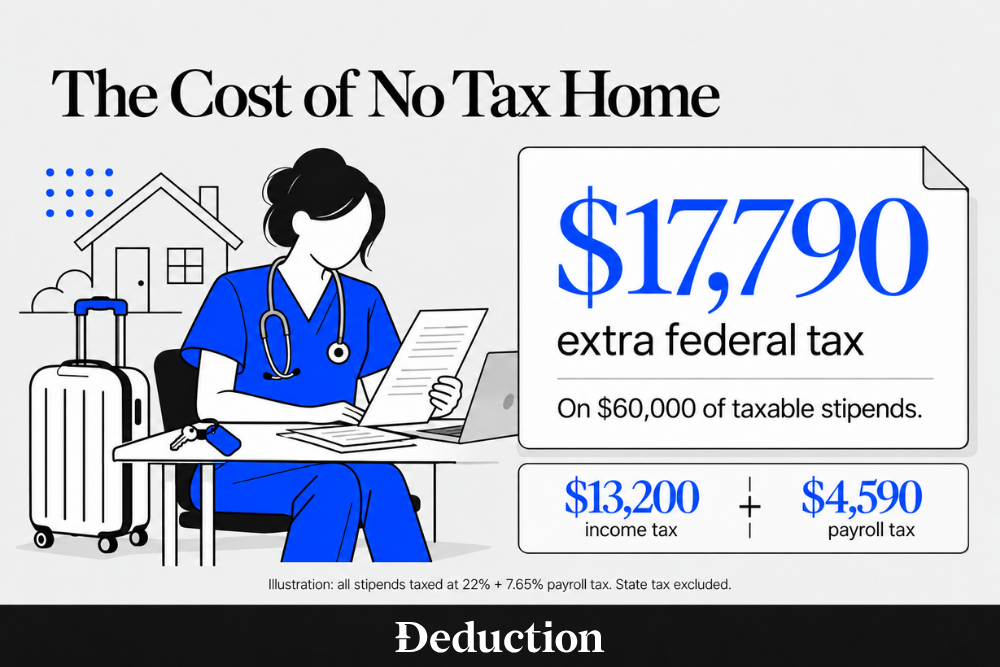
You’re an itinerant, so your stipends become taxable wages and you can’t deduct any travel costs. For tax purposes, you’re never away from home.
Here’s what that can cost, using estimates for illustration:
- $1,500 a week in stipends for 40 weeks of work comes to $60,000.
- About $13,200 in federal income tax if all of it is taxed in the 22% bracket.
- About $4,590 in Social Security and Medicare tax at the employee rate of 7.65%.
That’s roughly $17,790 more in federal taxes for the year, before any state income tax, compared with keeping a tax home.
W-2 or 1099: How Your Contract Decides What You Can Deduct
One line on your contract decides whether the 1099 list above applies to you.
As a W-2 employee, you can’t deduct unreimbursed job costs on your federal return. The 2017 tax law suspended this deduction, and the 2025 law made the suspension permanent.
If you’re a W-2 nurse, your tax breaks are the three in the W-2 group: tax-free stipends, the overtime deduction, and state deductions where your state allows them. Mileage, scrubs, licenses, and the rest of the 1099 list don’t apply on your federal return, even when you paid for them yourself.
If you’re a 1099 nurse, you report your income and expenses on Schedule C. You pay 15.3% self-employment tax, which is Social Security and Medicare tax, on most of your net profit, and you can deduct half of it.
No agency withholds tax for you, so you generally make quarterly estimated payments. Paying enough to meet the safe harbor for estimated taxes keeps you clear of underpayment penalties.
You may also qualify for the QBI deduction, which can let you deduct up to 20% of your business profit. Nursing counts as a health service, so the deduction phases out at higher incomes.
How Your Pay Package Split Affects Your Taxes
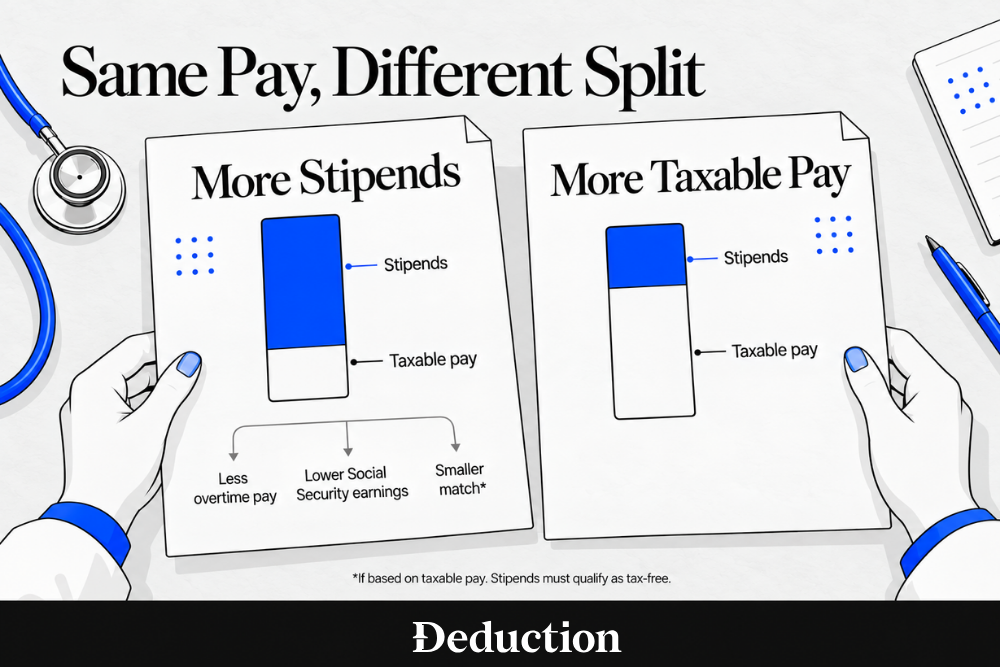
Travel nurse offers are divided into a taxable hourly wage and stipends that may be tax-free. Two offers can promise the same weekly pay but divide it differently. One might pay $25 an hour plus $2,000 a week in stipends, while another offers a higher hourly wage and smaller stipends.
A bigger stipend may sound like a better deal because of the lower taxes, but it has some practical benefits and downsides. Here are some possible outcomes:
- You pay less tax now: The stipend part of your pay isn’t taxed, as long as you keep a tax home, work away from it, and the stipends stay within the federal per diem rate for the area. The more of your pay that comes as stipends, the less of it you pay tax on this year.
- Your overtime pays less, and you deduct less: Overtime is time and a half of your taxable hourly rate, because stipends that reasonably match your travel costs aren’t counted in it. At $25 an hour, an overtime hour pays $37.50, and at $40 it pays $60. The smaller premium also means a smaller overtime deduction.
- You build less toward Social Security and retirement: Social Security figures your future benefit from the wages you pay Social Security tax on, so tax-free stipends don’t count. If your retirement plan matches a percentage of taxable pay, a lower hourly rate shrinks that match too.
- The IRS can treat your stipends as wages: If your agency pays you the same total whether or not you travel, and simply calls part of it a stipend, the stipends count as taxable wages. An IRS ruling on this uses a nurse staffing agency as its example. Before you sign, ask whether your total pay would change for a local assignment.
How to Track Your Deductions as a Travel Nurse
What you keep depends on how you’re paid, but every travel nurse needs proof of a tax home and the dates of each assignment. Those two records protect your tax-free stipends and every travel deduction.
- If you’re a W-2 nurse: Keep your home lease or mortgage statements and utility bills, each contract with its dates and location, and your pay stubs showing the stipends. Check every agency’s W-2 for box 12 codes L and TT, and keep job-expense receipts if your state still allows that deduction.
- If you’re a 1099 nurse: Keep all of the above, plus a mileage log with the date, miles, and purpose of each trip, a log of the days you claim the meal rate, and receipts for lodging and any other travel expense of $75 or more.
A routine makes this a few minutes a week instead of a weekend in April:
- Make one folder per contract: Save the contract, the lease, and that assignment’s receipts together, labeled by city and dates.
- Log as you go: Record miles and meal days each week, and split your mileage at July 1 for the 2026 rate change.
- Watch the calendar: Note each contract’s start and end dates, including extensions, so you can see when you’re nearing a year in one area.
- Gather every form in January: Collect the W-2 or 1099 from each agency you worked for, and check them against your pay stubs.
Deduction can hold all of this in one place. Upload contracts, statements, and receipts to your Vault, or forward the emails they came in, and Taylor, its AI tax agent, keeps track of your documents and deductible expenses through the year. If you’re on a 1099, Taylor can also work out your quarterly estimated payments.
Get Help With Travel Nurse Tax Filing
Your tax bill depends on decisions you make when signing a contract, well before April. Does a six-month extension push you past a year in that city? Does giving up your lease between contracts cost you your tax home? Is the taxable rate in a new offer low enough to raise questions?
Deduction is a tax filing service built around AI. Ask Taylor, its AI tax agent, about an extension or a new offer before you sign, and upload your W-2s, 1099s, and receipts as they arrive. A CPA or licensed tax professional reviews your return before it’s filed. Ask Taylor about your next contract to get started.
Frequently Asked Questions About Travel Nurse TaxDeductions
Do Travel Nurses Pay Less in Taxes?
Often, yes, on federal income tax. Travel nurses who keep a tax home and take temporary assignments away from it get stipends that aren’t taxed, up to the federal per diem rate, so less of their pay counts as income. The savings come from the stipends, not from deductions.
What Are the IRS Rules for Travel Nurses?
Keep a tax home, take assignments expected to last a year or less in any one area, and keep stipends within the federal per diem rate. If you’re paid on a W-2, you can’t deduct unreimbursed job costs on your federal return. The tax home section above explains the test.
Do Travel Nurse Agencies Pay for Your Housing?
Most agencies offer either a housing stipend or housing they arrange and pay for. Either one is tax-free only if you have a tax home and are working away from it on a temporary assignment. Without a tax home, the stipend or the value of the housing counts as taxable pay.
What Is the Most You Can Claim Without Receipts?
There’s no amount you can claim without records. A 1099 nurse can use the federal per diem meal rate instead of meal receipts but still needs a log of the dates, places, and business purpose of each trip. You need receipts for lodging and for any other travel expense of $75 or more.
What Is the $600 Rule?
It was the old threshold for a business to send you a Form 1099-NEC. For payments made in 2026, the threshold is $2,000, and it’s adjusted for inflation after that. Your income is taxable whether or not you receive a form, so report every payment, including contracts that came without a 1099.
This article is general information, not tax advice. Travel nurse taxes depend on your tax home, your contract, and the states you work in, so check your situation with a CPA or licensed tax professional before you file.