
Farm tax credits lower your tax bill dollar for dollar, while tax deductions lower the income you’re taxed on.
Federal and state programs offer tax credits that can lower your costs for farm fuel, solar panels, employee benefits, crop donations, and land you rent or sell to a beginning farmer.
Most farmers leave the paperwork to a tax preparer, but you still need to tell them about purchases and activities that could qualify for a credit. Some state credits require an application before you file, so you can prepare them before its too late.
The July 2025 tax law also ended several credits and set a 2027 deadline for new farm solar and wind systems.
Here are the credits you can still claim in 2026, so you know what to ask about. The table gives the quick version:
Federal Farm Tax Credits You Can Claim in 2026
Most working farms can claim the fuel tax credit. The other two credits may be less familiar to farmers, but they’re also used by businesses in other industries which you can try to claim and apply for:
1. Fuel Tax Credit (Form 4136)
Gasoline and undyed diesel include the federal fuel tax at the pump. When you use that fuel on the farm, you can recover the tax: 18.3 cents per gallon for gasoline and 24.3 cents per gallon for undyed diesel.
Fuel used off the farm, such as on the highway, doesn't count, and dyed diesel has no tax to claim. Keep a simple log of the gallons used on the farm, so your preparer can claim it.
2. Clean Electricity Credit for Farm Solar, Wind and Geothermal (Form 3468)
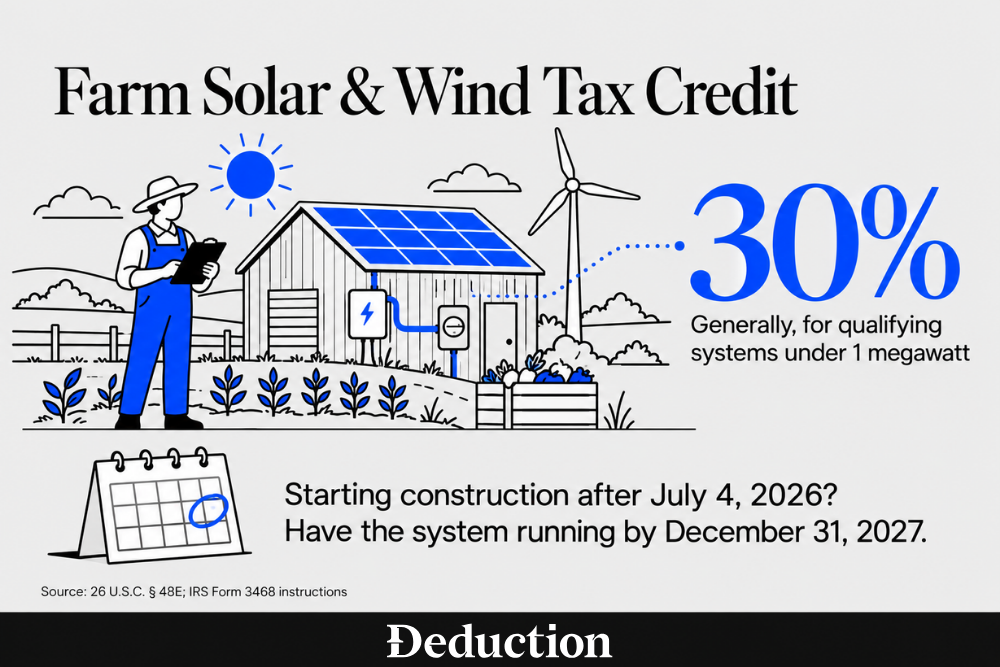
If you install solar panels or a wind turbine to power your farm, this credit generally covers 30% of the cost for systems under 1 megawatt. Most farm systems fall below that limit. A new solar or wind system must be up and running by December 31, 2027 to qualify.
Geothermal heat pumps for farm buildings can qualify for a separate tax credit. New rules can limit eligibility if too much of the equipment comes from certain foreign-owned manufacturers. Ask your installer to confirm that your system meets the requirements.
3. Clean Fuel Production Credit (Form 7218)
Farmers who produce and sell qualifying low-emission transportation fuel may claim this credit if they’re registered with the IRS. For example, a dairy farm that turns manure into gas and sells it as vehicle fuel may qualify.
Corn, soybean, sorghum, and spring canola growers may benefit through their buyers. Under USDA guidelines, growers can have practices such as no-till farming and cover crops verified. A biofuel producer may then pay more for those crops.
Employer Credits for Farms With Workers
If you hire farmworkers, these four federal credits can cover part of what you spend on their benefits. Farms with only owners and no other employees don’t qualify.
1. Small Business Health Care Credit (Form 8941)
The Small Business Health Care Tax Credit helps small employers pay for their workers’ health insurance by reducing their tax bill. If your farm qualifies, the credit can equal up to 50% of the insurance premiums you pay.
You generally need fewer than 25 full-time equivalent employees, average wages below the annual limit, and coverage purchased through SHOP, the health insurance marketplace for small employers. You must also pay at least half of each worker’s employee-only premium.
The credit gets smaller as employee numbers and average wages rise, and you can claim it for two consecutive tax years.
2. Employer Child Care Credit (Form 8882)
If you help pay for child care for your farmworkers, you may qualify for a tax credit worth 40% to 50% of eligible costs starting in 2026. For example, you could qualify by paying a licensed child care facility to care for your workers’ children.
3. Paid Family and Medical Leave Credit (Form 8994)
If you pay farmworkers while they take family or medical leave, you may qualify for a tax credit worth 12.5% to 25% of those wages. You need a written leave policy that meets IRS rules and is in place before the leave begins. The July 2025 law made the credit permanent.
4. Retirement Plan Startup and Auto-Enrollment Credits (Form 8881)
If you have 100 or fewer employees and start a retirement plan for them, such as a SIMPLE IRA or 401(k), you may qualify for a tax credit worth up to $5,000 a year for three years to help cover setup costs. Automatically enrolling employees can qualify you for another $500 a year. A separate credit can cover part of the money you contribute to their retirement accounts.
State Farm Tax Credits
Many states offer their own farm tax credits. Most require an application to a state agency, and funding can run out, so discuss them with your tax preparer early. The tables below show examples from several states.
1. Beginning Farmer Tax Credits
If you rent or sell land to a certified beginning farmer, you may qualify for a state tax credit. Some programs also cover equipment or livestock. The credit usually goes to you as the owner or seller, rather than to the beginning farmer.
2. Food Donation Tax Credits
If you donate crops or other food to a food bank or pantry, a state tax credit may reduce your tax bill by part of the donation’s value. Ask for a receipt showing what you donated.
3. Conservation Easement Tax Credits
You could get a state tax credit for donating a conservation easement to a land trust or government agency. You agree to permanently limit development on your land, but can usually keep farming it. The states below offer credits worth part of the easement’s value.
4. Conservation and Water Project Credits
You could qualify for a state tax credit for spending on soil and water conservation, irrigation, or certain equipment. The credit covers part of your costs, but most programs require an approved plan before you start the work.
5. Farm Labor and Farmworker Housing Credits
If you pay farmworkers overtime in New York or Oregon, you may qualify for a state tax credit based on the extra pay above their regular rate. Both states offer these credits as they phase in overtime requirements for farmworkers.
6. Farmland and School Tax Credits
If you pay property taxes on farmland, you may qualify for a state tax credit that offsets part of that cost. Some programs specifically cover school taxes, the local taxes that fund public schools. How much you can claim and which farmland qualifies depend on the state program, as the table below shows.
How a Farm Tax Credit Differs From a Deduction
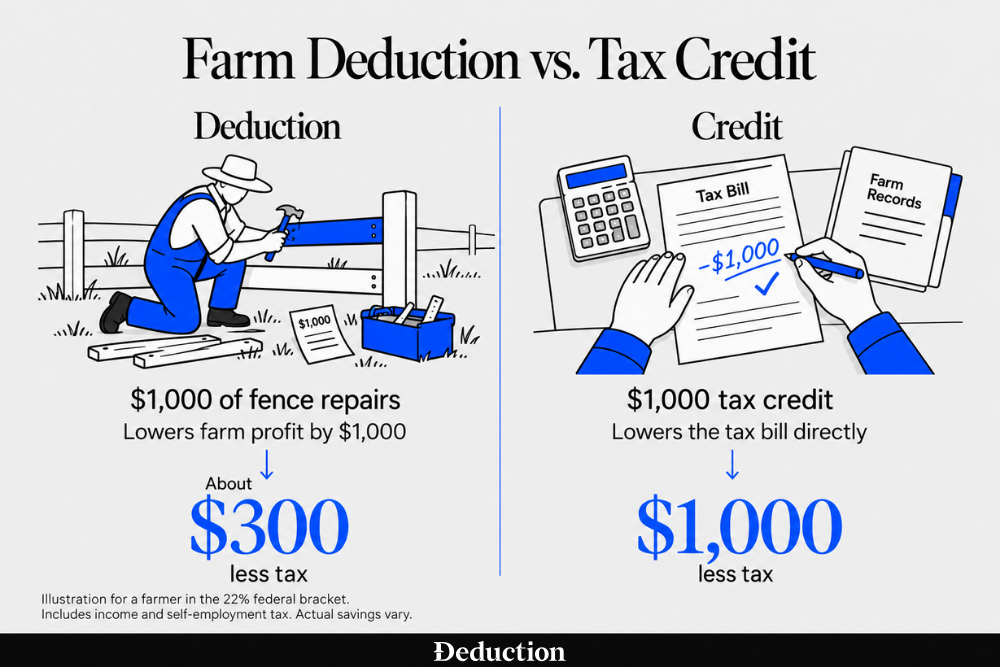
A deduction reduces the income you’re taxed on. A credit reduces the tax you owe dollar for dollar, so it saves you more than a deduction of the same amount.
Say you’re a farmer in the 22% federal tax bracket with a $1,000 fence repair bill and a $1,000 federal tax credit. Both can lower your taxes, but by different amounts:
The roughly $300 saving combines lower self-employment tax and lower income tax. This example assumes you’re in the 22% income tax bracket, pay the full self-employment tax rate, and qualify for the full 20% qualified business income deduction.
- The deduction: Your $1,000 fence repair bill lowers your farm profit by $1,000. That saves about $141 in self-employment tax, the Social Security and Medicare taxes you pay when you work for yourself.
- The income tax saving: You also save about $164 in income tax. Why not $220? Lower profit also reduces two other deductions: the deduction for half your self-employment tax and the 20% business income deduction. After those adjustments, your taxable income falls by about $743. At 22%, that saves about $164.
- The total: About $141 in self-employment tax savings plus $164 in income tax savings equals $305, rounded to roughly $300. Your actual savings depend on your tax situation.
- The credit: A $1,000 credit you can fully use reduces your tax bill by $1,000. If you owe $8,000 before the credit, you owe $7,000 afterward.
In this example, the $1,000 deduction saves roughly $300, while the $1,000 credit saves the full $1,000. That’s why it pays to tell your preparer about every credit you might qualify for.
Refundable credits, such as the fuel tax credit, pay you even if you owe no tax. Most federal business credits aren't refundable, but unused amounts can usually carry to other years. For deductions such as feed, fuel, and equipment, see the guide to farm tax deductions.
Federal Credits That Ended or Are Ending
These credits ended or are ending, mostly because of the July 2025 law:
How to Claim Farm Tax Credits
You don't need to fill in the forms yourself. These three steps help your preparer claim what you qualify for:
- Tell your preparer what changed this year: New workers or benefits, solar panels, food donations, land rentals or sales, and conservation projects can all point to a credit.
- Apply early for state credits: Many need state approval before you can claim them, and funding can run out.
- Keep simple records: Keep a log of fuel used on the farm, plus invoices, payroll records, food bank receipts and any state certificates.
Let Deduction Find the Farm Tax Credits You Qualify For
Credits are easy to miss because nothing arrives in the mail to remind you about them, and some need an application long before you file. Deduction helps you spot them as an ai tax deduction finder, it works on credits also, with a licensed CPA reviewing your return before it's filed:
- Upload your farm records: Fuel receipts, payroll records, solar invoices, and any state credit certificates go into your Vault as they are.
- Taylor checks for credits: Deduction's AI tax agent compares your records with the credits you may qualify for and flags the decisions you need to make.
- A CPA reviews and files: A licensed tax professional checks every number and form before anything goes to the IRS.
You can ask Taylor questions and upload documents for free, and you pay when you're ready to file or need a licensed professional to review a high-impact decision.
The Personal plan is $499 a year and includes federal and state filing with a 100% accuracy guarantee. If your farm is a solo S corporation or a small partnership LLC, the Simple Business plan is $999 a year.
Frequently Asked Questions About Farm Tax Credits
Here are some frequently asked questions about farm tax credits:
What Tax Credits Can Farmers Claim?
Most farms can claim the federal fuel tax credit for gasoline and undyed diesel used on the farm. Farms adding solar or wind may claim the clean electricity credit, and farms with employees may claim credits for health insurance, child care, paid leave, and retirement plans. Many states add credits of their own.
What's the Difference Between a Farm Tax Credit and a Deduction?
A deduction lowers the income you're taxed on, while a credit lowers your tax bill directly. For a farmer in the 22% federal bracket, $1,000 of fence repairs saves roughly $300 in income and self-employment tax, while a $1,000 credit saves $1,000.
Is There a Federal Beginning Farmer Tax Credit?
No. Beginning farmer credits are state programs, offered in states such as Iowa, Minnesota, Pennsylvania, Nebraska, and Ohio. They mostly go to the landowner or seller who rents or sells to a beginning farmer, not to the new farmer.
Can Farmers Still Get the Solar Tax Credit in 2026?
Yes, for a system that powers the farm business. The credit is generally 30% for farm-sized systems, but a new system must be up and running by December 31, 2027. The home solar credit for your house ended after 2025.
Are Farm Tax Credits Refundable?
Some are. The fuel tax credit is refundable, so you get it even if you owe no tax. Most federal business credits aren't, but unused amounts can usually carry to other years. Several state credits are refundable, including some of New York's farm credits.
This article is general information, not tax advice. Credit rules and state funding change often, so confirm anything you plan to act on with your tax preparer or a CPA.