

AI is already part of the work for tax firms and agents.
The statistics below show how fast that shift is happening.
Look, AI is going to stay, but there are going to be some hiccups along the way, so these statistics also show where tax professionals still need to oversee AI-assisted work.
Key Statistics to Look Out For
Among the statistics we have sifted, these stand out:
- 72% of accounting firms use AI at least weekly, and 35% use it every day. [4]
- Tax research is the most common use, cited by 69% of tax and accounting professionals who use generative AI. [2]
- Accuracy is the top concern: it's the main reason professionals give for keeping generative AI out of their work. [2]
- Accountants using AI finalized monthly statements 7.5 days faster. [5]
- 94% of US firms now offer advisory services, but advice makes up only 13% of the average US firm's revenue. [4]
- 77% of accounting firms plan to increase AI spending over the next three years, and 78% of US firms do. [4]
Adoption & Usage Extensiveness
AI use in accounting has taken a huge leap, moving from tests to applied, intensive use cases.
If you work with an accountant or tax preparer, AI may already play some part in how they handle your return. Most firms still use it for one segment of their process, though, rather than letting it take over the workflow.

- 75% of finance teams now actively use AI, up from 30% in 2024. That's more than double in about two years. [1]
- Across professional services, 40% of organizations used AI company-wide in 2026, nearly double the 22% a year earlier. [2]
- About one in three tax firms already uses generative AI, meaning tools that write text and answer questions. [2]
- Only 14% of tax firms use agentic AI, meaning tools that can carry out a series of tasks on their own, while 63% are considering or planning it. [2]
- In Deloitte's spring 2025 survey, just 14% of finance organizations already using AI had fully built AI agents into their day-to-day work, so most are still early in that shift. [6]
- 72% of accounting firms use AI at least once a week, and 35% use it every day. [4]
- In the US, 70% of firms use AI at least weekly. Among fast-growing firms, that rises to 76%, and 34% use it daily. [4]
- 60% of tax professionals now use AI for tax research at least weekly, up from 33% a year earlier. [18]
- 80% of professionals expect AI to have a transformational or high impact on their work in the next five years: 44% say transformational and 36% say high. [3]
Productivity & Measured Outcomes
The early results suggest AI mainly saves accountants time on routine work, which they can then spend with clients. If you are a tax filer yourself, that may mean your accountant has more time to answer your questions.
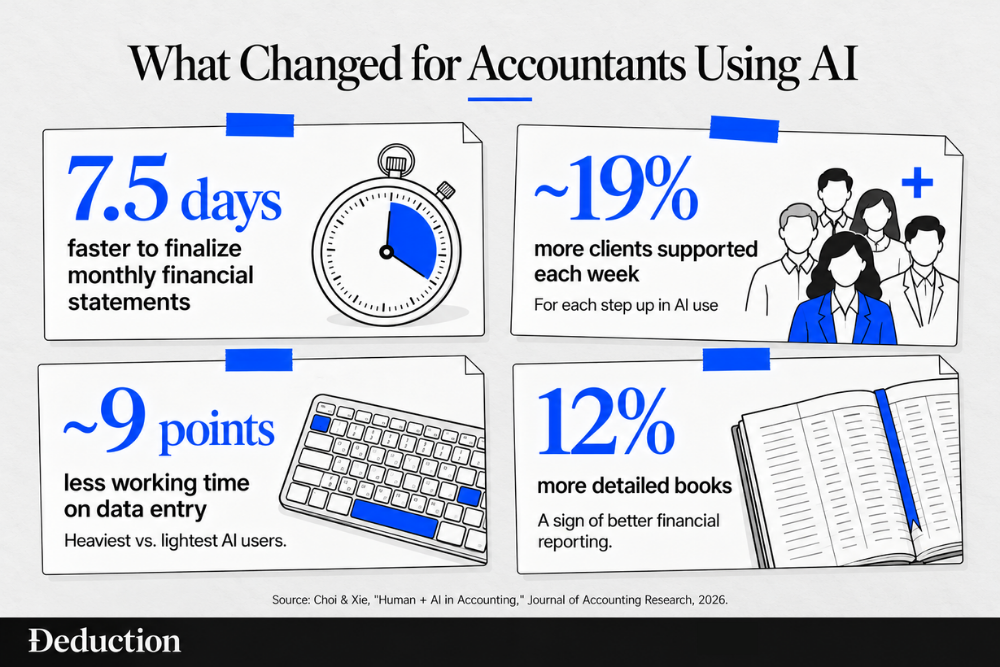
- Accountants who used AI finalized monthly financial statements 7.5 days faster. [5]
- Accountants who used AI more heavily supported more clients. Each step up in AI use (one standard deviation) came with about a 19% increase in clients supported each week, and the gap reached about 80% between the heaviest and lightest users. [5]
- The heaviest AI users spent about 9 percentage points less of their working time on routine data entry than the lightest users, with more time going to talking with clients and checking quality. [5]
- The books got more detailed. Ledger granularity, meaning how detailed a company's books are, rose 12% among accountants using AI. Researchers treat it as a sign of better financial reporting. [5]
- 71% of finance leaders say AI has sped up their decisions, 70% say it has improved decision quality, and 64% say their forecasts are more accurate. [1]
- 71% of finance leaders say their AI spending has met or beaten their expectations for return on investment. [1]
- Preparation makes a difference. Organizations that are "assurance-ready" for AI, meaning they can produce audit evidence for their AI use quickly and without disruption, are far more likely to cut errors: 33% report a significant drop in errors, compared with 6% of organizations that aren't ready. Only 42% say they are fully assurance-ready. [1]
- Only 18% of professionals say their organization tracks whether its AI tools pay off, and 40% don't know. [2]
- Professionals expect AI to save them about five hours a week over the next year. [3]
- In 2025, 81% of accountants said AI had made them more productive, and 86% said it had reduced the mental load of their work. [8]
Use cases & where AI gets pointed
Firms that use AI mostly point it at the work closest to your return: researching tax rules, keeping the books, and preparing filings, so the tools mostly affect how your file gets handled.
- Among tax and accounting professionals who use generative AI, 69% use it for tax research. Next come summarizing documents (57%), reviewing documents (55%), and accounting and bookkeeping, tax advice, and preparing tax returns (53% each). [2]
- About 40% of firms still limit AI to tasks such as tax research and summarizing documents. [4]
- Among the most tech-forward firms, 56% use AI to make predictions from data, and 55% use it to monitor compliance, meaning checking that work meets tax and reporting rules. [4]
- About one in three firms uses agentic AI to improve and personalize client communication, and 29% use it to draw predictions from client data. [4]
- The most common ways US firms use AI today are faster client service (33%), fewer errors (33%), and automating routine tasks (32%). [9]
Risk, trust & governance
Accuracy is the biggest concern among professionals, ahead of data security and job losses.
- Reliability and accuracy top the list of reasons professionals give for not using generative AI, ahead of generic output and the need for human oversight. [2]
- Job worries are growing: 24% of tax and accounting professionals now call AI a major threat to jobs, up from 9% a year earlier. [2]
- In a survey of 277 accountants, 62% were concerned about errors made by AI, 43% about data security, and 37% about job stability. [5]
- In a field experiment, accountants sometimes accepted wrong AI suggestions for categorizing transactions. Experienced accountants were more likely to step in when the AI showed low confidence. [5]
- Just 29% of organizations formally track where their AI efforts fail. [1]
- Only 8% of finance and accounting leaders say their organization is very well prepared to manage AI, and another 21% say it is well prepared. That leaves most feeling less than well prepared. [11]
Workforce, pipeline & pay
AI is trickling down the industry while firms struggle to find skilled people. Fewer graduates in recent years and harder hiring may help explain why firms are turning to AI for repetitive work, and demand for accountants is still expected to grow.
- The US had 1,595,200 accountants and auditors in 2025, plus 1,532,400 bookkeeping, accounting, and auditing clerks. [10]
- Jobs for accountants and auditors are projected to grow 5% from 2025 to 2035, with about 115,300 openings each year. [10]
- Unemployment for accountants and auditors was 2.0% in 2025, well below the 4.3% national rate. [7]
- Median pay for US accountants and auditors was $83,680 a year in May 2025. [10]
- Colleges awarded 55,152 accounting degrees in the 2023–24 school year, 6.6% fewer than the year before. [11]
- That trend may be turning: undergraduate enrollment in accounting programs reached 281,992 students in spring 2026, up 5.7% from a year earlier. [13]
- 36,590 people started on the path to becoming a CPA in 2025, and 23,978 passed their final exam section. [12]
- 61% of finance and accounting hiring managers say skilled candidates are harder to find than a year ago. [15]
- In the second quarter of 2026, 85% of finance and accounting job postings were on-site, 12% were hybrid, and 3% were fully remote. [15]
- Starting pay at CPA firms rose sharply: a median $67,750 for new master's graduates in 2025, up about 17% from 2023, and $60,834 for bachelor's graduates, up 11%. [14]
- 56% of finance leaders say generative AI is their most prominent skills gap. [11]
- In a 2026 survey of 629 CPA firm professionals, firms of every size ranked change driven by technology and AI as the top expected impact over the next five years. [11]
- To close AI skills gaps, 38% of finance teams are training current staff, and 28% are hiring people with new skills. [1]
Investment, spend & market size
Firms plan to keep spending on AI, and most expect to increase it over the next few years.
- 77% of accounting firms plan to increase AI spending over the next three years, and 78% of US firms do. Among fast-growing US firms, that rises to 87%. [4]
- More firms plan to invest in or upgrade AI each year: 57% in 2024 and 64% in 2025. [8]
- Firms plan to spend about $22,000 on technology over the next 12 months, up from about $21,000 in the past year. [8]
- The US accounting services market is worth about $158.4 billion in 2026. In 2025, it was spread across 85,322 businesses. [19]
Advisory shift & client expectations
As AI takes on more routine work, firms are offering more advice, and clients are asking for it.
For you, that may mean your accountant offers more planning help beyond filing your return. Advice is still a small share of what most firms earn.
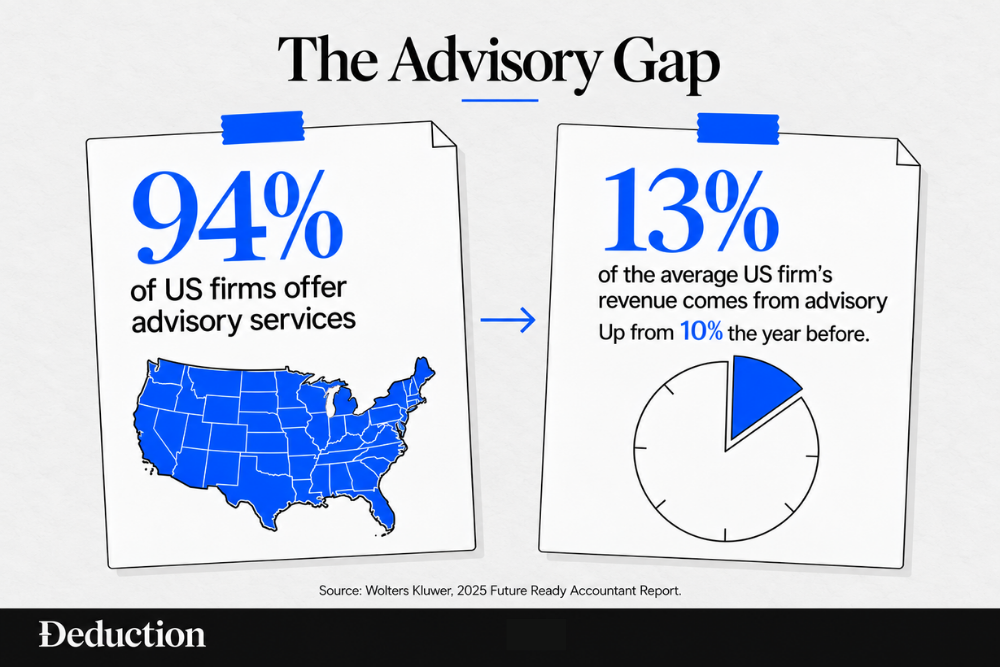
- 93% of accounting firms worldwide now offer advisory services, up from 83% a year earlier. In the US, the figure is 94%. [4]
- Even so, advice makes up only 13% of the average US firm's revenue, up from 10% the year before. [4]
- 35% of clients now ask for strategic business advice, and 87% of firms analyze client data to find where they can offer it. [4]
- 83% of firms worldwide reported higher revenue and 79% reported better profitability, both up from the year before. [4]
- Among professionals whose technology is at least 75% integrated, 87% saw revenue growth. [4]
- Client advisory services practices, which handle ongoing bookkeeping and business advice, grew at a median rate of 17%. Their median projected growth is 99% over three years. [16]
- Compliance work, such as preparing and filing returns, takes up 62% of firms' workload. Firms want to bring that down to 58%. [8]
- In 2025, 66% of accounting professionals said they felt overwhelmed by their technology at least once a week. By 2026, the average firm ran 10 different apps to manage operations and clients. [8]
- 97% of firms believe they use their technology inefficiently, and 43% say that inefficiency is creating more manual work, not less. [17]
Sources
Numbered to match the tags on each sentence. Primary studies are named rather than the aggregator pages that reprinted them.
- KPMG, Global AI in Finance 2026. 1,013 senior finance leaders in 20 countries, territories and jurisdictions; fielded March 2026; released 11 May 2026. https://kpmg.com/kpmg-us/content/dam/kpmg/pdf/2026/kpmg-ai-in-finance.pdf
- Thomson Reuters, 2026 AI in Professional Services Report. 1,514 respondents across 27 countries, surveyed October–November 2025; published 9 February 2026. https://www.thomsonreuters.com/en/institute/reports/2026-ai-in-professional-services-report
- Thomson Reuters, 2025 Future of Professionals Report. 2,275 respondents, surveyed February–March 2025; published 26 June 2025. https://www.thomsonreuters.com/en/press-releases/2025/june/the-ai-adoption-reality-check-firms-with-ai-strategies-are-twice-as-likely-to-see-ai-driven-revenue-growth-those-without-risk-falling-behind
- Wolters Kluwer, 2025 Future Ready Accountant Report. More than 2,700 professionals worldwide; released 8 October 2025, with US findings published February–May 2026. https://www.wolterskluwer.com/en/news/wolters-kluwer-releases-its-2025-future-ready-accountant-report
- Choi, Jung Ho (Stanford GSB) and Xie, Chloe (MIT Sloan), "Human + AI in Accounting: Early Evidence from the Field." Journal of Accounting Research, Vol. 64, No. 3 (June 2026). Survey of 277 accountants plus transaction-level field data from 79 small and mid-sized enterprises. Working paper on SSRN, abstract 5240924. https://onlinelibrary.wiley.com/doi/10.1111/1475-679x.70052
- Deloitte, Finance Trends 2026. 1,326 finance leaders in 23 countries, surveyed spring 2025. https://www.deloitte.com/us/en/insights/topics/leadership/finance-trends-leadership/2026.html
- US Bureau of Labor Statistics, Current Population Survey, Table 25b: unemployment by detailed occupation, 2025 annual averages. https://www.bls.gov/cps/cpsaat25b.htm
- Intuit QuickBooks Accountant Technology Survey, 2025 (700 US accounting professionals, April 2025) and 2026 (725 US accounting professionals, May 2026). 2025: https://www.firmofthefuture.com/news/accountant-tech-survey-2025/ · 2026: https://www.accountingtoday.com/partnerinsights/article/intuit/intuits-2026-accountant-technology-survey-ai-fragmentation-and-the-future-of-the-profession
- Xero, US State of the Industry Report 2025. 250 US accountants and bookkeepers. https://www.xero.com/us/media-releases/us-state-of-the-industry-report-2025/
- US Bureau of Labor Statistics, Occupational Outlook Handbook. 2025 base year; 2025–2035 projections; updated 27 August 2026. https://www.bls.gov/ooh/business-and-financial/accountants-and-auditors.htm
- AICPA & CIMA: 2025 Trends report; Future-Ready Finance survey of 1,446 finance leaders (December 2025); and the 2026 PCPS CPA Firm Top Issues Survey (629 respondents). Trends: https://www.aicpa-cima.com/news/article/accounting-firms-report-strong-hiring-outlook-aicpa-report-finds · Future-Ready Finance: https://www.aicpa-cima.com/news/article/ai-transformation-opens-door-for-finance-professionals-to-build-future-ready · Top Issues: https://www.aicpa-cima.com/news/article/aicpa-survey-cites-change-management-for-technology-and-ai-as-top-long-term-issue-facing-accounting-firms
- NASBA, CPA candidate and licensure data, 2025 (released August 2026). https://nasba.org/wp-content/uploads/2026/08/Explore-the-Numbers-Behind-CPA-Exam-Success_-2026-NASBA-Report-Now-Available_Press-Release_Final-14Aug26.pdf
- Journal of Accountancy, spring 2026 enrollment data, via the National Student Clearinghouse. https://www.journalofaccountancy.com/news/2026/jun/student-enrollment-in-accounting-continues-to-rise.html
- AICPA PCPS and CPA.com, 2025 National MAP Survey starting salary data, reported in the Journal of Accountancy. https://www.journalofaccountancy.com/news/2025/sep/map-survey-finds-big-jumps-in-cpa-firm-starting-pay.html
- Robert Half, finance and accounting hiring and remote-work data, 2026 (job postings, Q2 2026). Hiring: https://www.roberthalf.com/us/en/insights/research/future-of-finance.html · Remote work: https://www.roberthalf.com/us/en/insights/research/remote-work-statistics-and-trends
- AICPA and CPA.com, CAS Benchmark Survey 2024. https://www.cpa.com/whitepapers/2024-cas-benchmark-survey
- CPA.com and BILL, 2025 Growth & Technology Survey (400 accounting firm leaders and practitioners). https://www.cpa.com/sites/cpa/files/2025-05/Growth_and_technology_survey-guide.pdf
- Blue J and CPA.com, AI Tax Research Solution Outlook Report, 2026 edition (1,000+ US tax professionals). https://www.cpa.com/news/blue-j-and-cpacom-survey-finds-ai-adoption-among-tax-firms-has-nearly-doubled-one-year
- IBISWorld, US accounting services industry: market size 2026, number of businesses 2025. Market size: https://www.ibisworld.com/united-states/market-size/accounting-services/1398/ · Businesses: https://www.ibisworld.com/united-states/number-of-businesses/accounting-services/1398/